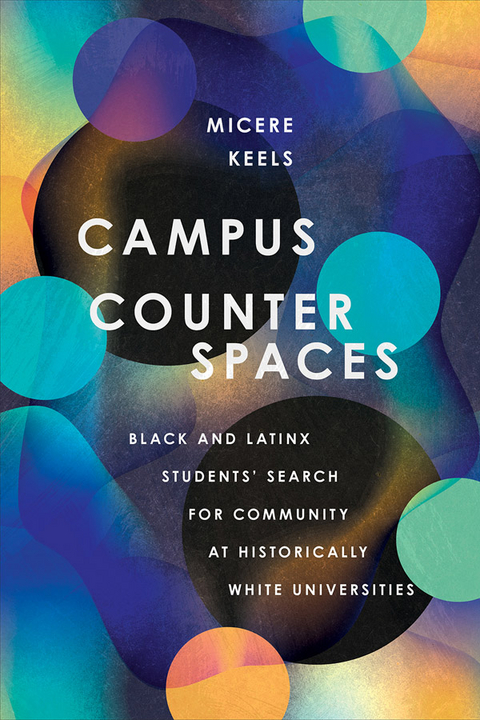
Campus Counterspaces (eBook)
240 Seiten
Cornell University Press (Verlag)
978-1-5017-4690-1 (ISBN)
Frustrated with the flood of news articles and opinion pieces that were skeptical of minority students' "imagined" campus microaggressions, Micere Keels, a professor of comparative human development, set out to provide a detailed account of how racial-ethnic identity structures Black and Latinx students' college transition experiences.
Tracking a cohort of more than five hundred Black and Latinx students since they enrolled at five historically white colleges and universities in the fall of 2013 Campus Counterspaces finds that these students were not asking to be protected from new ideas. Instead, they relished exposure to new ideas, wanted to be intellectually challenged, and wanted to grow. However, Keels argues, they were asking for access to counterspaces—safe spaces that enable radical growth. They wanted counterspaces where they could go beyond basic conversations about whether racism and discrimination still exist. They wanted time in counterspaces with likeminded others where they could simultaneously validate and challenge stereotypical representations of their marginalized identities and develop new counter narratives of those identities.
In this critique of how universities have responded to the challenges these students face, Keels offers a way forward that goes beyond making diversity statements to taking diversity actions.
Micere Keels is Associate Professor in Comparative Human Development at the University of Chicago. She is also the founding director of the Trauma Responsive Educational Practices project.
Introduction: It Doesn't Have to Be Race-Ethnicity to Be about Race-Ethnicity
1. Outlining the Problem
2. The Impossibility of a Color-Blind Identity: Shifting Social Identities from the Margin to the Center of Our Understanding of How Historically Marginalized Students Experience Campus Life
3. An Ambivalent Embrace: How Financially Distressed Students Make Sense of the Cost of College —With Resney Gugwor
4. Strategic Disengagement: Preserving One's Academic Identity by Disengaging from Campus Life —With Ja'Dell Davis
5. Power in the Midst of Powerlessness: Scholar-Activist Identity amid Racially and Ethnically Motivated Violence—With Elan Hope
6. Importance of a Critical Mass: Experiencing One's Differences as Valued Diversity Rather Than a Marginalized Threat—With Carly Offidani-Bertrand
7. Finding One's People and One's Self on Campus: The Role of Extracurricular Organizations —With Gabriel Velez
8. Split between School, Home, Work, and More: Commuting as a Status and a Way of Being —With Hilary Tackie and Elan Hope
9. Out of Thin Air: When One's Academic Identity Is Not Simply an Extension of One's Family Identity —With Emily Lyons
10. A Guiding Hand: Advising That Connects with Students' Culturally Situated Motivational Orientations toward College—With Tasneem Mandviwala
11. (Dis)integration: Facilitating Integration by Carefully Attending to Difference
| Erscheint lt. Verlag | 15.1.2020 |
|---|---|
| Zusatzinfo | 1 chart |
| Verlagsort | Ithaca |
| Sprache | englisch |
| Maße | 150 x 150 mm |
| Themenwelt | Schulbuch / Wörterbuch ► Lernhilfen ► Sekundarstufe I |
| Sozialwissenschaften ► Ethnologie | |
| Sozialwissenschaften ► Pädagogik ► Erwachsenenbildung | |
| Sozialwissenschaften ► Soziologie | |
| Schlagworte | Race-ethnicity, college, identity, microaggressions, postsecondary • Race-ethnicity, college, identity, microaggressions, postsecondary, student-life, college-advising |
| ISBN-10 | 1-5017-4690-1 / 1501746901 |
| ISBN-13 | 978-1-5017-4690-1 / 9781501746901 |
| Informationen gemäß Produktsicherheitsverordnung (GPSR) | |
| Haben Sie eine Frage zum Produkt? |
 EPUB (Adobe DRM)
Kopierschutz: Adobe-DRM
Adobe-DRM ist ein Kopierschutz, der das eBook vor Mißbrauch schützen soll. Dabei wird das eBook bereits beim Download auf Ihre persönliche Adobe-ID autorisiert. Lesen können Sie das eBook dann nur auf den Geräten, welche ebenfalls auf Ihre Adobe-ID registriert sind.
Details zum Adobe-DRM
Dateiformat: EPUB (Electronic Publication)
EPUB ist ein offener Standard für eBooks und eignet sich besonders zur Darstellung von Belletristik und Sachbüchern. Der Fließtext wird dynamisch an die Display- und Schriftgröße angepasst. Auch für mobile Lesegeräte ist EPUB daher gut geeignet.
Systemvoraussetzungen:
PC/Mac: Mit einem PC oder Mac können Sie dieses eBook lesen. Sie benötigen eine
eReader: Dieses eBook kann mit (fast) allen eBook-Readern gelesen werden. Mit dem amazon-Kindle ist es aber nicht kompatibel.
Smartphone/Tablet: Egal ob Apple oder Android, dieses eBook können Sie lesen. Sie benötigen eine
Geräteliste und zusätzliche Hinweise
Buying eBooks from abroad
For tax law reasons we can sell eBooks just within Germany and Switzerland. Regrettably we cannot fulfill eBook-orders from other countries.
aus dem Bereich