


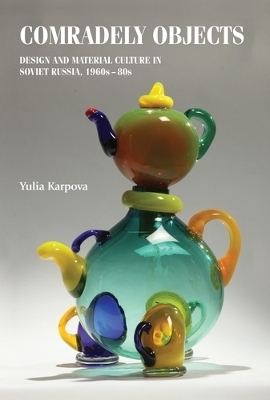
Comradely Objects
Design and Material Culture in Soviet Russia, 1960s–80s
Seiten
2020
Manchester University Press (Verlag)
978-1-5261-3987-0 (ISBN)
Manchester University Press (Verlag)
978-1-5261-3987-0 (ISBN)
This book offers a new perspective on the history of Soviet design. It argues that the ‘comradely objects’ of Russian productivism were not just shabby copies of western commodities – they were agents of progressive social relations with a discernible inheritance from the 1920s avant-garde. -- .
The Russian avant-garde of the 1920s is broadly recognised to have been Russia’s first truly original contribution to world culture. In contrast, Soviet design of the post-war period is often dismissed as hack-work and plagiarism that resulted in a shabby world of commodities. This book offers a new perspective on the history of Soviet design by focusing on the notion of the comradely object as an agent of progressive social relations that state-sponsored Soviet design inherited from the avant-garde. It introduces a shared history of domestic objects, hand-made as well as machine made, mass-produced as well as unique, utilitarian as well as challenging the conventional notion of utility. This is a study of post-avant-garde Russian productivism at the intersection of intellectual history, social history and material culture studies, an account attentive to the complexities and contradictions of Soviet design.
An electronic edition of this book is freely available under a Creative Commons (CC BY-NC-ND) licence. -- .
The Russian avant-garde of the 1920s is broadly recognised to have been Russia’s first truly original contribution to world culture. In contrast, Soviet design of the post-war period is often dismissed as hack-work and plagiarism that resulted in a shabby world of commodities. This book offers a new perspective on the history of Soviet design by focusing on the notion of the comradely object as an agent of progressive social relations that state-sponsored Soviet design inherited from the avant-garde. It introduces a shared history of domestic objects, hand-made as well as machine made, mass-produced as well as unique, utilitarian as well as challenging the conventional notion of utility. This is a study of post-avant-garde Russian productivism at the intersection of intellectual history, social history and material culture studies, an account attentive to the complexities and contradictions of Soviet design.
An electronic edition of this book is freely available under a Creative Commons (CC BY-NC-ND) licence. -- .
Yulia Karpova is assistant archivist at Vera and Donald Blinken Open Society Archives, Budapest -- .
Introduction: Soviet things that talk
1 The aesthetic turn after Stalin
2 Technical aesthetics against the disorder of things
3 Objects of neodecorativism
4 From objects to design programmes
5 A new production culture and non-commodities
Epilogue
Select bibliography
Index -- .
| Erscheinungsdatum | 10.05.2021 |
|---|---|
| Reihe/Serie | Studies in Design and Material Culture |
| Zusatzinfo | 16 colour illustrations, 20 black & white illustrations |
| Verlagsort | Manchester |
| Sprache | englisch |
| Maße | 170 x 240 mm |
| Gewicht | 739 g |
| Themenwelt | Kunst / Musik / Theater ► Kunstgeschichte / Kunststile |
| Sozialwissenschaften | |
| ISBN-10 | 1-5261-3987-1 / 1526139871 |
| ISBN-13 | 978-1-5261-3987-0 / 9781526139870 |
| Zustand | Neuware |
| Informationen gemäß Produktsicherheitsverordnung (GPSR) | |
| Haben Sie eine Frage zum Produkt? |
Mehr entdecken
aus dem Bereich

aus dem Bereich
kleine Kulturgeschichte einer brillanten Allianz
Buch | Softcover (2025)
Iudicium (Verlag)
CHF 33,90


