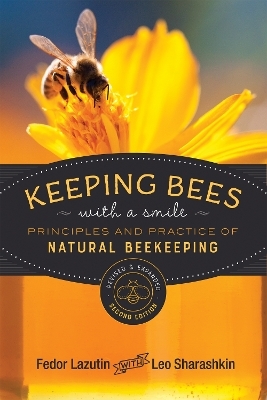
Keeping Bees with a Smile
New Society Publishers (Verlag)
978-0-86571-927-9 (ISBN)
Keep healthy, productive bees without chemicals, stress, or constant intervention. Master beekeeper reveals natural methods that work with bee biology instead of against it, producing more honey with less work while building stronger, disease-resistant colonies.
Why Chemical-Free Beekeeping Works Better:
Conventional beekeeping relies on treatments that weaken bee immunity and create dependency. This natural approach strengthens hives from within, resulting in healthier bees, better honey yields, and dramatically reduced colony losses.
What You'll Master
Natural hive management - work with bee instincts rather than fighting them
Chemical-free disease prevention - build immunity through nutrition and environment
Stress-free seasonal care - minimal intervention techniques that bees prefer
Honey harvesting ethics - take surplus while ensuring winter survival
Problem diagnosis - read bee behavior to prevent issues before they start
Results You Can Expect:
Beekeepers using these methods report 90% lower colony losses, 40% higher honey yields, and 75% less time spent on hive maintenance compared to conventional chemical-dependent approaches.
Transform beekeeping from constant worry to joyful partnership with nature. Your bees (and your harvest) will thank you.
Fedor Lazutin was one of Europe's leading natural beekeepers, the author of bestselling natural beekeeping guide Keeping Bees with a Smile. He founded a number of model apiaries southwest of Moscow, Russia, championed habitat restoration projects, and served as the first president of Russia's Ecovillage Union. Leo Sharashkin, PhD, is a full-time natural beekeeper and founder of HorizontalHive.com He has edited numerous books on natural beekeeping, writes for major magazines, and speaks internationally on bee-friendly beekeeping. He holds a PhD in Forestry from the University of Missouri and a master's in Natural Resources from Indiana University. Sharashkin's forest apiaries are composed entirely of local wild honeybees housed in bee-friendly horizontal hives. He lives in the Ozarks of southern Missouri.
Acknowledgments
Foreword— The Bee Book That Makes Sense: A Roadmap to Natural Beekeeping
Part I: A Path to Natural Apiculture
A Brief Introduction
How It All Got Started
A Small Side Note
The Industrial and Natural Approaches
The Bee Colony's Intelligence
The Goals of This Book
The Tree Hollow as the Bees' Natural Home
Some Useful Facts about Comb
The Bee Colony's Developmental Cycle
A Year in the Life of a Bee Colony
A Word or Two on Wintering
The Ideal Comb: How Deep Is Deep Enough?
Winter Ventilation of the Beehive
Bee Races
The European Dark Bee
Bee Diseases
Symbiosis in Nature (A Philosophical Digression)
Bees and Their Enemies
A Bit of History
The History of the Frame
Modern Systems of Industrial Beekeeping
Bees in the Industrial Hive
A Word or Two about Swarming
"Little to Smile About"
Is There a Way Out?
The History of Horizontal Hives with Extra-Deep Frames
The Modern Horizontal Hive
The Horizontal Hive with Extra-Deep Frames
Using the Extra-Deep Frame
Part II: The Practice of Natural Apiculture
A Description of the Horizontal Hive with 25 Extra-Deep Frames
How to Keep Bees in a Horizontal Hive with Extra-Deep Frames
The Central Commandments of Natural Beekeeping
A Beekeeper's Tasks in Spring and Summer
Fall Procedures: Pulling Honey and Preparing for Winter
How to Make Extra-Deep Frames
Brushstrokes
How to Capture a Swarm in a Swarm Trap
Responsibility
Questions and Answers
Epilogue to Parts I and II
Part III: The Finer Points of Natural Beekeeping
Three Years Later
Principles of Natural Beekeeping Revisited
The Recipe for Success in Beekeeping
Nectar Resources
Bee Race and Colony Strength
On the Mean Bees
The Queen
The Vital Rhythms of a Bee Colony
The Death of Bee Colonies
Various Approaches to Natural Beekeeping
More on Supersedure
Swarming
How to Collect a Swarm
The Hive Entrance
Spring Inspection of Bee Colonies
Spring Buildup of Bee Colonies
Preparing for the Main Honeyflow
The Main Honeyflow and the Second Half of Summer
Pulling Honey and Preparing for Winter
Questions and Answers
Part IV: How Bee Colonies Winter, And How to Make Wintering as Successful as Possible
Introduction
The Facts: What You Must Know about the Wintering Process of an Individual Bee and of the Colony as a Whole
The Colony's Main Job During the Winter
The Thermal Physics of a Wintering Colony
Bee Respiration in the Winter Cluster
The Role of Water in the Wintering Process
The Search for the Ideal Home for a Bee Colony
The Physiological Condition of a Colony as It Enters the Winter Period
Winter Reserves
The Location of Winter Reserves
The European Dark Bee
Wintering Indoors
Conclusions to Part IV
Afterword
Afterword to the Second Edition: Natural Beekeeping Accessible to All
Appendix 1: How to Make Swarm Traps and Capture Swarms
Appendix 2: How to Produce, Install, and Unite Swarms
Appendix 3: Nucs: What to Expect and How to Handle Them
Appendix 4: Operations Throughout the Year
Appendix 5: How to Build a Horizontal Hive with Extra-Deep Frames (Version 1)
Appendix 6: How to Build a Horizontal Hive with Extra-Deep Frames (Version 2)
Appendix 7: Lazutin Hive Plans (US Version 4— New)
Appendix 8: Summary Handouts
Glossary
Index
About the Author / Editor
About New Society Publishers
| Erscheinungsdatum | 10.09.2020 |
|---|---|
| Reihe/Serie | Mother Earth News Wiser Living Series |
| Übersetzer | Mark Pettus |
| Zusatzinfo | 34 Illustrations, color; 40 Illustrations, black and white; 24 Plates, color |
| Verlagsort | Gabriola Island |
| Sprache | englisch |
| Maße | 152 x 229 mm |
| Gewicht | 658 g |
| Themenwelt | Sachbuch/Ratgeber ► Gesundheit / Leben / Psychologie |
| Sachbuch/Ratgeber ► Natur / Technik ► Natur / Ökologie | |
| Sozialwissenschaften | |
| Weitere Fachgebiete ► Land- / Forstwirtschaft / Fischerei | |
| ISBN-10 | 0-86571-927-6 / 0865719276 |
| ISBN-13 | 978-0-86571-927-9 / 9780865719279 |
| Zustand | Neuware |
| Informationen gemäß Produktsicherheitsverordnung (GPSR) | |
| Haben Sie eine Frage zum Produkt? |
aus dem Bereich