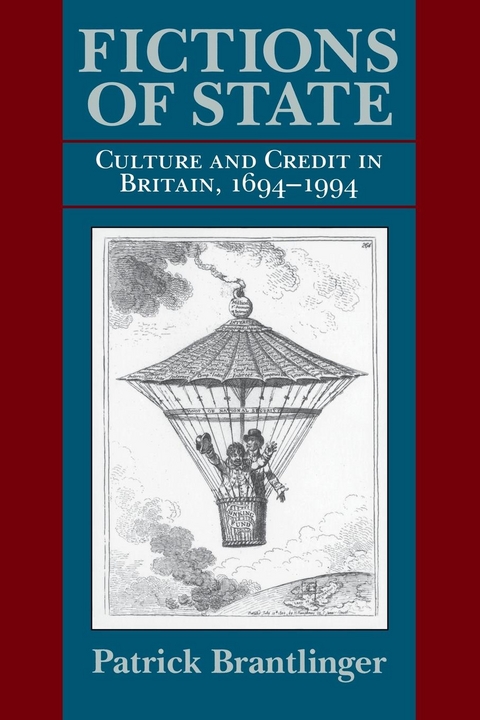
Fictions of State (eBook)
304 Seiten
Cornell University Press (Verlag)
978-1-5017-1179-4 (ISBN)
In this ambitious book, Patrick Brantlinger offers a cultural history of Great Britain focused on the concept of "public credit," from the 1694 founding of the Bank of England to the present.
In this ambitious book, Patrick Brantlinger offers a cultural history of Great Britain focused on the concept of "public credit," from the 1694 founding of the Bank of England to the present. He draws on literary texts ranging from Augustan satire such as Gulliver's Travels to postmodern satire such as Martin Amis's Money: A Suicide Note. All critique the misrecognition of public credit as wealth. The economic foundations of modern nation-states involved national debt, public credit, and paper money. Brantlinger traces the emergence of modern, imperial Great Britain from those foundations. He analyzes the process whereby nationalism, both the cause and the result of wars and imperial expansion, multiplied national debt and produced crises of public credit resolved only through more nationalism and war. During the first half of the eighteenth century, conservatives attacked public credit as fetishistic and characterized national debt as alchemical. From the 1850s, the stabilizing theories of public credit authored by David Hume, Adam Smith, Henry Thornton, and others, helped initiate the first "social science" economics. In the nineteenth century, literary criticism both paralleled and questioned early capitalist discourse on public credit and nationalism, while the Victorian novel refigured debt as the individual, private credit and debt. During the era of high modernism and Keynesian economics, the notion of high culture as genuine value recast the debate over money and national indebtedness. Brantlinger relates this cultural-historical trajectory to Marxist, poststructuralist, and postcolonial theories about the decline of the European empires after World War II, the global debt crisis, and the weakening of western nation-states in the postmodern era.
In this ambitious book, Patrick Brantlinger offers a cultural history of Great Britain focused on the concept of "public credit," from the 1694 founding of the Bank of England to the present. He draws on literary texts ranging from Augustan satire such as Gulliver's Travels to postmodern satire such as Martin Amis's Money: A Suicide Note. All critique the misrecognition of public credit as wealth.
The economic foundations of modern nation-states involved national debt, public credit, and paper money. Brantlinger traces the emergence of modern, imperial Great Britain from those foundations. He analyzes the process whereby nationalism, both the cause and the result of wars and imperial expansion, multiplied national debt and produced crises of public credit resolved only through more nationalism and war. During the first half of the eighteenth century, conservatives attacked public credit as fetishistic and characterized national debt as alchemical. From the 1850s, the stabilizing theories of public credit authored by David Hume, Adam Smith, Henry Thornton, and others, helped initiate the first "social science" economics.
In the nineteenth century, literary criticism both paralleled and questioned early capitalist discourse on public credit and nationalism, while the Victorian novel refigured debt as the individual, private credit and debt. During the era of high modernism and Keynesian economics, the notion of high culture as genuine value recast the debate over money and national indebtedness. Brantlinger relates this cultural-historical trajectory to Marxist, poststructuralist, and postcolonial theories about the decline of the European empires after World War II, the global debt crisis, and the weakening of western nation-states in the postmodern era.
Patrick Brantlinger is Professor of English and Cultural Studies at Indiana University. He is also the author of Bread and Circuses: Theories of Mass Cultures as Social Decay and Rule of Darkness: British Literature and Imperialism, both from Cornell.
| Erscheint lt. Verlag | 30.6.2019 |
|---|---|
| Verlagsort | Ithaca |
| Sprache | englisch |
| Maße | 150 x 150 mm |
| Themenwelt | Literatur ► Anthologien |
| Geschichte ► Teilgebiete der Geschichte ► Kulturgeschichte | |
| Geisteswissenschaften ► Sprach- / Literaturwissenschaft ► Anglistik / Amerikanistik | |
| Geisteswissenschaften ► Sprach- / Literaturwissenschaft ► Literaturgeschichte | |
| Geisteswissenschaften ► Sprach- / Literaturwissenschaft ► Literaturwissenschaft | |
| Sozialwissenschaften ► Ethnologie | |
| Sozialwissenschaften ► Soziologie | |
| ISBN-10 | 1-5017-1179-2 / 1501711792 |
| ISBN-13 | 978-1-5017-1179-4 / 9781501711794 |
| Informationen gemäß Produktsicherheitsverordnung (GPSR) | |
| Haben Sie eine Frage zum Produkt? |
 PDF (Adobe DRM)
Kopierschutz: Adobe-DRM
Adobe-DRM ist ein Kopierschutz, der das eBook vor Mißbrauch schützen soll. Dabei wird das eBook bereits beim Download auf Ihre persönliche Adobe-ID autorisiert. Lesen können Sie das eBook dann nur auf den Geräten, welche ebenfalls auf Ihre Adobe-ID registriert sind.
Details zum Adobe-DRM
Dateiformat: PDF (Portable Document Format)
Mit einem festen Seitenlayout eignet sich die PDF besonders für Fachbücher mit Spalten, Tabellen und Abbildungen. Eine PDF kann auf fast allen Geräten angezeigt werden, ist aber für kleine Displays (Smartphone, eReader) nur eingeschränkt geeignet.
Systemvoraussetzungen:
PC/Mac: Mit einem PC oder Mac können Sie dieses eBook lesen. Sie benötigen eine
eReader: Dieses eBook kann mit (fast) allen eBook-Readern gelesen werden. Mit dem amazon-Kindle ist es aber nicht kompatibel.
Smartphone/Tablet: Egal ob Apple oder Android, dieses eBook können Sie lesen. Sie benötigen eine
Geräteliste und zusätzliche Hinweise
Buying eBooks from abroad
For tax law reasons we can sell eBooks just within Germany and Switzerland. Regrettably we cannot fulfill eBook-orders from other countries.
aus dem Bereich