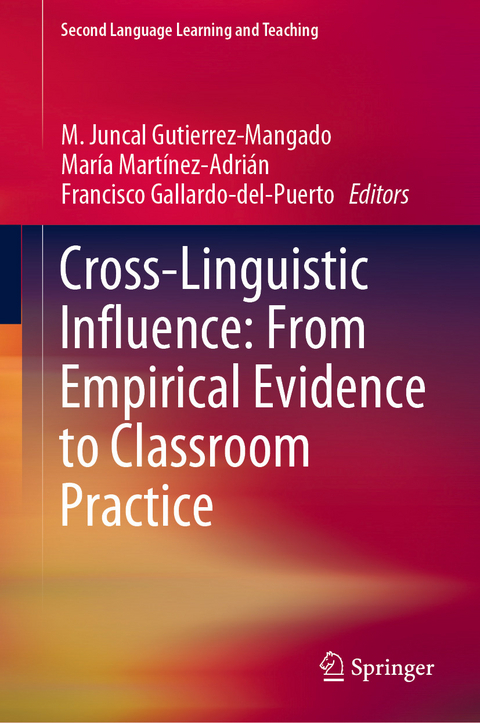
Cross-Linguistic Influence: From Empirical Evidence to Classroom Practice (eBook)
265 Seiten
Springer International Publishing (Verlag)
978-3-030-22066-2 (ISBN)
This book presents the latest research in various areas of cross-linguistic influence (CLI), providing educators with insights into how previously learned languages influence the learning of an additional language at different levels, such as phonetics/phonology, morphosyntax, vocabulary, pragmatics, writing style and learning context. While the majority of the chapters have English as the target language, one investigates the acquisition of French. The L1s of the learners include Arabic, Basque, Catalan, Chinese, Czech, Danish, Finnish, Galician, Georgian, German, Norwegian, Polish, Russian, Spanish and Swedish. Each chapter ends with a reflection on possible pedagogical implications of the findings and offers recommendations on how to make the most of cross-linguistic influence in the classroom.
Foreword 7
Acknowledgements 15
Introduction 16
Contents 18
Contributors 20
Abbreviations 22
Cross-Linguistic Influence in Second Language Speech: Implications for Learning and Teaching 24
1 Introduction 25
2 The Second Language Linguistic Perception Model—a Framework for L2 Learning and Teaching 27
2.1 Ingredients 1 and 2: The Initial L2 State 28
2.2 Ingredient 3: The Learning Task 31
2.3 Ingredient 4: L2 Development 33
2.4 Ingredient 5: The End State 35
3 L2LP: Implications for Teaching and Learning 36
3.1 L2LP and the Effect of Dialect 37
3.2 Individual Variation Within the L2LP Model 38
3.3 The L2LP Model—A Framework for Education 40
4 Summary and Conclusion 43
/ð? ?mus?k ?n?dustr? jas es?tarted teikin le?gal ak???n/*. A Preliminary Study on the Nature and Impact of Phonological and Orthographic Transfer in the English Speech of Bilingual Speakers of Spanish and Galician 44
1 Introduction 44
1.1 An Overview of the Orthographic and Phonological Systems of Spanish/Galician and General British 48
2 Method 51
2.1 Participants 51
2.2 Materials 52
2.3 Data Analysis 54
2.4 Results and Discussion 54
3 Conclusions and Implications for the Teaching of EFL in Spain 68
CLI in Lexical Accessibility 71
1 Introduction 72
2 Literature Review 72
2.1 Cross-Lexical Influence 72
2.2 Lexical Availability 74
2.3 Bilinguals, Cross-Lexical Influence and Lexical Availability 75
3 Study Design 76
3.1 Participants 76
3.2 Instruments 77
3.3 Data Analysis and Procedures 77
4 Results 78
5 Discussion 81
6 Implications for the FL Classroom 83
7 Conclusion 85
Cross-Linguistic Influence at the Level of Word Order in L3 English by L1 Georgian/L2 Russian Speakers 86
1 Introduction 87
2 Factors Affecting the Direction of CLI 87
3 Word Order Patterns in Georgian, Russian, and English 90
4 Research Questions and Hypotheses 93
5 The Study 94
5.1 Participants 94
5.2 Materials 94
5.3 Experiment 1: The Grammaticality Judgment Task (The GJT) 95
5.4 Experiment 2: The Translation Task (The TT) 96
5.5 Procedure 97
5.6 Codification and Analysis 97
6 Results 97
6.1 Experiment 1: The GTJ Results 98
6.2 Experiment 2: The TT Results 99
7 Discussion 100
8 Pedagogical Implications 102
Appendices 104
Didactic Challenges in the Multilingual Classroom—The Case of French as a Foreign Language 108
1 Introduction 108
2 Background 110
3 Research Questions 112
4 Methodology 112
4.1 Participants 112
4.2 Task and Data Collection 113
4.3 Identification and Categorization of Cross-Linguistic Influence 114
5 Results 116
5.1 Lexical CLI 116
5.2 Grammatical CLI 116
6 Discussion 117
7 Pedagogical Implications 119
8 Conclusion 119
Appendix: The Dog Story 120
Syntactic Transfer in L3 Learning. What Do Models and Results Tell Us About Learning and Teaching a Third Language? 121
1 Introduction 122
2 Multilingualism, Transfer and Cross-Linguistic Influence 123
3 L3 Syntax Models 126
3.1 The Cumulative Enhancement Model 128
3.2 The L2 Status Factor Hypothesis 128
3.3 The Typological Primacy Model 130
3.4 The Scalpel Model 131
3.5 The Linguistic Proximity Model (LPM) 133
4 Discussion of the Five Models 134
5 Implications for Language Learning and Teaching 137
6 Conclusion 139
What Lies Beneath: L1 Morphosyntax Seeping in Through Young Learners’ EFL 141
1 Introduction 141
2 Literature Review 142
2.1 L1 Use: Proficiency and Age 142
2.2 L1 Use: The Interlocutor and Task Factors 144
3 Research Questions 146
4 The Study 146
4.1 Participants 146
4.2 The Task 147
4.3 Procedure 147
4.4 Data Coding 149
5 Results and Discussion 152
5.1 L1 Use 152
5.2 L1 Structures 153
6 Conclusions and Pedagogical Implications 159
Appendix: The Tasks 161
D1T1: Birthday Party 161
D1T2: The Snowman 163
D2T1: On a Rainy Day 165
D2T2: The Toyshop 167
“I’m Jealous but I Am Very Happy”: Congratulating in an EFL Context 169
1 Introduction 170
2 Review of the Literature 171
2.1 Defining the Speech Act of Congratulating 171
2.2 The Speech Act of Congratulating: A Review of Studies 172
3 The Study 174
3.1 Pilot Study 174
3.2 Context 174
3.3 Participants 174
3.4 Instruments 175
3.5 Procedure 176
3.6 Analysis 176
4 Results 177
5 Discussion 179
6 Pedagogical Implications 182
7 Conclusion 183
Appendix: WDCT 184
The Use of Communication Strategies in L3 English CLIL Learners 188
1 Introduction 189
2 Research on Communication Strategies 191
3 Research Questions 194
4 The Study 194
4.1 Participants 194
4.2 Instruments and Data Analysis 196
5 Results 198
5.1 Quick Placement Test 198
5.2 Vocabulary Level Test 199
5.3 Oral Production Task 199
5.4 Correlation Analyses 203
6 Discussion 203
7 Conclusion 206
8 Pedagogical Implications 207
Explicit Plurilingualism in Co-taught CLIL Instruction: Rethinking L1 Use 209
1 Introduction 210
1.1 Sociocultural Perspectives on L1 Use 211
1.2 CLIL and Co-teaching 212
1.3 Previous Research on L1 Use in CLIL and Non-CLIL Contexts 214
1.4 L1 Interactional Strategies 216
2 Research Questions 218
3 Method 219
3.1 Participants 219
3.2 Procedure 220
3.3 Coding and Data Analysis 220
4 Results 221
5 Discussion 226
6 Conclusions 230
Native Language Identification by Human Judges 232
1 Introduction 233
2 Past Research 235
3 Study 1 237
3.1 Method 237
3.2 Results and Discussion 238
4 Study 2 240
4.1 Method 240
4.2 Results and Discussion 241
5 General Discussion 244
6 Conclusion 248
References 249
Index 276
| Erscheint lt. Verlag | 9.7.2019 |
|---|---|
| Reihe/Serie | Second Language Learning and Teaching | Second Language Learning and Teaching |
| Zusatzinfo | XXIV, 265 p. |
| Sprache | englisch |
| Themenwelt | Sozialwissenschaften ► Pädagogik ► Schulpädagogik / Grundschule |
| Schlagworte | Cross-Linguistic Pedagogical Implications • Language Levels • multilingual acquisition • Orthographic Transfer in the Language • Phonological Transfer in the Language |
| ISBN-10 | 3-030-22066-4 / 3030220664 |
| ISBN-13 | 978-3-030-22066-2 / 9783030220662 |
| Informationen gemäß Produktsicherheitsverordnung (GPSR) | |
| Haben Sie eine Frage zum Produkt? |
 PDF (Wasserzeichen)
DRM: Digitales Wasserzeichen
Dieses eBook enthält ein digitales Wasserzeichen und ist damit für Sie personalisiert. Bei einer missbräuchlichen Weitergabe des eBooks an Dritte ist eine Rückverfolgung an die Quelle möglich.
Dateiformat: PDF (Portable Document Format)
Mit einem festen Seitenlayout eignet sich die PDF besonders für Fachbücher mit Spalten, Tabellen und Abbildungen. Eine PDF kann auf fast allen Geräten angezeigt werden, ist aber für kleine Displays (Smartphone, eReader) nur eingeschränkt geeignet.
Systemvoraussetzungen:
PC/Mac: Mit einem PC oder Mac können Sie dieses eBook lesen. Sie benötigen dafür einen PDF-Viewer - z.B. den Adobe Reader oder Adobe Digital Editions.
eReader: Dieses eBook kann mit (fast) allen eBook-Readern gelesen werden. Mit dem amazon-Kindle ist es aber nicht kompatibel.
Smartphone/Tablet: Egal ob Apple oder Android, dieses eBook können Sie lesen. Sie benötigen dafür einen PDF-Viewer - z.B. die kostenlose Adobe Digital Editions-App.
Buying eBooks from abroad
For tax law reasons we can sell eBooks just within Germany and Switzerland. Regrettably we cannot fulfill eBook-orders from other countries.
aus dem Bereich