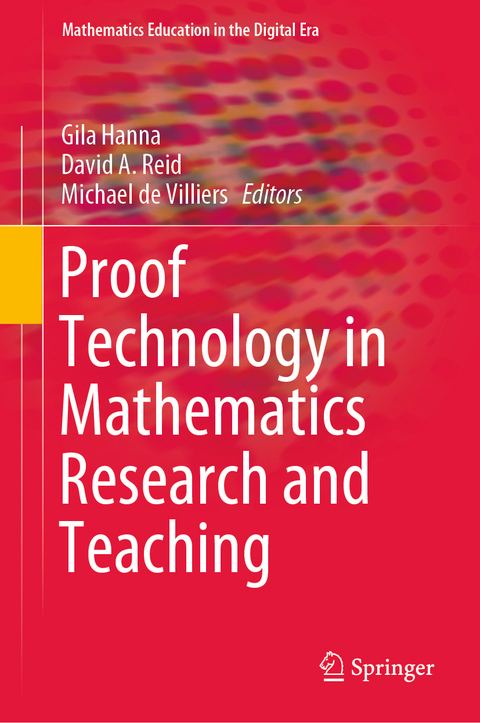
Proof Technology in Mathematics Research and Teaching
Springer International Publishing (Verlag)
978-3-030-28482-4 (ISBN)
Proving is sometimes thought to be the aspect of mathematical activity most resistant to the influence of technological change. While computational methods are well known to have a huge importance in applied mathematics, there is a perception that mathematicians seeking to derive new mathematical results are unaffected by the digital era. The reality is quite different. Digital technologies have transformed how mathematicians work together, how proof is taught in schools and universities, and even the nature of proof itself. Checking billions of cases in extremely large but finite sets, impossible a few decades ago, has now become a standard method of proof. Distributed proving, by teams of mathematicians working independently on sections of a problem, has become very much easier as digital communication facilitates the sharing and comparison of results. Proof assistants and dynamic proof environments have influenced the verification or refutation of conjectures, and ultimately how and why proof is taught in schools. And techniques from computer science for checking the validity of programs are being used to verify mathematical proofs.
Chapters in this book include not only research reports and case studies, but also theoretical essays, reviews of the state of the art in selected areas, and historical studies. The authors are experts in the field.
Chapter 1. Proof technology: Implications for teaching.- Chapter 2. A fully automatic theorem prover with human-style output.- Chapter 3. A common type of rigorous proof that resists Hilbert's programme.- Chapter 4. SMTCoq: Mixing automatic and interactive proof technologies.- Chapter 5. Studying algebraic structures using Prover9 and Mace4.- Chapter 6. Didactical issues at the interface of mathematics and computer science.- Chapter 7. Issues and challenges in instrumental proof.- Chapter 8. Reasoning by equivalence: the potential contribution of an automatic proof checker.- Chapter 9. Virtual manipulatives and students' counterexamples during proving.- Chapter 10. Proof technology and learning in mathematics: Common issues and perspectives.
"This book is intended for specialists in mathematics education with an interest in computer science advances as well as for researchers in the field of automated reasoning with an interest in the pedagogical and didactic implications of their work. It provides a valuable contribution to mathematics education by initiating a process of in-depth reflection on the educational value of new technological tools such as automatic theorem provers and dynamic geometric environments." (Frédéric Morneau-Guérin, MAA Reviews, May 24, 2020)
| Erscheinungsdatum | 20.10.2019 |
|---|---|
| Reihe/Serie | Mathematics Education in the Digital Era |
| Zusatzinfo | VIII, 379 p. 137 illus., 83 illus. in color. |
| Verlagsort | Cham |
| Sprache | englisch |
| Maße | 155 x 235 mm |
| Gewicht | 771 g |
| Themenwelt | Sozialwissenschaften ► Pädagogik ► Schulpädagogik / Grundschule |
| Schlagworte | Computer-assisted mathematical proof • Conjecture generation or refutation by computer • Interactive proof assistants • Polymath collaborative proofs • Proof in social media • Teaching proving with technology |
| ISBN-10 | 3-030-28482-4 / 3030284824 |
| ISBN-13 | 978-3-030-28482-4 / 9783030284824 |
| Zustand | Neuware |
| Informationen gemäß Produktsicherheitsverordnung (GPSR) | |
| Haben Sie eine Frage zum Produkt? |
aus dem Bereich