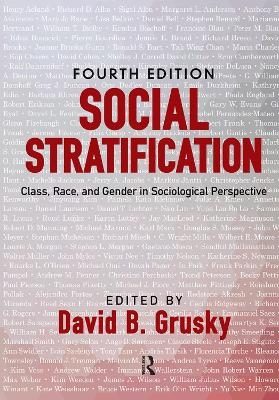
Social Stratification
Routledge (Verlag)
978-0-367-31949-6 (ISBN)
Grusky, David B.
Preface and Acknowledgments -- Resources for the Study of Poverty and Inequality -- Introduction -- The Stories We Tell About Inequality -- The Functions and Dysfunctions of Inequality -- Some Principles of Stratification -- Some Principles of Stratification -- Inequality by Design -- Inequality in Comparative Perspective -- Cross-Societal Differences -- A Compressed History of Inequality -- The Welfare State and Redistribution -- Trends in Economic Inequality -- Top Incomes in the Long Run of History -- The Race Between Education and Technology -- Unions, Norms, and the Rise in U.S. Wage Inequality -- Why Is Income Inequality Growing? -- Winner-Take-All Politics -- Leapfrogs and the Surge in Executive Pay -- The Winners of the Third Industrial Revolution -- The Structure of Inequality -- Marxian Theories of Class -- Alienation and Social Classes -- Classes in Capitalism and Pre-Capitalism -- Ideology and Class -- Class and Class Conflict in Industrial Society -- A General Framework for the Analysis of Class Structure -- Class Conflict in the Capitalist World Economy -- Weberian Theories of Class -- Class, Status, Party -- Status Groups and Classes -- Open and Closed Relationships -- The Class Structure of the Advanced Societies -- Marxism and Class Theory -- Is There a Status Order in Contemporary British Society? -- Durkheimian Theories of Class -- The Division of Labor in Society -- The Changing Form of Inequality -- Classic Gradationalism -- Occupational Prestige in Comparative Perspective -- Occupational Grading and Occupational Prestige -- Prestige or Socioeconomic Scales in the Study of Occupational Achievement? -- Socioeconomic Indexes for Occupations -- The New Gradationalism? -- Foundations of a Rent-Based Class Analysis -- From Income Inequality to Economic Inequality -- The Ruling Class, Elites, and the Upper Class -- Classic Statements -- The Ruling Class -- The Power Elite -- Elites and Power -- Contemporary Statements -- Who Rules America? -- The Future of Intellectuals and the Rise of the New Class -- Bobos in Paradise -- Post-Communist Managerialism -- China’s Evolving Oligarchy -- Poverty and the Underclass -- The Experience of Poverty -- Nickel and Dimed -- Low-Income Urban Fathers and the “Package Deal” of Family Life -- Poverty and the Economy -- Being Poor, Black, and American -- Poverty and the Great Recession -- The Effects of Politics and Institutions -- How Rich Countries Lift Up the Poor -- Taxing the Poor -- Neighborhoods and Segregation -- American Apartheid -- Legacies of Inequality -- Does Changing Neighborhoods Change Lives? -- The Legacy of Multigenerational Disadvantage -- How Important is Early Childhood? -- Skill Formation and the Economics of Investing in Disadvantaged Children -- The Long Reach of Early Childhood Poverty -- Stressing Out the Poor -- Incarceration and Poverty -- Incarceration and Social Inequality -- Who Gets Ahead? -- Class Mobility -- A Refined Model of Occupational Mobility -- Trends in Class Mobility -- Social Mobility in Europe -- It’s a Decent Bet That Our Children Will Be Professors Too -- Income Mobility -- Intergenerational Income Mobility -- Advantage in Comparative Perspective -- Classic Models of Status Attainment -- The Process of Stratification -- Inequality -- Education and Reproduction -- Explaining Educational Differentials -- The Widening Academic Achievement Gap Between the Rich and the Poor -- Nonpersistent Inequality in Educational Attainment -- Determined to Succeed -- Toward a Theory of Inequality in Higher Education -- Does College Still Have Equalizing Effects? -- Who Benefits Most from College? -- The Educational and Early Occupational Attainment Process -- Ain’t No Makin’ It -- A New Social Psychological Model of Educational Attainment -- Labor Markets -- The Dual Labor Market -- An Outline of a Theory of the Matching of Persons to Jobs -- The Rise of Precarious Work -- Little Labor -- Social Capital, Networks, And Attainment -- The Strength of Weak Ties -- Social Networks and Status Attainment -- Structural Holes -- Networks, Race, and Hiring -- When Do Social Networks Increase Inequality? -- Race and Ethnicity -- Constructing Racial Categories -- Racial Formation in the United States -- The Dynamics of Racial Fluidity and Inequality -- Classic Modes Of Incorporation -- A Theory of Ethnic Antagonism -- The Immigrant Enclave -- Assimilation Theory for an Era of Unprecedented Diversity -- New Modes of Incorporation -- The New Second Generation -- Why Replenishment Strengthens Racial and Ethnic Boundaries -- Discrimination -- Are Emily and Greg More Employable Than Lakisha and Jamal? -- Stereotype Threat and African-American Student Achievement -- Marked -- Are Racial and Ethnic Distinctions Declining in Significance? -- The Declining Significance of Race -- The Declining Significance of Race -- How Do Latino Immigrants Fit into the Racial Order? -- Are Recent Trends in Intermarriage Consistent with Assimilation Theory? -- Gender Inequality -- Labor Force Participation -- The Time Bind -- The Opt-Out Revolution -- Opting Out? -- Discrimination -- Orchestrating Impartiality -- Getting a Job -- Do Openly Gay Men Experience Employment Discrimination? -- Rethinking Employment Discrimination and Its Remedies -- Discrimination -- Sex Segregation -- The Structure and Process of Sex Segregation -- Revolving Doors -- Labor Markets as Queues -- Glass Ceilings in Corporate Law Firms -- Egalitarianism and Gender Inequality -- Gender Gap in Wages -- The Within-Gender Wage Gap -- Devaluation and the Pay of Comparable Male and Female Occupations -- Why Do Female Occupations Pay Less? -- The Sources of the Gender Pay Gap -- How Gender Intersects -- Why Race, Class, and Gender Matter -- Double Jeopardy -- A Stalling Out? -- The Gender Revolution -- The Anti-Feminist Backlash and Recent Trends in Gender Attitudes -- The Persistence of Gender Inequality -- The Consequences of Inequality -- Lifestyles -- Distinction -- The Social Stratification of Theater, Dance, and Cinema Attendance -- Unequal Childhoods -- Income Inequality and Income Segregation -- Politics and Attitudes -- What’s the Matter with Kansas? -- The Realignment of U.S. Presidential Voting -- Health -- Health Inequalities and the Psychosocial Environment -- The Fundamentals of Fundamental Causality -- Why Do Mortality Disparities Persist? -- The Future of Inequality -- Industrialism and Post-Industrialism -- The Coming of Post-Industrial Society -- Social Foundations of Post-Industrial Economies -- The Labor Force and the Great Recession -- Post-Socialism -- Post-Socialist Stratification -- Making Capitalism Without Capitalists -- Elite Opportunity in Transitions from State Socialism -- Post-Modernity and High Modernity -- The Evolution of Modern Stratification Systems -- Social Justice and Social Divisions -- Globalization and Inequality -- Globalism’s Discontents -- The New Geography of Global Income Inequality
| Erscheinungsdatum | 08.07.2019 |
|---|---|
| Verlagsort | London |
| Sprache | englisch |
| Maße | 178 x 254 mm |
| Gewicht | 453 g |
| Themenwelt | Sozialwissenschaften ► Soziologie |
| ISBN-10 | 0-367-31949-7 / 0367319497 |
| ISBN-13 | 978-0-367-31949-6 / 9780367319496 |
| Zustand | Neuware |
| Informationen gemäß Produktsicherheitsverordnung (GPSR) | |
| Haben Sie eine Frage zum Produkt? |
aus dem Bereich