


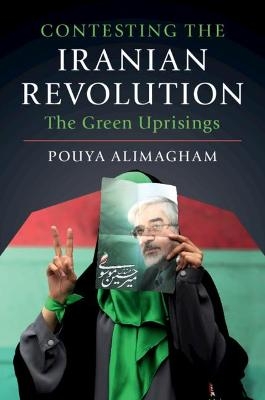
Contesting the Iranian Revolution
The Green Uprisings
Seiten
2020
Cambridge University Press (Verlag)
978-1-108-47544-0 (ISBN)
Cambridge University Press (Verlag)
978-1-108-47544-0 (ISBN)
Challenging binary interpretations of Iran's Green Uprisings of 2009 as a 'failed revolution', this dynamic history of Iran and the Middle East focuses on the men and women who existed at the centre of these contentious politics, with wider insights into US foreign policy, political Islam and revolutionary politics.
Most observers of Iran viewed the Green Uprisings of 2009 as a 'failed revolution', with many Iranians and those in neighbouring Arab countries agreeing. In Contesting the Iranian Revolution, however, Pouya Alimagham re-examines this evaluation, deconstructing the conventional win-lose binary interpretations in a way which underscores the subtle but important victories on the ground, and reveals how Iran's modern history imbues those triumphs with consequential meaning. Focusing on the men and women who made this dynamic history, and who exist at the centre of these contentious politics, this 'history from below' brings to the fore the post-Islamist discursive assault on the government's symbols of legitimation. From powerful symbols rooted in Shiʿite Islam, Palestinian liberation, and the Iranian Revolution, Alimagham harnesses the wider history of Iran and the Middle East to highlight how activists contested the Islamic Republic's legitimacy to its very core.
Most observers of Iran viewed the Green Uprisings of 2009 as a 'failed revolution', with many Iranians and those in neighbouring Arab countries agreeing. In Contesting the Iranian Revolution, however, Pouya Alimagham re-examines this evaluation, deconstructing the conventional win-lose binary interpretations in a way which underscores the subtle but important victories on the ground, and reveals how Iran's modern history imbues those triumphs with consequential meaning. Focusing on the men and women who made this dynamic history, and who exist at the centre of these contentious politics, this 'history from below' brings to the fore the post-Islamist discursive assault on the government's symbols of legitimation. From powerful symbols rooted in Shiʿite Islam, Palestinian liberation, and the Iranian Revolution, Alimagham harnesses the wider history of Iran and the Middle East to highlight how activists contested the Islamic Republic's legitimacy to its very core.
Pouya Alimagham is Lecturer and historian of the Middle East at the Massachusetts Institute of Technology. Receiving his Ph.D. in History from the University of Michigan, his thesis on which this book is based was awarded the Mehrdad Mashayekhi Dissertation Award by the Association for Iranian Studies in 2016.
1. Situating the 2009 Green Uprisings; 2. Primer: from the theory of Islamic Republicanism to practice, 1979–2009; 3. On the streets and beyond: crowd action and the symbolic appropriation of the past; 4. Contesting Palestine: generating revolutionary meaning; 5. Co-opting mourning ceremonies: Montazeri, post-Islamism, and revolutionary Ashura; 6. Conclusion.
| Erscheinungsdatum | 19.03.2020 |
|---|---|
| Zusatzinfo | Worked examples or Exercises; 31 Halftones, black and white |
| Verlagsort | Cambridge |
| Sprache | englisch |
| Maße | 158 x 235 mm |
| Gewicht | 650 g |
| Themenwelt | Sozialwissenschaften ► Politik / Verwaltung ► Staat / Verwaltung |
| ISBN-10 | 1-108-47544-2 / 1108475442 |
| ISBN-13 | 978-1-108-47544-0 / 9781108475440 |
| Zustand | Neuware |
| Informationen gemäß Produktsicherheitsverordnung (GPSR) | |
| Haben Sie eine Frage zum Produkt? |
Mehr entdecken
aus dem Bereich


aus dem Bereich
Organisationen steuern, Strukturen schaffen, Prozesse gestalten
Buch | Softcover (2024)
Rehm Verlag
CHF 53,20
über 1000 Stichworte mit Fundstellenhinweisen
Buch (2025)
NWB Verlag
CHF 36,90


