


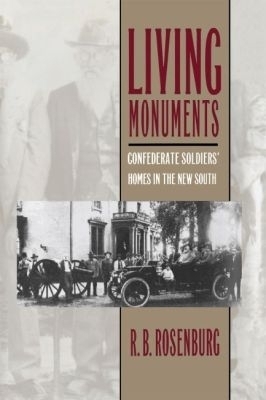
Living Monuments
Confederate Soldiers' Homes in the New South
Seiten
2001
|
New edition
The University of North Carolina Press (Verlag)
978-0-8078-4955-2 (ISBN)
The University of North Carolina Press (Verlag)
978-0-8078-4955-2 (ISBN)
While battlefield parks and memorials have served to commemorate southern valour in the Civil War, Confederate soldiers' homes were actually “living monuments” to the Lost Cause. R.B. Rosenburg provides the first account of the establishment and operation of these homes for disabled and indigent southern veterans, which had their heyday between the 1880s and the 1920s.
While battlefield parks and memorials erected in town squares and cemeteries have served to commemorate southern valor in the Civil War, Confederate soldiers' homes were actually 'living monuments' to the Lost Cause, housing the very men who made that cause their own. R. B. Rosenburg provides the first account of the establishment and operation of these homes for disabled and indigent southern veterans, which had their heyday between the 1880s and the 1920s. These institutions were commonly perceived as dignified retreats, where veterans who had seen better days could find peace, quiet, comfort, and happiness. But as Rosenburg shows, the harsher reality often included strict disciplinary tactics to maintain order and the treatment of indigent residents as wards and inmates rather than honored veterans. Many men chafed under the rigidly paternalistic administrative control and resented being told by their 'betters' how to behave.
Rosenburg makes clear the idealism and sense of social responsibility that motivated the homes' founders and administrators, while also showing that from the outset the homes were enmeshed in political self-interest and the exploitation of the Confederate heritage.
While battlefield parks and memorials erected in town squares and cemeteries have served to commemorate southern valor in the Civil War, Confederate soldiers' homes were actually 'living monuments' to the Lost Cause, housing the very men who made that cause their own. R. B. Rosenburg provides the first account of the establishment and operation of these homes for disabled and indigent southern veterans, which had their heyday between the 1880s and the 1920s. These institutions were commonly perceived as dignified retreats, where veterans who had seen better days could find peace, quiet, comfort, and happiness. But as Rosenburg shows, the harsher reality often included strict disciplinary tactics to maintain order and the treatment of indigent residents as wards and inmates rather than honored veterans. Many men chafed under the rigidly paternalistic administrative control and resented being told by their 'betters' how to behave.
Rosenburg makes clear the idealism and sense of social responsibility that motivated the homes' founders and administrators, while also showing that from the outset the homes were enmeshed in political self-interest and the exploitation of the Confederate heritage.
R. B. Rosenburg, research assistant professor of history at the University of Tennessee, is editor of 'For the Sake of My Country': The Diary of Colonel William W. Ward, 9th Tennessee Cavalry, Morgan's Brigade, C.S.A.
| Erscheint lt. Verlag | 28.2.2001 |
|---|---|
| Verlagsort | Chapel Hill |
| Sprache | englisch |
| Maße | 152 x 229 mm |
| Gewicht | 333 g |
| Themenwelt | Geschichte ► Allgemeine Geschichte ► Neuzeit (bis 1918) |
| Geisteswissenschaften ► Geschichte ► Regional- / Ländergeschichte | |
| Geschichte ► Teilgebiete der Geschichte ► Militärgeschichte | |
| Sozialwissenschaften ► Soziologie | |
| ISBN-10 | 0-8078-4955-3 / 0807849553 |
| ISBN-13 | 978-0-8078-4955-2 / 9780807849552 |
| Zustand | Neuware |
| Informationen gemäß Produktsicherheitsverordnung (GPSR) | |
| Haben Sie eine Frage zum Produkt? |
Mehr entdecken
aus dem Bereich


aus dem Bereich
Geschichte einer wilden Handlung
Buch | Hardcover (2024)
C.H.Beck (Verlag)
CHF 47,60


