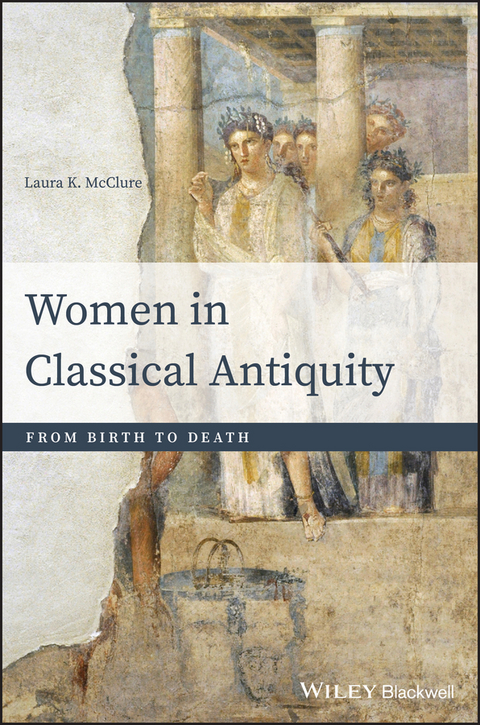
An introduction to women and gender in the classical world that draws on the most recent research in the field
Women in Classical Antiquity focuses on the important objects, events and concepts that combine to form a clear understanding of ancient Greek and Roman women and gender. Drawing on the most recent findings and research on the topic, the book offers an overview of the historical events, values, and institutions that are critical for appreciating and comparing the life situations of women across both cultures.
The author examines the lifecycle of women in ancient Greek and Rome beginning with how young females acquired the gendered characteristics necessary for adulthood. The text explores female adolescence, including concerns about virginity, medical views of the female body, religious roles, and education. Views of marriage, motherhood, sexual activity, adultery, and prostitution are also examined. In addition, the author explores how women exercised authority and the possibilities for their civic engagement. This important resource:
- Explores the formation of classical women's social identity through the life stages of birth, adolescence, marriage, childbirth, old age, and death
- Contains information on the most recent research in this rapidly evolving field
- Offers a review of the life course as a way to understand the social processes by which Greek and Roman females acquired gender traits
- Includes questions for review, suggestions for further reading, and a glossary of key terms
Written for academics and students of classical antiquity, Women in Classical Antiquity offers a general introduction to women and gender in the classical world.
Laura K. McClure, PhD, is Professor of Classics in the Department of Classical and Ancient Near Eastern Studies in the College of Letters and Science at the University of Wisconsin-Madison. Her diverse research interests include Athenian drama, the study of women in the ancient world, and classical reception. Her publications include books on the representation of women in Athenian drama and the courtesan in the Greek literary tradition.
Laura K. McClure, PhD, is Professor of Classics in the Department of Classical and Ancient Near Eastern Studies in the College of Letters and Science at the University of Wisconsin-Madison. Her diverse research interests include Athenian drama, the study of women in the ancient world, and classical reception. Her publications include books on the representation of women in Athenian drama and the courtesan in the Greek literary tradition.
Abbreviations
The abbreviations used here are mostly those used in the third edition of the Oxford Classical Dictionary.
General
| BCE | Before Common Era, used in place of BC (“Before Christ”) |
| c. | circa, “approximately” |
| CE | Common Era, used in place of AD (Latin Anno Domini, “in the year of our Lord”) |
| Cf. | confer, “compare” |
| e.g. | exempli gratia, “for example” |
| fl. | floruit, “s/he flourished,” the general period in which a person lived |
| Fr. | Fragment (pl. Frr.) |
Collections of Sources and Reference Works
| AE | L’Année Épigraphique, published in Revue Archéologique and separately (1888–) |
| CEG | Carmina Epigraphica Graeca |
| CIL | Corpus Inscriptionum Latinarum |
| CMG | Corpus Medicorum Graecorum |
| IG | Inscriptiones Graecae |
| P. Oxy | Oxyrhynchus Papyri |
| SEG | Supplementum Epigraphicum Graecum |
| TLE | Thesaurus Linguae Etruscae, a collection of Etruscan tomb inscriptions. |
| WO | U. Wilcken (ed.), Griechische Ostraka aus Aegypten und Nubien (Leipzig and Berlin, 1899) |
Greek and Roman Authors and Texts
| Aesch. | Aeschylus |
| Ag. | Agamemnon |
| Cho. | Choephori, “Libation Bearers” |
| Eum. | Eumenides |
| Anth. Gr. | Greek Anthology |
| Alc. | Alcman |
| Ap. Rhod. | Apollonius of Rhodes, Voyage of the Argo |
| App. | Appian |
| B Civ. | Civil Wars |
| Ar. | Aristophanes |
| Ach. | Acharnians |
| Eccl. | Ecclesiazusae, “Women of the Ecclesia” |
| Lys. | Lysistrata |
| Nub. | Nubes, “Clouds” |
| Thesm. | Thesmophoriazusae, “Women of the Thesmophoria” |
| Arch. | Archilochus |
| Arist. | Aristotle |
| Eth. Eud. | Eudemian Ethics |
| Eth. Nic. | Nichomachean Ethics |
| Gen. An. | Generation of Animals |
| Pol. | Politics |
| Rhet. | Rhetoric |
| Ath. | Athenaeus, Deipnosophistae, “Dining Sophists” |
| Aug. | Augustus |
| RG | Res Gestae, “The Deeds of Divine Augustus” |
| Aul. Gell. | Aulus Gellius, Attic Nights |
| Catull. | Catullus |
| Cic. | Cicero |
| Att. | Letters to Atticus |
| Brut. | Brutus |
| Cael. | In Defense of Caelius |
| Har. resp. | On the Responses of the Haruspices |
| Mur. | In Defense of Murena |
| Phil. | Philippics |
| Tusc. | Tusculan Disputations |
| Verr. | Against Verres |
| Dem. | Demosthenes |
| [Dem.] | Pseudo‐Demosthenes |
| Dio | Dio Cassius, Roman History |
| Dion. Hal. | Dionysius of Halicarnassus |
| Ant. Rom. | Roman Antiquities |
| Eur. | Euripides |
| Alc. | Alcestis |
| Andr. | Andromache |
| Cap. Mel. | Captive Melanippe |
| Hec. | Hecuba |
| Hipp. | Hippolytus |
| IA | Iphigenia in Aulis |
| IT | Iphigeneia in Tauris |
| Med. | Medea |
| Pho. | Phoenician Women |
| Tro. | Trojan Women |
| Hdt. | Herodotus |
| Hes. | Hesiod |
| Op. | Works and Days |
| Theog. | Theogony |
| Herod. | Herodas |
| Hippoc. | Hippocrates |
| Mul. | Diseases of Women |
| Nat. Puer | On the Nature of the Child |
| Ster. | On Infertility |
| Virg. | On Virgins |
| Hom. | Homer |
| Il. | Iliad |
| Od. | Odyssey |
| Hom. Hymn Aphr. | Homeric Hymn to Aphrodite |
| Hom. Hymn. Dem. | Homeric Hymn to Demeter |
| Hor. | Horace |
| Carm. saec. | Carmen Saeculare, “Secular Hymn” |
| Ep. | Epistles |
| Juv. | Juvenal |
| Luc. | Lucian |
| Dial. Meretr. | Dialogue of the Courtesans |
| Lys. | Lysias |
| Macr. | Macrobius |
| Sat. | Saturnalia |
| Mart. | Martial |
| Men. | Menander |
| Per. | Perikeiromene, “The Girl Who Gets Her Hair Cut Short” |
| Nep. | Cornelius Nepos, On Famous Men |
| Ov. | Ovid |
| Am. | Amores |
| Ars | Art of Love |
| Fast. | Fasti |
| Met. | Metamorphoses |
| Trist. | Tristia |
| Pers. | Persius |
| Pl. | Plato |
| Tim. | Timaeus |
| Plaut. | Plautus |
| Amph. | Amphitryo |
| Aul. | Aulularia |
| Cas. | Casina |
| Men. | Menaechmi |
| Mil. | Braggart Soldier |
| Plin. | Pliny the... |
| Erscheint lt. Verlag | 13.6.2019 |
|---|---|
| Sprache | englisch |
| Themenwelt | Geschichte ► Allgemeine Geschichte ► Vor- und Frühgeschichte |
| Geschichte ► Allgemeine Geschichte ► Altertum / Antike | |
| Sozialwissenschaften ► Soziologie ► Gender Studies | |
| Schlagworte | Ancient & Classical History • Ancient Culture • Antike • Antike u. klassische Geschichte • A Teenage Girl in a Heroic World</p> • Athens and the Classical Period and women • Classical Studies • Female adolescence in Greece • Frau • Greek domestic space • Growing up female in the Greek family • Humanistische Studien • Klassisches Altertum • <p>Guide to Women in Classical Antiquity • Minoan and Mycenaean Civilizations and women • protecting female purity in ancient Greece • Resource to Women in Classical Antiquity • Social Identity in the Ancient World • textile production in ancient Greece • Text on Women in Classical Antiquity • The family of ancient Sparta • The Greek family and household • The Rise of the Polis in the Archaic Period • Understanding Women in Classical Antiquity • Women in Greece in the Bronze Age • women in the iron age |
| ISBN-13 | 9781118413654 / 9781118413654 |
| Informationen gemäß Produktsicherheitsverordnung (GPSR) | |
| Haben Sie eine Frage zum Produkt? |
 EPUB (Adobe DRM)
Kopierschutz: Adobe-DRM
Adobe-DRM ist ein Kopierschutz, der das eBook vor Mißbrauch schützen soll. Dabei wird das eBook bereits beim Download auf Ihre persönliche Adobe-ID autorisiert. Lesen können Sie das eBook dann nur auf den Geräten, welche ebenfalls auf Ihre Adobe-ID registriert sind.
Details zum Adobe-DRM
Dateiformat: EPUB (Electronic Publication)
EPUB ist ein offener Standard für eBooks und eignet sich besonders zur Darstellung von Belletristik und Sachbüchern. Der Fließtext wird dynamisch an die Display- und Schriftgröße angepasst. Auch für mobile Lesegeräte ist EPUB daher gut geeignet.
Systemvoraussetzungen:
PC/Mac: Mit einem PC oder Mac können Sie dieses eBook lesen. Sie benötigen eine
eReader: Dieses eBook kann mit (fast) allen eBook-Readern gelesen werden. Mit dem amazon-Kindle ist es aber nicht kompatibel.
Smartphone/Tablet: Egal ob Apple oder Android, dieses eBook können Sie lesen. Sie benötigen eine
Geräteliste und zusätzliche Hinweise
Buying eBooks from abroad
For tax law reasons we can sell eBooks just within Germany and Switzerland. Regrettably we cannot fulfill eBook-orders from other countries.
aus dem Bereich