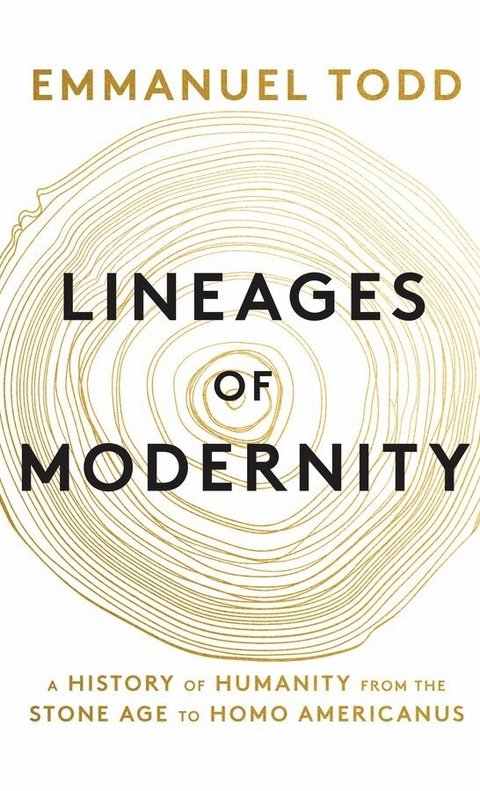
Lineages of Modernity (eBook)
776 Seiten
John Wiley & Sons (Verlag)
978-1-5095-3449-4 (ISBN)

In most developed countries there is a palpable sense of confusion about the contemporary state of the world. Much that was taken for granted a decade or two ago is being questioned, and there is a widespread urge to try and understand how we reached our present situation, and where we are heading.
In this major new book, the leading sociologist, historical anthropologist and demographer Emmanuel Todd sheds fresh light on our current predicament by reconstructing the historical dynamics of human societies from the Stone Age to the present. Eschewing the tendency to attribute special causal significance to the economy, Todd develops an anthropological account of history, focusing on the long-term dynamics of family systems and their links to religion and ideology - what he sees as the slow-moving, unconscious level of society, in contrast to the conscious level of the economy and politics. He also analyses the dramatic changes brought about by the spread of education. This enables him to explain the different historical trajectories of the advanced nations and the growing divergence between them, a divergence that can be observed in such phenomena as the rise of the Anglosphere in the modern period, the paradox of a Homo americanus who is both innovative and archaic, the startling electoral success of Donald Trump, the lack of realism in the will to power shown by Germany and China, the emergence of stable authoritarian democracy in Russia, the new introversion of Japan and the recent turbulent developments in Europe, including Brexit.
This magisterial account of human history brings into sharp focus the massive transformations taking place in the world today and shows that these transformations have less to do with the supposedly homogenizing effects of globalization and the various reactions to it than with an ethnic diversity that is deeply rooted in the long history of human evolution.
Emmanuel Todd is a sociologist, demographer and historical anthropologist at the National Institute of Demographic Studies (INED), Paris. He was one of the first scholars to predict the collapse of the Soviet Union and is the author of many bestselling books, including After the Empire and Who Is Charlie?
In most developed countries there is a palpable sense of confusion about the contemporary state of the world. Much that was taken for granted a decade or two ago is being questioned, and there is a widespread urge to try and understand how we reached our present situation, and where we are heading. In this major new book, the leading sociologist, historical anthropologist and demographer Emmanuel Todd sheds fresh light on our current predicament by reconstructing the historical dynamics of human societies from the Stone Age to the present. Eschewing the tendency to attribute special causal significance to the economy, Todd develops an anthropological account of history, focusing on the long-term dynamics of family systems and their links to religion and ideology what he sees as the slow-moving, unconscious level of society, in contrast to the conscious level of the economy and politics. He also analyses the dramatic changes brought about by the spread of education. This enables him to explain the different historical trajectories of the advanced nations and the growing divergence between them, a divergence that can be observed in such phenomena as the rise of the Anglosphere in the modern period, the paradox of a Homo americanus who is both innovative and archaic, the startling electoral success of Donald Trump, the lack of realism in the will to power shown by Germany and China, the emergence of stable authoritarian democracy in Russia, the new introversion of Japan and the recent turbulent developments in Europe, including Brexit. This magisterial account of human history brings into sharp focus the massive transformations taking place in the world today and shows that these transformations have less to do with the supposedly homogenizing effects of globalization and the various reactions to it than with an ethnic diversity that is deeply rooted in the long history of human evolution.
* Preface to the English edition
* Introduction. The differentiation of family structures and the inverse model of history
* Chapter One. The differentiation of family systems: Eurasia
* Chapter Two. The differentiation of family systems: Indian America and Africa
* Chapter Three. Homo sapiens
* Chapter Four. Judaism and early Christianity: family and literacy
* Chapter Five. Germany, Protestantism and universal literacy
* Chapter Seven. Educational take-off and economic development
* Chapter Eight. Secularization and the crisis of transition
* Chapter Nine. The English matrix of globalization
* Chapter Ten. Homo americanus
* Chapter Eleven. Democracy is always primitive
* Chapter Twelve. Democracy undermined by higher education
* Chapter Thirteen. A crisis in Black and White
* Chapter Fourteen: Donald Trump as will and representation
* Chapter Fifteen. The memory of places
* Chapter Sixteen. Stem family societies: Germany and Japan Chapter Seventeen. The metamorphosis of Europe
* Chapter Eighteen. Communitarian societies: Russia and China
* Envoi
* Post-script: the future of liberal democracy
* Notes
* Index
*
To the study of the United States, the Soviet Union and France, Emmanuel Todd has brought a unique combination of empirical rigour and humanist insight. Now, in Lineages of Modernity, this great thinker has found his greatest subject.'
Michael Lind, author of Land of Promise: An Economic History of the United States
'Emmanuel Todd provides intellectual nourishment of the first order. His family-based, anthropological-historical account uncovers another part of the hidden wiring of human development and provides a welcome antidote to the relentless economism of so much contemporary analysis. And for those of us unfamiliar with the Todd perspective, he writes with clarity and erudition, marshalling a huge amount of evidence to provide a fresh but undogmatic perspective on the modern world, usually with half an eye on the ancient one.'
David Goodhart, member of the Policy Exchange think-tank and author of The Road to Somewhere: The New Tribes Shaping British Politics
'Emmanuel Todd is an internationally known scholar whose work on the development and influence of family systems around the world has challenged many preconceptions. This is a bold, iconoclastic, wide-ranging study, marshalling a great deal of material from history, anthropology, demography and other disciplines. It is written from an unusual angle and rightly challenges the primacy of economic forces, emphasizing instead the role of family systems, ideology, education and culture in the shaping of human history. There is much to learn from this work.'
Alan Macfarlane, Life Fellow, King's College, Cambridge
'Vast and mind-expanding'
The Independent
"[Todd] Uncovers the hidden wiring of modernity using his own special historical-anthropological method -- which predicted both the collapse of the Soviet Union and the rise of Donald Trump."
Evening Standard
PREFACE TO THE ENGLISH EDITION
When the English language first appeared in the fourteenth century, its kingdom of 3 million inhabitants was just a tiny peripheral country on the edge of a Eurasia that had a population of 300 million. This language is now unifying the world. The Anglosphere – the United Kingdom, the United States, Canada, Australia, New Zealand – is characterized not only by its language, but by an individualistic family structure, and by a corresponding social and political temperament: in 2018–19 it had more than 450 million inhabitants. British globalization in the nineteenth century, followed by American globalization in the twentieth, generated a worldwide economic organization. Yet Britain remains an island and continues to amaze Europeans with its particularism – its habit of driving on the left, its royal family, its humour, its general refusal to conform. Solving the paradox of a culture that is not only tiny but particularistic, one that created the United States and shaped the world, is the central focus of this book.
I had to start from the emergence of Homo sapiens and reconstruct the history of the family systems of our species before I finally understood that, as so often, the problem was basically the solution. It was because it was peripheral and residual that England succeeded. Its dynamism, and even more so that of America, is the dynamism of the original Homo sapiens. Elsewhere, successive civilizations have had time to imprison themselves in complex constructions that are liable to paralyse human creativity.
The principle of conservatism of peripheral areas, familiar to linguists and anthropologists before the Second World War, explains why archaic anthropological, family, ideological and political systems remain as isolated pockets on the periphery of historical territories, while, conversely, the most elaborate constructions can be observed in the centre of the continental regions where they form continuous blocks. On a map of Eurasia, the nuclear family appears as a peripheral, and therefore archaic, phenomenon. The central mass of the continent is occupied by dense, communitarian, patrilineal, anti-individualistic anthropological systems.
We can agree with many previous scholars that individualistic social systems nourish human creativity and experimentation. But we must accept that individualism is not an invention of modernity. It is the original state of humankind. If it is abolished, history grinds to a stop. The confinement of the individual in compact family blocks across the mass of Eurasia very gradually produced, between 2500 BCE and 1800 BCE, an educational, technological, economic and social paralysis. If history began in Sumer – with the city, writing and the state – it did so at a time when the family was not too oppressive, the status of women was elevated and children were brought up to be free. At the very most, in the middle of the third millennium BCE, we can detect a first densification of the family due to male primogeniture – a primogeniture that would be observed one and a half millennia later in China and more than three and a half millennia later in Japan and Germany. Primogeniture and the stem family, invented to transmit the family’s possessions, initially produced a cultural and economic acceleration before leading, via an initial fossilization and then even more complex mutations that entailed a confinement of men and women, to a paralysis of history. As the geographical successor of Mesopotamia, Iraq is so weak and dominated today that it has become a training ground for various armies; in that country, the family, slowly developed over five thousand years of history, has become communitarian, patrilineal and endogamous, with rates of marriages between cousins in the order of 35 per cent. Meanwhile, England, which was for a long time on the margins of the civilized world, has kept its original nuclear family type, while acquiring agriculture, writing, the city and the state, all elements of civilization from the Middle East that passed via Greece, Rome and France. Protestantism has completed the purification of its nuclear family type, now ‘absolute’ in my terminology, destroying the undifferentiated and flexible kinship network that initially framed it. This, then, was the anthropological basis for the English take-off: the flexibility of the family system. My model of history, at this stage, is built on the ideas of Alan Macfarlane, who was my PhD examiner at Cambridge. But in my view England is not unique; its archaism is the remnant of a form that was once common to the whole of the human species, the survival of a concrete universal. In this preface, I extend to England this notion of the concrete universal, which I had not dared apply to any country other than America (see chapter 11), and I contrast it with the abstract ideological universal of France.
In the United States, the English family type, albeit somewhat transformed by cultural waves from the heart of Eurasia, instead reverted more closely to the original type of humanity. This is why it is Homo americanus who appears in this book as the most legitimate successor of the original Homo sapiens.
This is the solution to the paradox of the Anglosphere, a peripheral archipelago surrounding Eurasia, but one whose individualistic dynamism has driven the history of the world since the English political revolutions of the seventeenth century and the industrial revolution of the late eighteenth century.
The English and the Americans
The hypothesis of a Homo americanus who is dynamic because he is close to the naturalness of origins does not seem too difficult to accept: continental Europeans perceive Americans not only as modernizers and experimenters, but also as a bit simple, not to say brutal and boorish. The English present us with the opposite image of sophistication, self-control and reserve, none of which suggests any naturalness. The contrast between the inhibited Englishman and the feisty American woman is a classic figure in cinema.1 Yet, beneath the tangible surface of a certain English rigidity – self-control, social control – stemming from the earlier adoption by the higher social strata of more continental, more authoritarian family forms, and doubtless even more from Protestantism of a Calvinist hue – it is not too difficult to detect an English naturalness: a naturalness that has allowed and still allows England to speak to all human beings, and to be universal in a concrete way, like America. To begin with, let’s note, for the record, the liberal economic system and the theory behind it. In England, they attained a strength and a level of abstraction that transformed the world, but in fact only modernized and formalized the spontaneous behaviour (predation, labour, acquisition and savings) of the original Homo sapiens, the hunter-gatherer and experimental farmer with little inclination for bureaucracy or Bolshevism. If we then proceed to more cultural matters, we find England affecting the world through its individualistic spontaneity. It invented the novel, then those so-called popular genres of crime and science fiction. The pop music of the 1960s, for its part, did more to undermine the strength of the Soviet regime than CIA-funded magazines.
As far as I am concerned, the most convincing proof of English naturalness is philosophical empiricism, because philosophy is supposed to distance us from the banality of the world. I come from a French family where the reading of A. J. Ayer’s Language, Truth and Logic was the equivalent of deciphering a Torah passage at your bar mitzvah. I fully accepted the way my family transmitted to me the idea of the superiority of British empiricism over continental rationalism, but I must admit that I have always perceived this philosophical empiricism as mere common sense – the common sense of a Homo sapiens who doesn’t want his mind to get muddled by words, who doesn’t want to lose touch with the reality of the world. One could extend the list of examples of English naturalness, such as the importance in its high culture of poetry, an archaic literary form. English humour itself, more than just a particularism, is perhaps connected to the idea of staying in touch with the healthy roots of human nature. To abstain from laughing or smiling are things that have to be learned; the spirit of seriousness, unfortunately, is a cultural achievement.
Table P1 Distance from Anglosphere values
In fact, is not the particularism of the English itself the manifestation of a certain human archaism? The original group always thinks of itself, as we shall see, in contrast with other groups: it is simultaneously separated, open and assimilative. The strong and early self-consciousness of the English did not prevent them from building America and absorbing into it those people who were fleeing from the over-dense, suffocating family systems of Eurasia, or the political autocracies that loured over them. Anglo-American liberal democracy will also appear in this book as a peripheral archaism that succeeded.
The Anglosphere, then, is not simply dynamic. Across the whole world, its temperament touches the buried, free and flexible heart of original humanity, however transformed it has been by the history of the local culture, however constrained by the ways in which individuals and groups have been forced into rigid patterns. But to touch something does not mean that, as if by waving some magic wand, you can set it free. Throughout Eurasia, a transformation did after all...
| Erscheint lt. Verlag | 10.6.2019 |
|---|---|
| Sprache | englisch |
| Themenwelt | Sozialwissenschaften ► Ethnologie |
| Sozialwissenschaften ► Soziologie ► Allgemeine Soziologie | |
| Sozialwissenschaften ► Soziologie ► Empirische Sozialforschung | |
| Schlagworte | Family Systems • Geschichte • Geschichte der Neuzeit (1780-1900) • Gesellschaftstheorie • Global Crisis • History • Human History • Humanität • Modern History (1780-1900) • Political Issues & Behavior • Political Science • Politikwissenschaft • Politische Fragen u. politisches Verhalten • Social Theory • Sociology • Soziologie |
| ISBN-10 | 1-5095-3449-0 / 1509534490 |
| ISBN-13 | 978-1-5095-3449-4 / 9781509534494 |
| Informationen gemäß Produktsicherheitsverordnung (GPSR) | |
| Haben Sie eine Frage zum Produkt? |
 EPUB (Adobe DRM)
Kopierschutz: Adobe-DRM
Adobe-DRM ist ein Kopierschutz, der das eBook vor Mißbrauch schützen soll. Dabei wird das eBook bereits beim Download auf Ihre persönliche Adobe-ID autorisiert. Lesen können Sie das eBook dann nur auf den Geräten, welche ebenfalls auf Ihre Adobe-ID registriert sind.
Details zum Adobe-DRM
Dateiformat: EPUB (Electronic Publication)
EPUB ist ein offener Standard für eBooks und eignet sich besonders zur Darstellung von Belletristik und Sachbüchern. Der Fließtext wird dynamisch an die Display- und Schriftgröße angepasst. Auch für mobile Lesegeräte ist EPUB daher gut geeignet.
Systemvoraussetzungen:
PC/Mac: Mit einem PC oder Mac können Sie dieses eBook lesen. Sie benötigen eine
eReader: Dieses eBook kann mit (fast) allen eBook-Readern gelesen werden. Mit dem amazon-Kindle ist es aber nicht kompatibel.
Smartphone/Tablet: Egal ob Apple oder Android, dieses eBook können Sie lesen. Sie benötigen eine
Geräteliste und zusätzliche Hinweise
Buying eBooks from abroad
For tax law reasons we can sell eBooks just within Germany and Switzerland. Regrettably we cannot fulfill eBook-orders from other countries.
aus dem Bereich