


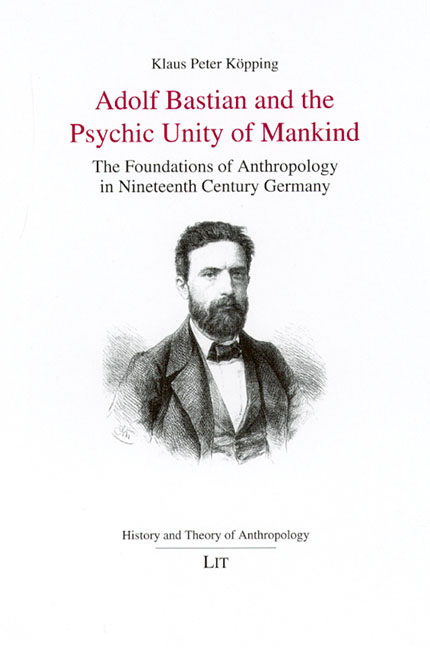
Adolf Bastian and the Psychic Unity of Mankind
The Foundations of Anthropology in Nineteenth Century Germany
Seiten
2005
|
1., Aufl.
Lit (Verlag)
978-3-8258-3989-5 (ISBN)
Lit (Verlag)
978-3-8258-3989-5 (ISBN)
- Titel ist leider vergriffen;
keine Neuauflage - Artikel merken
Adolf Bastian mapped a programme for anthropological research in the nineteenth century which is still accepted in the international scholarly community today, without the figure of its founder being known. This is the first time that seminal pieces of the work of this much-neglected scholar have been translated into English. Bastian had an impact, directly and indirectly, on geography, psychology, comparative religious studies, and ethnology in the twentieth century. The translation is preceded by a scholarly introduction, exploring the complexities of nineteenth century developments in the sciences and humanities in Germany, and tracing the rise of anthropological thinking within this framework. The foundations of ethnology and ethnography on the European Continent are extensively discussed in the light of predecessors, as well as the emergence of diverse schools of the social sciences up to an including structuralism, with the focus on Bastian. The translation concentrates on those works of Bastian which deal with the epistemological basis of anthropology and ethnology as natural sciences. Problems of salvage and applied anthropology and the comparative study of religious phenomena, particularly shamanism, are now of interest again, a hundred years after the programme was outlined by Bastian. The main emphasis of the book is to familiarize readers with the true meaning of such widely used concepts as "psychic unity of mankind", and the ramifications of terms like "elementary ideas" and "folk-ideas" as tools of conceptual classification of ethnographic data collection. Bastian is placed in the tradition of the major concerns of the nineteenth century, which began with the Enlightenment and found expression in various schemes of positivism from Comte to Durkheim and Spencer. Bastian's evolutionism is traced to the movement of German psycho-physics from Herbart to Fechner and Lotze. The ideas of a polyhistor like Bastian do not fit easily any preconceived notions about "schools of thought".
Klaus-Peter Köpping is Professor of Anthropology at the Ruprecht-Karls-University Heidelberg.
| Reihe/Serie | History and Theory of Anthropology /Geschichte und Theorie der Ethnologie ; 1 |
|---|---|
| Zusatzinfo | Abb. |
| Sprache | englisch |
| Maße | 162 x 235 mm |
| Einbandart | Paperback |
| Themenwelt | Sozialwissenschaften ► Ethnologie ► Völkerkunde (Naturvölker) |
| Schlagworte | Anthropologie • Bastian, Adolf • Deutschland, Geschichte; Geistes-/Kultur-Geschichte • Hardcover, Softcover / Ethnologie/Völkerkunde • HC/Ethnologie/Völkerkunde |
| ISBN-10 | 3-8258-3989-3 / 3825839893 |
| ISBN-13 | 978-3-8258-3989-5 / 9783825839895 |
| Zustand | Neuware |
| Informationen gemäß Produktsicherheitsverordnung (GPSR) | |
| Haben Sie eine Frage zum Produkt? |
Mehr entdecken
aus dem Bereich

aus dem Bereich
die Ethnologische Sammlung der Georg-August-Universität Göttingen
Buch | Softcover (2024)
Universitätsverlag Göttingen
CHF 58,75
Buch | Softcover (2023)
transcript (Verlag)
CHF 75,60


