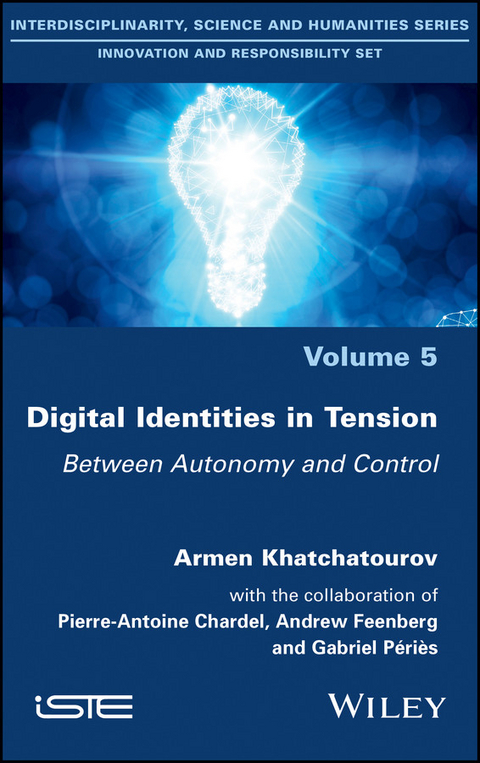
Digital Identities in Tension (eBook)
224 Seiten
John Wiley & Sons (Verlag)
9781119629603 (ISBN)
Today, companies and states are increasingly engaged in the surveillance and management of our digital identities. In response, we must study the effects that the new industrial, economic and political logics have on ethical issues and our ability to act.
This book examines the effects of digitalization on new modes of existence and subjectivation in many spheres: digital identity management systems, Big Data and machine learning, the Internet of Things, smart cities, etc. The study of these transformations is one of the major conditions for more responsible modes of data governance to emerge.
Armen Khatchatourov is an engineer and doctor of philosophy of technology, specialist in responsible data management, member of the Chair Values and Policies of Personal Information and a teacher-researcher at the Institut Mines-Telecom Business School, France.
Foreword ix
Chapter 1. Identity as an Issue of Constraint and Recognition: A Question of Fundamental Ethics 1
Pierre-Antoine CHARDEL
1.1. Introduction 1
1.2. Digital ethics in context 2
1.3. Identification, corporality and recognition issues 6
1.4. Digital metamorphosis, subjectivation and liquid societies 9
1.5. Narrative identities and self-expressions 11
1.6. Identity as an ethical issue 14
1.7. Traceability and fetishism of form 18
Chapter 2. Digital Regimes of Identity Management: From the Exercise of Privacy to Modulation of the Self 23
Armen KHATCHATOUROV
2.1. Introduction 23
2.2. From identity to digital identity: Historical and conceptual elements 28
2.2.1. Historical premises 28
2.2.2. About identification 33
2.2.3. Contemporary liquidity 38
2.2.4. Implementation of the approach: From narrative to writing 41
2.3. The digital and the appropriation of meaning 45
2.3.1. Digital transformation of meaning 45
2.3.2. Digital technology and the construction of identity: First elements 48
2.4. Transformations of existential territories 50
2.4.1. The relationship with the state and institutions 50
2.4.2. The relationship with market services 54
2.4.3. Social relations and production of the self 60
2.4.4. Sketch of the articulation between existential territories 64
2.5. From autonomy to modulated identity 66
2.5.1. The inadequacy of the concept of autonomy 66
2.5.2. Historical perspective: Discipline and control 67
2.5.3. Sketch of a typology of data production and control 75
2.5.4. Big Data as a minimum of control and initiative (exemplary case 1) 77
2.5.5. Quantified Self as maximum of control and initiative (exemplary case 2) 96
2.5.6. The illusion of control: Cross-domain aspects 104
2.5.7. The four trends at work in identities 109
2.6. Conclusion: Privacy in question in the digital transformation 113
2.6.1. The social value of privacy 114
2.6.2. Modulated identity and its private life 120
Chapter 3. Individuals, Normativity and Urban Spaces: Critical Perspectives on Digital Governance 127
Gabriel PÉRIÈS
3.1. Introduction 127
3.2. Identity-identification as a social fact: the systemic construction of digital identity 132
3.2.1. Identity and identification 132
3.2.2. From algorithmic rationality to the human body 133
3.2.3. The e-individual: Between systemic analysis and redefinition of the social field 136
3.3. e-Identity under construction in the smart city space 141
3.3.1. The smart city and the state 141
3.3.2. The interactive city and its actors 142
3.3.3. Some structuring elements of governance of the smart city 148
3.4. Conclusion: Identified citizen participation 152
Chapter 4. Wait a minute, dystopia has not arrived yet? - Digital Identities and the Ability to Act Collectively, an Interview with Andrew Feenberg 155
Andrew FEENBERG, Armen KHATCHATOUROV and Pierre-Antoine CHARDEL
References 177
List of Authors 195
Index 197
| Erscheint lt. Verlag | 4.6.2019 |
|---|---|
| Sprache | englisch |
| Themenwelt | Sozialwissenschaften ► Soziologie |
| Schlagworte | Cultural Studies • Digital Culture & the Information Age • Digitale Kultur im Informationszeitalter • Kulturwissenschaften |
| ISBN-13 | 9781119629603 / 9781119629603 |
| Informationen gemäß Produktsicherheitsverordnung (GPSR) | |
| Haben Sie eine Frage zum Produkt? |
 PDF (Adobe DRM)
Kopierschutz: Adobe-DRM
Adobe-DRM ist ein Kopierschutz, der das eBook vor Mißbrauch schützen soll. Dabei wird das eBook bereits beim Download auf Ihre persönliche Adobe-ID autorisiert. Lesen können Sie das eBook dann nur auf den Geräten, welche ebenfalls auf Ihre Adobe-ID registriert sind.
Details zum Adobe-DRM
Dateiformat: PDF (Portable Document Format)
Mit einem festen Seitenlayout eignet sich die PDF besonders für Fachbücher mit Spalten, Tabellen und Abbildungen. Eine PDF kann auf fast allen Geräten angezeigt werden, ist aber für kleine Displays (Smartphone, eReader) nur eingeschränkt geeignet.
Systemvoraussetzungen:
PC/Mac: Mit einem PC oder Mac können Sie dieses eBook lesen. Sie benötigen eine
eReader: Dieses eBook kann mit (fast) allen eBook-Readern gelesen werden. Mit dem amazon-Kindle ist es aber nicht kompatibel.
Smartphone/Tablet: Egal ob Apple oder Android, dieses eBook können Sie lesen. Sie benötigen eine
Geräteliste und zusätzliche Hinweise
Buying eBooks from abroad
For tax law reasons we can sell eBooks just within Germany and Switzerland. Regrettably we cannot fulfill eBook-orders from other countries.
aus dem Bereich