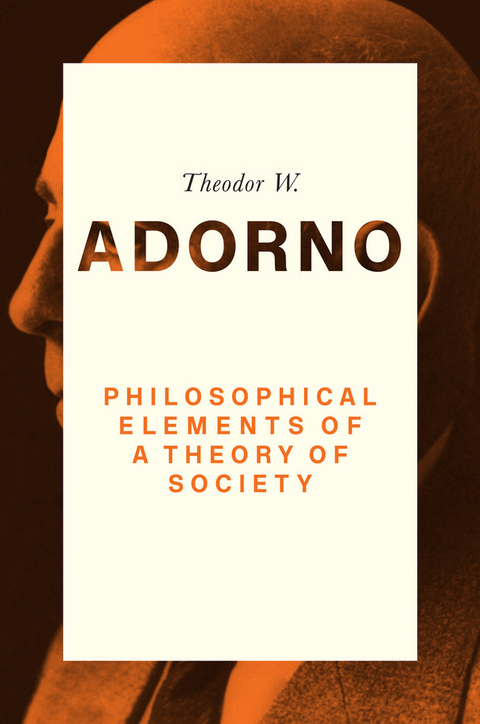
Philosophical Elements of a Theory of Society (eBook)
John Wiley & Sons (Verlag)
978-0-7456-9491-7 (ISBN)
In this lecture course given in 1964, Adorno develops a critique of both sociology and philosophy, emphasizing that theoretical work requires a specific mediation between the two disciplines. Adorno advocates a philosophical approach to social theory that challenges the drive towards uniformity and a lack of ambiguity, highlighting instead the fruitfulness of experience, in all its messy complexity, for critical social analysis. At the same time, he shows how philosophy must also realise that it requires sociology if it is to avoid falling for the old idealistic illusion that the totality of real conditions can be grasped through thought alone.
Masterfully bringing together philosophical and empirical approaches to an understanding of society, these lectures from one of the most important social thinkers of the 20th century will be of great interest to students and scholars in philosophy, sociology and the social sciences generally.
Theodor W. Adorno (1903-1969), a prominent member of the Frankfurt School, was one of the most influential thinkers of the 20th century in the areas of social theory, philosophy and aesthetics.
As an exile in America during the War, Theodor Adorno grew acquainted with the fundamentals of empirical social research, something which would shape the work he undertook in the early 1950s as co-director of the Frankfurt Institute for Social Research. Yet he also became increasingly aware of the fetishism of method in sociology, and saw the serious limitations of theoretical work based solely on empirical findings.In this lecture course given in 1964, Adorno develops a critique of both sociology and philosophy, emphasizing that theoretical work requires a specific mediation between the two disciplines. Adorno advocates a philosophical approach to social theory that challenges the drive towards uniformity and a lack of ambiguity, highlighting instead the fruitfulness of experience, in all its messy complexity, for critical social analysis. At the same time, he shows how philosophy must also realise that it requires sociology if it is to avoid falling for the old idealistic illusion that the totality of real conditions can be grasped through thought alone.Masterfully bringing together philosophical and empirical approaches to an understanding of society, these lectures from one of the most important social thinkers of the 20th century will be of great interest to students and scholars in philosophy, sociology and the social sciences generally.
Theodor W. Adorno (1903-1969), a prominent member of the Frankfurt School, was one of the most influential thinkers of the 20th century in the areas of social theory, philosophy and aesthetics.
"a joy to read"
Marx & Philosophy Review of Books
"Against the alleged waning of Adorno's radical commitments in his last years, these lectures of 1964 on the relationship between social theory and empirical research testify to his abiding Marxist loyalties. Exhorting his students to pierce the "technological veil" of their "administered world," he insists on the power of class, reified consciousness, and the impoverishment of experience in the irrational totality of late capitalism."
Martin Jay, Berkeley
LECTURE 1
12 May 1964
Ladies and gentlemen,
The title under which this course of lectures has been announced is somewhat amphibious: ‘Philosophical Elements of a Theory of Society’.1 Some of you will have racked your brains and asked, ‘So is that philosophy or sociology?’ And only those who have been exposed to my corrupting influence for some time will have recalled that I do not make the distinction between these disciplines as separate trades so strictly, in keeping with what Mr Horkheimer said yesterday in his introductory seminar course: philosophy is anything but a trade.2 What led me to this formulation is not the twofold title of my professorship, however,3 but something far more serious, namely the fact that I am asked time and again, and now especially by students of sociology: ‘So, you speak of a theory of society – what actually is that? Do you have such a theory? If you have it, why don’t you just come out with it, and if you don’t, why are you talking about it?’ So these constantly recurring questions led me to put it that way.
I hope I will be able to answer these questions at least to the extent that I can elaborate to you some of what I imagine I know about a theory of society, but, at the same time, I must explain to you the flaw of such a thoroughgoing theory of society; for it is always better to admit to, and hopefully explain well, an existing lack than to conceal it through some ideology. But it goes without saying that such a matter as the nature of a theory of society, in so far as it includes a reflection on theory itself, is at once something substantially philosophical; for while the standard practices of scholarship can be used to form theories, an examination of the possibility and nature of theory, and also a specific theory, is considered the domain of philosophy. In this context, let me remind all of you – but especially the sociology students among you – that the work of Max Weber, whose incredible wealth of material and empirical familiarity with the facts of society no one could deny, contains a special volume of so-called methodological writings;4 it is a matter of taste whether the reader wishes to call these texts philosophy or sociology.
The task I have set myself is twofold: on the one hand, I would like to give you a notion of what a theory of society actually is, what it can be and what it might look like. But, on the other hand – in keeping with both the brevity of such a lecture and my own way of approaching such things – I would also like to use a number of models to develop for you the elements, as announced, of such a theory of society itself. These two things, incidentally, are very difficult to keep apart; one of the dimensions of these lectures that will require a little relearning on your part is that I am not willing to make a rigid separation of method and contact – indeed, that I will even do all I can to unsettle the thinking habits that insist on such a separation. In other words, I will develop the methodological questions from the factual ones and, conversely, reflect on the factual questions themselves with methodological considerations, for example the structure of dialectical thought. That is also one reason why I will not begin by presenting a definition of a theory of society and its elements, as some of you might expect, because I believe that an understanding of such a theory can be attained only by addressing the philosophically epistemological questions on the one hand and the factual structural questions of society itself on the other.
To begin with, then, I am referring to the concept of a theory of society – and I am merely saying this so that you can get your bearings before being offered an elaborated concept of a theory of society – roughly as is familiar to you without having to engage in great philosophical deliberations, namely as an explanation or interpretation of phenomena, as opposed to their mere collection and subsequent more or less systematic presentation. So, if I say first of all that a theory is understood here as a body of more or less coherent contexts of ideas about society, that will be enough for now. I must add at once, however, that this deliberately very general definition of what such a theory is will form the framework for something that, at least epistemologically, is a central intention of what I have begun here: the distinction between a genuine theory of society and mere containers or collections of data. To the extent that we will deal with methodological considerations and questions about the concept of a theory of society, that will certainly be one of the most important tasks that is revealed to us by the current situation of scientific theory.
Now, ladies and gentlemen, I had told you that some speak time and again, especially in the context of the shortcomings of positivism,5 of both the necessity and the deficiency of a theory of society, but without being truly able to offer such a theory with a clear conscience. And, indeed, no one does what people used to do in the days when the great so-called fathers of sociology – Saint-Simon, Comte, Spencer, Marx too, and finally perhaps even Durkheim, though one could question that – presented their conceptions of society. I would argue, however, that the reason for this can be found not only in the advance of a positivist scientific mindset (though this scientific mindset essentially views all theory with suspicion and considers it a necessary evil). The earlier positivists such as Comte and Saint-Simon, who can be considered positivists in a broader sense, referred to what we call theory in a substantive sense with other, somewhat derogatory, terms – ‘metaphysics’, for example, was a frequent choice. I think that the crisis of theoretical thought in sociology, and it is certainly no exaggeration to speak of such a crisis – those of you who were at the Heidelberg congress6 and heard the reactions of the panel members to the lecture by my friend Marcuse7 will have seen very clearly from the start how widespread the hatred towards emphatic theory is in academically established, official sociology, how widespread a genuine hatred of any theory that is more than the abbreviation of the facts it encompasses – this crisis depends not only on the scientific mindset but ultimately also on the matter itself. That is to say: the increasing difficulty of truly grasping contemporary society with theoretical concepts, on the one hand, and, on the other hand, certain changes in the consciousness of thinkers and researchers that make it increasingly difficult for them to adopt any theoretical stance at all. In relation to these changes in the object and in the subject’s level of awareness, however, the slogans of positivism very often strike me as mere rationalizations to conceal something that lies beneath and bears much greater weight. In the history of positivist thought in sociology and positivist research in sociology, moreover, almost every sociologist who does more than simply conduct some narrow investigations is immediately suspected by his successors of being a crazed theorist – or, to use the term from the Index Verborum Prohibitorum of the positivists,8 a metaphysician. If you read Durkheim’s Rules,9 for example, you will find that even Comte, who God knows offered no shortage of invective towards metaphysics and metaphysical thought, is denounced there as a metaphysician, for the telling reason that he worked with categories related to the totality of historical movement in society, such as progress or an internally cohesive humanity, both of which are unacceptable for a nominalism as extreme as Durkheim’s.10 Or, to give you a different example of the same general phenomenon, it is no exaggeration to count Max Weber among the positivists, at least in a substantial intention of his work – not only because he argued that a rational actor should heroically take the disenchantment of the world upon themselves, but also in the method of his work, which from the outset describes the concepts it uses as mere auxiliary tools that have no independence from whatever facts, but whose purpose is simply to measure the facts in order to structure them; and these can then, as he says quite openly, be discarded if necessary, as prefigured in Weber’s famous theory of ‘ideal types’.11
As an aside, as this year happens to be the centenary of Max Weber’s birth, I would like to connect, as far as I can – without giving an outright lecture on Max Weber – these problems to Weber’s work and repeatedly open up perspectives on his œuvre, not only because of its wealth of material, but also because the problems we are dealing with are addressed in many of his texts at a very high level and with very great clarity and rigour. It is therefore not a coincidence that I keep returning to Weber, but a specific intention. Although I told you that, in certain basic tendencies, Weber can be considered an exponent of positivism, and thus of an actually anti-theoretical stance, and although I will add to this by noting that there is nothing by Weber that truly resembles a theory of society – that he did try out sociologies dealing with specific topics such as the great sociology of religion,12 or finally individual sociologies such as the outline ‘On the Sociology of Music’,13 or that he examined certain interconnections between categories but never produced anything like a theory of...
| Erscheint lt. Verlag | 29.5.2019 |
|---|---|
| Sprache | englisch |
| Themenwelt | Sozialwissenschaften ► Soziologie ► Allgemeine Soziologie |
| Schlagworte | Gesellschaftstheorie • Philosophie • Philosophie in den Gesellschaftswissenschaften • Philosophy • Philosophy of social science • Social Analysis • Social Research • Social Theory • Sociology • Sociology Special Topics • Soziologie • Spezialthemen Soziologie |
| ISBN-10 | 0-7456-9491-8 / 0745694918 |
| ISBN-13 | 978-0-7456-9491-7 / 9780745694917 |
| Informationen gemäß Produktsicherheitsverordnung (GPSR) | |
| Haben Sie eine Frage zum Produkt? |
 EPUB (Adobe DRM)
Kopierschutz: Adobe-DRM
Adobe-DRM ist ein Kopierschutz, der das eBook vor Mißbrauch schützen soll. Dabei wird das eBook bereits beim Download auf Ihre persönliche Adobe-ID autorisiert. Lesen können Sie das eBook dann nur auf den Geräten, welche ebenfalls auf Ihre Adobe-ID registriert sind.
Details zum Adobe-DRM
Dateiformat: EPUB (Electronic Publication)
EPUB ist ein offener Standard für eBooks und eignet sich besonders zur Darstellung von Belletristik und Sachbüchern. Der Fließtext wird dynamisch an die Display- und Schriftgröße angepasst. Auch für mobile Lesegeräte ist EPUB daher gut geeignet.
Systemvoraussetzungen:
PC/Mac: Mit einem PC oder Mac können Sie dieses eBook lesen. Sie benötigen eine
eReader: Dieses eBook kann mit (fast) allen eBook-Readern gelesen werden. Mit dem amazon-Kindle ist es aber nicht kompatibel.
Smartphone/Tablet: Egal ob Apple oder Android, dieses eBook können Sie lesen. Sie benötigen eine
Geräteliste und zusätzliche Hinweise
Buying eBooks from abroad
For tax law reasons we can sell eBooks just within Germany and Switzerland. Regrettably we cannot fulfill eBook-orders from other countries.
aus dem Bereich