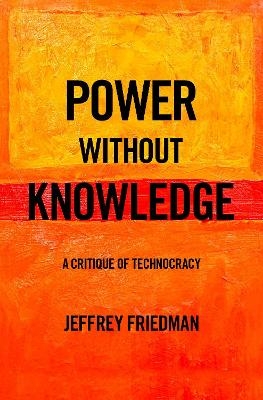
Power without Knowledge
Oxford University Press Inc (Verlag)
978-0-19-087717-0 (ISBN)
Technocrats claim to know how to solve the social and economic problems of complex modern societies. But as Jeffrey Friedman argues in Power without Knowledge, there is a fundamental flaw with technocracy: it requires an ability to predict how the people whom technocrats attempt to control will act in response to technocratic policies. However, the mass public's ideas-the ideas that drive their actions-are far too varied and diverse to be reliably predicted.
But that is not the only problem. Friedman reminds us that a large part of contemporary mass politics, even populist mass politics, is essentially technocratic too. Members of the general public often assume that they are competent to decide which policies or politicians will be able to solve social and economic problems. Yet these ordinary "citizen-technocrats" typically regard the solutions to social problems as self-evident, such that politics becomes a matter of vetting public officials for their good intentions and strong wills, not technocratic expertise.
Finally, Friedman argues that technocratic experts themselves drastically oversimplify technocratic realities. Economists, for example, theorize that people respond rationally to the incentives they face. This theory is simplistic, but it gives the appearance of being able to predict people's behavior in response to technocratic policy initiatives. If stripped of such gross oversimplications, though, technocrats themselves would be forced to admit that a rational technocracy is nothing more than an impossible dream.
Ranging widely over the philosophy of social science, rational choice theory, and empirical political science, Power without Knowledge is a pathbreaking work that upends traditional assumptions about technocracy and politics, forcing us to rethink our assumptions about the legitimacy of modern governance.
Jeffrey Friedman, a Visiting Scholar in the Charles and Louise Travers Department of Political Science, University of California, Berkeley, is the editor of Critical Review: A Journal of Politics and Society, the editor of The Rational Choice Controversy: Economic Models of Politics Reconsidered (Yale University Press), and coauthor of Engineering the Perfect Storm: The Financial Crisis and the Failure of Regulation. He has taught political and social theory at Barnard College, Columbia University, Dartmouth College, Harvard University, and Yale University.
Acknowledgments
Preface
Introduction: Technocracy and Political Epistemology
-The Absence of an Argument for Technocratic Knowledge
-Technocracy and Distributive Justice
-Technocratic Regulation and the Limits of State Autonomy
-The Technocratic Value Consensus
-The Politics of Negative Utilitarianism
-Citizens as Technocrats
-Distortions Caused by the Standard Definition of Technocracy
-The Public-Choice Alternative
-Democratic Technocracy and Nationalism
-Outline of the Book
Part I. Belief, Interpretation, and Unpredictability
Chapter 1: Technocratic Naïveté
-Naïve Realism and the Fact of Technocratic Disagreement
-Four Types of Technocratic Knowledge and the Possibility of Unintended Consequences
-Naïve Realism as a Methodological Problem
-A Criterion of Technocratic Legitimacy and the Theodicy of Technocracy
Chapter 2: Lippmann and Dewey: The Unjoined Debate
-Lippmann and Progressive Epistemology
-Lippmann's Political Epistemology
-Dewey's Defense of Democratic Technocracy
-The Fundamental Dilemma of Democratic Technocracy
-Dewey's Evolving Defenses of Policy Science
Chapter 3: Technocracy and Interpretation
-Dewey's Evolutionary Epistemology
-Heterogeneous Beliefs and Environmental Unpredictability
-Epistemological Individualism
-Intellectual History and the Practical Problems of Technocracy
-Homogenizing Factors
Part II. Toward an Empirical Epistemology of Technocracy
Chapter 4: The Pathological Pressure to Predict
-Economics and the Assumption of Effective Omniscience
-Economics as a Policy Science
-The Taming of Ignorance by Behavioral Economics
-Econometrics and the Confrontation with Heterogeneity
-Non-Technocratic Social Scientists Who Think Like Technocrats
Chapter 5: Epistocracy and the Spiral of Conviction
-The Spiral of Conviction
-The Spiral of Conviction among Experts
-The Financial Crisis in Retrospect: The Economist as Ideologue
Chapter 6: Public Ignorance and Democratic Technocracy
-Public Ignorance as an A-Fortiori Argument for Epistocracy
-The Unfulfilled Promise of Heuristics Research
-Public Ignorance: Radical, Not Rational
-A Bias for Technocratic Action
-Simple Heuristics for a Complex World
-Systemic Pressures in a Democratic Technocracy
Part III. Exitocracy
Chapter 7: Capitalism, Socialism, and Technocracy
-A Revised Standard of Technocratic Legitimacy
-Exit and Voice
-The Public-Private Asymmetry in Voice
-Some Epistemic Limits of Exit
-An Exitocratic Difference Principle
-No Exit Redux: Epistemic and Cultural Critiques
-Exit and Human Happiness
Afterword
Technocracy and the Left
References
| Erscheinungsdatum | 16.01.2020 |
|---|---|
| Verlagsort | New York |
| Sprache | englisch |
| Maße | 165 x 241 mm |
| Gewicht | 635 g |
| Themenwelt | Geisteswissenschaften ► Philosophie ► Allgemeines / Lexika |
| Sozialwissenschaften ► Politik / Verwaltung ► Politische Systeme | |
| Sozialwissenschaften ► Politik / Verwaltung ► Politische Theorie | |
| Sozialwissenschaften ► Politik / Verwaltung ► Staat / Verwaltung | |
| ISBN-10 | 0-19-087717-0 / 0190877170 |
| ISBN-13 | 978-0-19-087717-0 / 9780190877170 |
| Zustand | Neuware |
| Informationen gemäß Produktsicherheitsverordnung (GPSR) | |
| Haben Sie eine Frage zum Produkt? |
aus dem Bereich