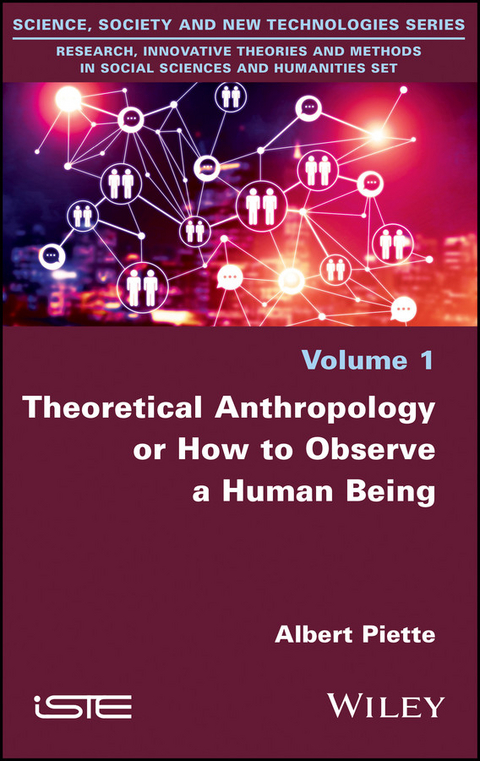
Theoretical Anthropology or How to Observe a Human Being (eBook)
208 Seiten
John Wiley & Sons (Verlag)
978-1-119-61831-7 (ISBN)
Theoretical Anthropology or How to Observe a Human Being establishes the foundations and conditions, both theoretical and methodological, which make it possible to consider the human being as a topic of observation and analysis, for himself as an entity, and not in the perspective of understanding social and cultural phenomena.
In debate with both anthropologists and philosophers, this book describes and analyzes the human being as a "volume". To this end, a specific lexicon is built around the notions of volume, volumography and volumology. These notions are further illustrated and enriched by several drawings.
Albert Piette is Professor of Anthropology at Paris Nanterre University in France and a researcher at the Centre for Ethnology and Comparative Sociology (CNRS). He is the author of several books on the epistemology of the social sciences, ritual or religious phenomena, existence and the human specificity.
Preface vii
Introduction xiii
Chapter 1. Theory: Observing the Human Volume 1
1.1. Volume and voluments 1
1.2. The entirety of a volume and the density of presence 9
1.3. Difference and separation 20
1.4. Volumuation and continuity 28
1.5. Lessereity 47
Chapter 2. Illustrating: Drawings of Theory 57
2.1. Drawings and contraspective 57
2.2. Focusing on the human figure 64
2.2.1. Putting into perspective 65
2.2.2. Separation 67
2.2.3. Focusing on the volume 68
2.2.4. Rays 69
2.2.5. Voluments 71
2.2.6. Consistency and style 72
2.2.7. Volugrams 73
2.2.8. Peripheral gestures, presence and absence 74
Chapter 3. Debates: Anthropology and the Human Entity 79
3.1. Experience and existence 81
3.2. Going beyond, wrenching and eccentricity 92
3.3. Lines and flow 99
3.4. Intersubjectivity 107
3.5. Perspections of the individual 115
Chapter 4. Further Development: Structural Existantism 125
4.1. Lévi-Strauss and the difficult ambition of anthropology 125
4.2. A structural approach and the human volume 133
Conclusion 151
Bibliography 159
Index 171
| Erscheint lt. Verlag | 26.4.2019 |
|---|---|
| Sprache | englisch |
| Themenwelt | Geisteswissenschaften ► Archäologie |
| Geschichte ► Allgemeine Geschichte ► Vor- und Frühgeschichte | |
| Sozialwissenschaften ► Ethnologie | |
| Sozialwissenschaften ► Politik / Verwaltung | |
| Sozialwissenschaften ► Soziologie | |
| Schlagworte | Anthropological Theory & Methods/Ethnography • Anthropologie • Anthropologie / Theorie u. Methoden, Ethnographie • Anthropology |
| ISBN-10 | 1-119-61831-2 / 1119618312 |
| ISBN-13 | 978-1-119-61831-7 / 9781119618317 |
| Informationen gemäß Produktsicherheitsverordnung (GPSR) | |
| Haben Sie eine Frage zum Produkt? |
 PDF (Adobe DRM)
Kopierschutz: Adobe-DRM
Adobe-DRM ist ein Kopierschutz, der das eBook vor Mißbrauch schützen soll. Dabei wird das eBook bereits beim Download auf Ihre persönliche Adobe-ID autorisiert. Lesen können Sie das eBook dann nur auf den Geräten, welche ebenfalls auf Ihre Adobe-ID registriert sind.
Details zum Adobe-DRM
Dateiformat: PDF (Portable Document Format)
Mit einem festen Seitenlayout eignet sich die PDF besonders für Fachbücher mit Spalten, Tabellen und Abbildungen. Eine PDF kann auf fast allen Geräten angezeigt werden, ist aber für kleine Displays (Smartphone, eReader) nur eingeschränkt geeignet.
Systemvoraussetzungen:
PC/Mac: Mit einem PC oder Mac können Sie dieses eBook lesen. Sie benötigen eine
eReader: Dieses eBook kann mit (fast) allen eBook-Readern gelesen werden. Mit dem amazon-Kindle ist es aber nicht kompatibel.
Smartphone/Tablet: Egal ob Apple oder Android, dieses eBook können Sie lesen. Sie benötigen eine
Geräteliste und zusätzliche Hinweise
Buying eBooks from abroad
For tax law reasons we can sell eBooks just within Germany and Switzerland. Regrettably we cannot fulfill eBook-orders from other countries.
aus dem Bereich