


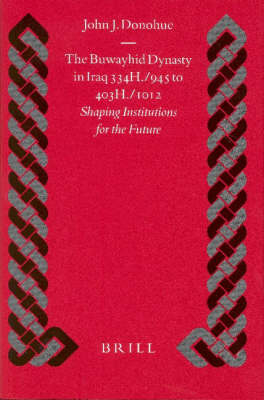
The Buwayhid Dynasty in Iraq 334H./945 to 403H./1012
Shaping Institutions for the Future
Seiten
2002
Brill (Verlag)
978-90-04-12860-6 (ISBN)
Brill (Verlag)
978-90-04-12860-6 (ISBN)
- Keine Verlagsinformationen verfügbar
- Artikel merken
A study of the shaping of political and social institutions in Baghdad by an Iranian Shiite dynasty that re-established the Caliphate on a new footing as the powerless symbol of authority and legitimacy.
A study of the development of political and social institutions in Baghdad, center of the Abbasid Caliphate, in that neglected period between Abbasid collapse and the coming of the Seljuk Turks. Three brothers, Daylemite mercenaries from the southern Caspian succeeded in establishing a dynasty that lasted nearly a century, controlling Iraq, a good part of Iran and the Gulf. The period has been labled the "Iranian intermezzo" but careful examination shows that the dynasty shaped the basic institutions to which the Seljuks would fall heir: the chief amirate, the system of army fiefs and the bureaucracy. It was a period of profound change and dislocation which fostered an open and creative cultural atmosphere. The Caliphate, bereft of power, was re-established as the center of authority and legitimation.
A study of the development of political and social institutions in Baghdad, center of the Abbasid Caliphate, in that neglected period between Abbasid collapse and the coming of the Seljuk Turks. Three brothers, Daylemite mercenaries from the southern Caspian succeeded in establishing a dynasty that lasted nearly a century, controlling Iraq, a good part of Iran and the Gulf. The period has been labled the "Iranian intermezzo" but careful examination shows that the dynasty shaped the basic institutions to which the Seljuks would fall heir: the chief amirate, the system of army fiefs and the bureaucracy. It was a period of profound change and dislocation which fostered an open and creative cultural atmosphere. The Caliphate, bereft of power, was re-established as the center of authority and legitimation.
John J. Donohue, Ph.D. (1966) in Arabic History, Harvard University, is Professor at St. Joseph University, Beirut, Director of the Center for the study of the Modern Arab World (CEMAM). He co-authored with John Esposito Islam in Transition (1982).
| Erscheint lt. Verlag | 27.11.2002 |
|---|---|
| Reihe/Serie | Islamic History and Civilization ; 44 |
| Verlagsort | Leiden |
| Sprache | englisch |
| Maße | 155 x 235 mm |
| Gewicht | 744 g |
| Themenwelt | Geschichte ► Allgemeine Geschichte ► Mittelalter |
| Geisteswissenschaften ► Geschichte ► Regional- / Ländergeschichte | |
| Sozialwissenschaften ► Politik / Verwaltung ► Politische Systeme | |
| Sozialwissenschaften ► Politik / Verwaltung ► Staat / Verwaltung | |
| ISBN-10 | 90-04-12860-3 / 9004128603 |
| ISBN-13 | 978-90-04-12860-6 / 9789004128606 |
| Zustand | Neuware |
| Informationen gemäß Produktsicherheitsverordnung (GPSR) | |
| Haben Sie eine Frage zum Produkt? |
Mehr entdecken
aus dem Bereich


aus dem Bereich
Geschichte einer Augsburger Familie (1367-1650)
Buch | Softcover (2024)
Kohlhammer (Verlag)
CHF 47,60


