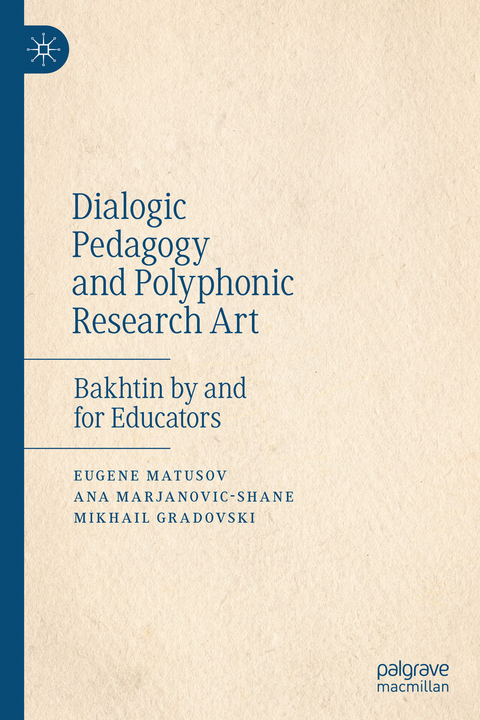
Dialogic Pedagogy and Polyphonic Research Art (eBook)
326 Seiten
Palgrave Macmillan US (Verlag)
978-1-137-58057-3 (ISBN)
This book presents voices of educators describing their pedagogical practices inspired by the ethical ontological dialogism of Mikhail M. Bakhtin. It is a book of educational practitioners, by educational practitioners, and primarily for educational practitioners. The authors provide a dialogic analysis of teaching events in Bakhtin-inspired classrooms and emerging issues, including: prevailing educational relationships of power, desires to create a so-called educational vortex in which all students can experience ontological engagement, and struggles of innovative pedagogy in conventional educational institutions. Matusov, Marjanovic-Shane, and Gradovski define a dialogic research art, in which the original pedagogical dialogues are approached through continuing dialogues about the original issues, and where the researchers enter into them with their mind and heart.
Eugene Matusov is Professor of Education at the University of Delaware, USA, and Editor-in-Chief of Dialogic Pedagogy: An International Online Journal. He investigates and works with sociocultural and Bakhtinian dialogic approaches to education.
Ana Marjanovic-Shane is an Independent Scholar and Deputy Editor-in-Chief of Dialogic Pedagogy: An International Online Journal. Her research interests include dialogue, democracy, and drama in education.
Mikhail Gradovski is Associate Professor of Social Education at the University of Stavanger, Norway. He teaches and researches using a dialogical approach.
This book presents voices of educators describing their pedagogical practices inspired by the ethical ontological dialogism of Mikhail M. Bakhtin. It is a book of educational practitioners, by educational practitioners, and primarily for educational practitioners. The authors provide a dialogic analysis of teaching events in Bakhtin-inspired classrooms and emerging issues, including: prevailing educational relationships of power, desires to create a so-called educational vortex in which all students can experience ontological engagement, and struggles of innovative pedagogy in conventional educational institutions. Matusov, Marjanovic-Shane, and Gradovski define a dialogic research art, in which the original pedagogical dialogues are approached through continuing dialogues about the original issues, and where the researchers enter into them with their mind and heart.
Eugene Matusov is Professor of Education at the University of Delaware, USA, and Editor-in-Chief of Dialogic Pedagogy: An International Online Journal. He investigates and works with sociocultural and Bakhtinian dialogic approaches to education.Ana Marjanovic-Shane is an Independent Scholar and Deputy Editor-in-Chief of Dialogic Pedagogy: An International Online Journal. Her research interests include dialogue, democracy, and drama in education.Mikhail Gradovski is Associate Professor of Social Education at the University of Stavanger, Norway. He teaches and researches using a dialogical approach.
Introduction: Inspired by Bakhtin—The Aim, Focus, and History Behind This Research ProjectPart I Teaching Cases and Their Online DiscussionChapter 1.1: Two Teaching Cases with Online Forum DiscussionsChapter 1.2: Standalone Teaching CasesPart II Analyses of Teaching Cases: Issues in Bakhtinian PedagogyChapter 2.1: What Is Bakhtinian Pedagogy for the Interviewed Bakhtinian Educators?Chapter 2.2: Ontological EngagementChapter 2.3: The Educational Vortex in Bakhtinian PedagogyChapter 2.4: Teacher–Student Power Relations in Bakhtinian PedagogyChapter 2.5: Bakhtinian Pedagogy in Conventional Educational InstitutionsPart III Dialogic Research ArtChapter 3.1: Introducing Dialogic Research ArtChapter 3.2: Dialogic and Positivist Research in the Social SciencesChapter 3.3: Summarizing Contrasts and Boundaries Between Positivist and Dialogic ResearchPart IV Conclusion: Lessons, Regrets, and HopesChapter 4.1: Lessons We Learned About Bakhtinian PedagogyChapter 4.2: Regrets About Our Polyphonic Dialogic ResearchChapter 4.3: Hopes About the Future of Bakhtinian Pedagogy and Dialogic ResearchChapter 4.4: Project Participants’ Holistic Judgments About the Book
| Erscheint lt. Verlag | 4.4.2019 |
|---|---|
| Zusatzinfo | VIII, 326 p. 1 illus. |
| Verlagsort | New York |
| Sprache | englisch |
| Themenwelt | Sozialwissenschaften ► Pädagogik ► Allgemeines / Lexika |
| Sozialwissenschaften ► Pädagogik ► Bildungstheorie | |
| Schlagworte | educational dialogue • Educational Philosophy • educational practitioners • Mikhail M. Bakhtin • ontological engagement |
| ISBN-10 | 1-137-58057-7 / 1137580577 |
| ISBN-13 | 978-1-137-58057-3 / 9781137580573 |
| Informationen gemäß Produktsicherheitsverordnung (GPSR) | |
| Haben Sie eine Frage zum Produkt? |
 PDF (Wasserzeichen)
DRM: Digitales Wasserzeichen
Dieses eBook enthält ein digitales Wasserzeichen und ist damit für Sie personalisiert. Bei einer missbräuchlichen Weitergabe des eBooks an Dritte ist eine Rückverfolgung an die Quelle möglich.
Dateiformat: PDF (Portable Document Format)
Mit einem festen Seitenlayout eignet sich die PDF besonders für Fachbücher mit Spalten, Tabellen und Abbildungen. Eine PDF kann auf fast allen Geräten angezeigt werden, ist aber für kleine Displays (Smartphone, eReader) nur eingeschränkt geeignet.
Systemvoraussetzungen:
PC/Mac: Mit einem PC oder Mac können Sie dieses eBook lesen. Sie benötigen dafür einen PDF-Viewer - z.B. den Adobe Reader oder Adobe Digital Editions.
eReader: Dieses eBook kann mit (fast) allen eBook-Readern gelesen werden. Mit dem amazon-Kindle ist es aber nicht kompatibel.
Smartphone/Tablet: Egal ob Apple oder Android, dieses eBook können Sie lesen. Sie benötigen dafür einen PDF-Viewer - z.B. die kostenlose Adobe Digital Editions-App.
Buying eBooks from abroad
For tax law reasons we can sell eBooks just within Germany and Switzerland. Regrettably we cannot fulfill eBook-orders from other countries.
aus dem Bereich