


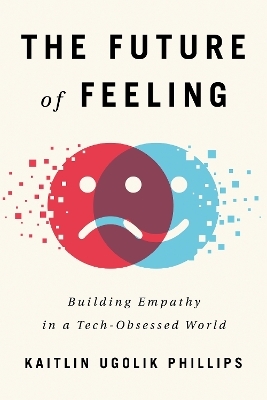
The Future of Feeling
Building Empathy in a Tech-Obsessed World
Seiten
2020
Little a (Verlag)
978-1-5420-4185-0 (ISBN)
Little a (Verlag)
978-1-5420-4185-0 (ISBN)
An insightful exploration of what social media, AI, robot technology, and the digital world are doing to our relationships with each other and with ourselves.
There’s no doubt that technology has made it easier to communicate. It’s also easier to shut someone out when we are confronted with online discourse. Why bother to understand strangers—or even acquaintances—when you can troll them, block them, or just click “Unfriend” and never look back? However briefly satisfying that might be, it’s also potentially eroding one of our most human traits: empathy.
So what does the future look like when something so vital to a peaceful, healthy, and productive society is fading away? The cautionary, yet hopeful, answer is in this champion for an endangered emotion.
In The Future of Feeling, Kaitlin Ugolik Phillips shares her own personal stories as well as those of doctors, entrepreneurs, teachers, journalists, and scientists about moving innovation and technology forward without succumbing to isolation. This book is for anyone interested in how our brains work, how they’re subtly being rewired to work differently, and what that ultimately means for us as humans.
There’s no doubt that technology has made it easier to communicate. It’s also easier to shut someone out when we are confronted with online discourse. Why bother to understand strangers—or even acquaintances—when you can troll them, block them, or just click “Unfriend” and never look back? However briefly satisfying that might be, it’s also potentially eroding one of our most human traits: empathy.
So what does the future look like when something so vital to a peaceful, healthy, and productive society is fading away? The cautionary, yet hopeful, answer is in this champion for an endangered emotion.
In The Future of Feeling, Kaitlin Ugolik Phillips shares her own personal stories as well as those of doctors, entrepreneurs, teachers, journalists, and scientists about moving innovation and technology forward without succumbing to isolation. This book is for anyone interested in how our brains work, how they’re subtly being rewired to work differently, and what that ultimately means for us as humans.
Kaitlin Ugolik Phillips is a journalist and editor who lives in Raleigh, North Carolina. Her writing on law, finance, health, and technology has appeared in the Establishment, VICE, Quartz, Institutional Investor magazine, Law360, Columbia Journalism Review, and Narratively, among others. She writes a blog and newsletter about empathy featuring reportage, essays, and interviews. For more information, visit www.kaitlinugolik.com.
| Erscheinungsdatum | 30.12.2019 |
|---|---|
| Verlagsort | Seattle |
| Sprache | englisch |
| Maße | 140 x 210 mm |
| Gewicht | 249 g |
| Themenwelt | Literatur ► Biografien / Erfahrungsberichte |
| Sachbuch/Ratgeber ► Natur / Technik | |
| Geschichte ► Teilgebiete der Geschichte ► Technikgeschichte | |
| Mathematik / Informatik ► Informatik | |
| Sozialwissenschaften | |
| ISBN-10 | 1-5420-4185-6 / 1542041856 |
| ISBN-13 | 978-1-5420-4185-0 / 9781542041850 |
| Zustand | Neuware |
| Informationen gemäß Produktsicherheitsverordnung (GPSR) | |
| Haben Sie eine Frage zum Produkt? |
Mehr entdecken
aus dem Bereich


aus dem Bereich
eine Geschichte der Fehlbarkeit von Mensch und Technologie
Buch | Hardcover (2025)
C.H.Beck (Verlag)
CHF 44,75
von Gutenberg bis zum Smartphone
Buch | Hardcover (2025)
Klett-Cotta (Verlag)
CHF 33,55
Buch | Softcover (2024)
Lehmanns Media (Verlag)
CHF 27,90


