


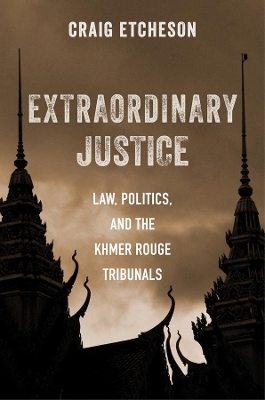
Extraordinary Justice
Law, Politics, and the Khmer Rouge Tribunals
Seiten
2019
Columbia University Press (Verlag)
978-0-231-19424-2 (ISBN)
Columbia University Press (Verlag)
978-0-231-19424-2 (ISBN)
In just a few short years, the Khmer Rouge presided over one of the twentieth century’s cruelest reigns of terror. Since its 1979 overthrow, there have been several attempts to hold the perpetrators accountable, from a People’s Revolutionary Tribunal shortly afterward through the early 2000s Extraordinary Chambers in the Courts of Cambodia, also known as the Khmer Rouge Tribunal. Extraordinary Justice offers a definitive account of the quest for justice in Cambodia that uses this history to develop a theoretical framework for understanding the interaction between law and politics in war crimes tribunals.
Craig Etcheson, one of the world’s foremost experts on the Cambodian genocide and its aftermath, draws on decades of experience to trace the evolution of transitional justice in the country from the late 1970s to the present. He considers how war crimes tribunals come into existence, how they operate and unfold, and what happens in their wake. Etcheson argues that the concepts of legality that hold sway in such tribunals should be understood in terms of their orientation toward politics, both in the Khmer Rouge Tribunal and generally. A magisterial chronicle of the inner workings of postconflict justice, Extraordinary Justice challenges understandings of the relationship between politics and the law, with important implications for the future of attempts to seek accountability for crimes against humanity.
Craig Etcheson, one of the world’s foremost experts on the Cambodian genocide and its aftermath, draws on decades of experience to trace the evolution of transitional justice in the country from the late 1970s to the present. He considers how war crimes tribunals come into existence, how they operate and unfold, and what happens in their wake. Etcheson argues that the concepts of legality that hold sway in such tribunals should be understood in terms of their orientation toward politics, both in the Khmer Rouge Tribunal and generally. A magisterial chronicle of the inner workings of postconflict justice, Extraordinary Justice challenges understandings of the relationship between politics and the law, with important implications for the future of attempts to seek accountability for crimes against humanity.
Craig Etcheson is a visiting scientist at the Harvard T. H. Chan School of Public Health. From 2006 to 2012, he was chief of investigations for the Office of Co-Prosecutors at the Extraordinary Chambers in the Courts of Cambodia. His previous books on Cambodia include The Rise and Demise of Democratic Kampuchea (1984) and After the Killing Fields: Lessons from the Cambodian Genocide (2005).
Acknowledgments
List of Acronyms
Introduction
1. Revolutionary Justice
2. Victor’s Justice
3. Negotiating Justice
4. Justice Delayed
5. Hybrid Justice
6. Transitional Justice
7. Selective Justice
8. Genocide Justice
9. Justice Denied
10. Extraordinary Justice
Notes
Select Bibliography
Index
| Erscheinungsdatum | 10.11.2019 |
|---|---|
| Zusatzinfo | 14 b&w figures |
| Verlagsort | New York |
| Sprache | englisch |
| Maße | 152 x 229 mm |
| Themenwelt | Geisteswissenschaften ► Geschichte ► Regional- / Ländergeschichte |
| Geschichte ► Teilgebiete der Geschichte ► Militärgeschichte | |
| Recht / Steuern ► EU / Internationales Recht | |
| Recht / Steuern ► Öffentliches Recht | |
| Sozialwissenschaften ► Politik / Verwaltung | |
| ISBN-10 | 0-231-19424-2 / 0231194242 |
| ISBN-13 | 978-0-231-19424-2 / 9780231194242 |
| Zustand | Neuware |
| Informationen gemäß Produktsicherheitsverordnung (GPSR) | |
| Haben Sie eine Frage zum Produkt? |
Mehr entdecken
aus dem Bereich

aus dem Bereich
von der Wiederbewaffnung bis zur Zeitenwende
Buch | Softcover (2025)
C.H.Beck (Verlag)
CHF 16,80
Deutschlands großer Volksaufstand
Buch | Softcover (2024)
Propyläen Verlag
CHF 30,80


