


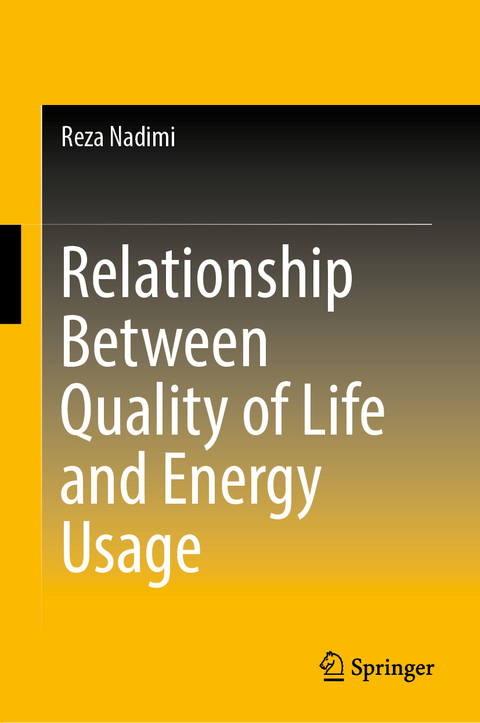
Relationship Between Quality of Life and Energy Usage
Seiten
2019
|
2019 ed.
Springer Verlag, Singapore
978-981-13-7839-3 (ISBN)
Springer Verlag, Singapore
978-981-13-7839-3 (ISBN)
One important aspect of this distinction is their different global energy policies and their priorities with regard to achieving sustainable energy consumption. (2) manufacturers and developers of renewable energy technologies who consider renewables as an option for mitigating energy poverty;
This book utilizes statistical techniques to define a quality of life (QoL) indicator combining the three dimensions of economy, health, and education. In turn, it uses modeling to assess the impact of energy consumption on 112 countries’ QoL. What sets the proposed model apart from previous research is its ability to distinguish between pre-developing, developing, and developed countries. One important aspect of this distinction is their different global energy policies and their priorities with regard to achieving sustainable energy consumption. Accordingly, the book also discusses eco-sufficiency, eco-efficiency, and energy poverty reduction for the three different types of countries.
In turn, the book provides general information on how to reconcile sustainable energy consumption with QoL and economic development. Optimization programming technique and simulation are applied to measure potential energy saving in each country, without sacrificing economic progress, and while maintaining QoL.
Given its scope, the book is highly recommended to the following audiences: (1) readers seeking a state-of-the-art quantitative work on energy systems and QoL; (2) manufacturers and developers of renewable energy technologies who consider renewables as an option for mitigating energy poverty; and (3) international institutions such as the United Nations seeking a sustainable global energy strategy.
This book utilizes statistical techniques to define a quality of life (QoL) indicator combining the three dimensions of economy, health, and education. In turn, it uses modeling to assess the impact of energy consumption on 112 countries’ QoL. What sets the proposed model apart from previous research is its ability to distinguish between pre-developing, developing, and developed countries. One important aspect of this distinction is their different global energy policies and their priorities with regard to achieving sustainable energy consumption. Accordingly, the book also discusses eco-sufficiency, eco-efficiency, and energy poverty reduction for the three different types of countries.
In turn, the book provides general information on how to reconcile sustainable energy consumption with QoL and economic development. Optimization programming technique and simulation are applied to measure potential energy saving in each country, without sacrificing economic progress, and while maintaining QoL.
Given its scope, the book is highly recommended to the following audiences: (1) readers seeking a state-of-the-art quantitative work on energy systems and QoL; (2) manufacturers and developers of renewable energy technologies who consider renewables as an option for mitigating energy poverty; and (3) international institutions such as the United Nations seeking a sustainable global energy strategy.
Chapter 1: Introduction.- Chapter 2: QoL modeling against energy consumption per capita.- Chapter 3: QoL and final energy consumption with other policy targets.- Chapter 4: Potential energy saving in the energy system via DEA technique by relying on QoL.- Chapter 5: Fundamental energy needs quantification for QoL improvement.- Chapter 6: General conclusion.
| Erscheinungsdatum | 20.05.2019 |
|---|---|
| Zusatzinfo | 54 Illustrations, color; 1 Illustrations, black and white; XVIII, 163 p. 55 illus., 54 illus. in color. |
| Verlagsort | Singapore |
| Sprache | englisch |
| Maße | 155 x 235 mm |
| Themenwelt | Sozialwissenschaften ► Soziologie ► Spezielle Soziologien |
| Technik ► Elektrotechnik / Energietechnik | |
| Wirtschaft ► Volkswirtschaftslehre ► Wirtschaftspolitik | |
| Schlagworte | Energy Consumption • energy efficiency • Energy modeling • Human Development • poverty reduction • quality of life |
| ISBN-10 | 981-13-7839-8 / 9811378398 |
| ISBN-13 | 978-981-13-7839-3 / 9789811378393 |
| Zustand | Neuware |
| Informationen gemäß Produktsicherheitsverordnung (GPSR) | |
| Haben Sie eine Frage zum Produkt? |
Mehr entdecken
aus dem Bereich


aus dem Bereich
Bullshit als politische Strategie
Buch | Softcover (2025)
Kohlhammer (Verlag)
CHF 33,55
eine Einführung
Buch | Softcover (2024)
De Gruyter Oldenbourg (Verlag)
CHF 41,90
Ressentiment in der Einwanderungsgesellschaft
Buch | Hardcover (2024)
Konstanz University Press (Verlag)
CHF 33,55


