


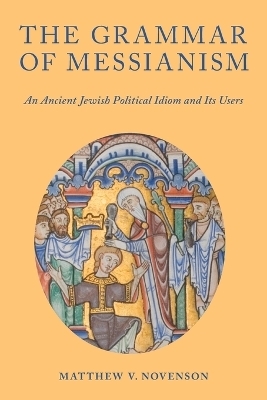
The Grammar of Messianism
An Ancient Jewish Political Idiom and Its Users
Seiten
2019
Oxford University Press Inc (Verlag)
9780190053215 (ISBN)
Oxford University Press Inc (Verlag)
9780190053215 (ISBN)
In this book, Novenson gives a revisionist account of messianism in antiquity. He shows that, for the ancient Jews and Christians who used the term, a messiah was not an article of faith but a manner of speaking: a scriptural figure of speech useful for thinking kinds of political order.
Messianism is one of the great themes in intellectual history. But because it has done so much important ideological work for the people who have written about it, the historical roots of the discourse have been obscured from view. What did it mean to talk about "messiahs" in the ancient world, before the idea of messianism became a philosophical juggernaut, dictating the terms for all subsequent discussion of the topic? In this book, Matthew V. Novenson offers a revisionist account of messianism in antiquity. He shows that, for the ancient Jews and Christians who used the term, a messiah was not an article of faith but a manner of speaking. It was a scriptural figure of speech, one among numerous others, useful for thinking about kinds of political order: present or future, real or ideal, monarchic or theocratic, dynastic or charismatic, and other variations besides. The early Christians famously seized upon the title "messiah" (in Greek, "Christ") for their founding hero and molded the sense of the term in certain ways; but, Novenson shows, this is just what all ancient messiah texts do, each in its own way. If we hope to understand the ancient texts about messiahs (from Deutero-Isaiah to the Parables of Enoch, from the Qumran Community Rule to the Gospel of John, from the Pseudo-Clementines to Sefer Zerubbabel), we must learn to think not in terms of a world-historical idea but of a language game, of so many creative reuses of an archaic Israelite idiom. In The Grammar of Messianism, Novenson demonstrates the possibility and the benefit of thinking of messianism in this way.
Messianism is one of the great themes in intellectual history. But because it has done so much important ideological work for the people who have written about it, the historical roots of the discourse have been obscured from view. What did it mean to talk about "messiahs" in the ancient world, before the idea of messianism became a philosophical juggernaut, dictating the terms for all subsequent discussion of the topic? In this book, Matthew V. Novenson offers a revisionist account of messianism in antiquity. He shows that, for the ancient Jews and Christians who used the term, a messiah was not an article of faith but a manner of speaking. It was a scriptural figure of speech, one among numerous others, useful for thinking about kinds of political order: present or future, real or ideal, monarchic or theocratic, dynastic or charismatic, and other variations besides. The early Christians famously seized upon the title "messiah" (in Greek, "Christ") for their founding hero and molded the sense of the term in certain ways; but, Novenson shows, this is just what all ancient messiah texts do, each in its own way. If we hope to understand the ancient texts about messiahs (from Deutero-Isaiah to the Parables of Enoch, from the Qumran Community Rule to the Gospel of John, from the Pseudo-Clementines to Sefer Zerubbabel), we must learn to think not in terms of a world-historical idea but of a language game, of so many creative reuses of an archaic Israelite idiom. In The Grammar of Messianism, Novenson demonstrates the possibility and the benefit of thinking of messianism in this way.
Matthew V. Novenson is Senior Lecturer in New Testament and Christian Origins at the University of Edinburgh. He has also been a visiting professor at Dartmouth College and Duke University and a visiting research fellow at Durham University. He is the author of Christ among the Messiahs (Oxford University Press, 2012).
Acknowledgements
Abbreviations
1. After the Messianic Idea
2. Oil and Power in Ancient Israel
3. Messiahs Born and Made
4. Messiahs Present and Absent
5. The Quest for the First Messiah
6. The Jewish Messiah-Christian Messiah Distinction
7. The Fate of Messiah Christology in Early Christianity
8. The Grammar of Messianism
Bibliography
Index of Subjects
Index of Ancient Sources
Index of Modern Authors
| Erscheinungsdatum | 06.04.2019 |
|---|---|
| Verlagsort | New York |
| Sprache | englisch |
| Maße | 155 x 231 mm |
| Gewicht | 567 g |
| Themenwelt | Geschichte ► Teilgebiete der Geschichte ► Religionsgeschichte |
| Religion / Theologie ► Christentum ► Kirchengeschichte | |
| Geisteswissenschaften ► Religion / Theologie ► Judentum | |
| Sozialwissenschaften ► Soziologie ► Spezielle Soziologien | |
| ISBN-13 | 9780190053215 / 9780190053215 |
| Zustand | Neuware |
| Informationen gemäß Produktsicherheitsverordnung (GPSR) | |
| Haben Sie eine Frage zum Produkt? |
Mehr entdecken
aus dem Bereich


aus dem Bereich
von der Antike bis zur Gegenwart
Buch | Softcover (2025)
C.H.Beck (Verlag)
CHF 16,80


