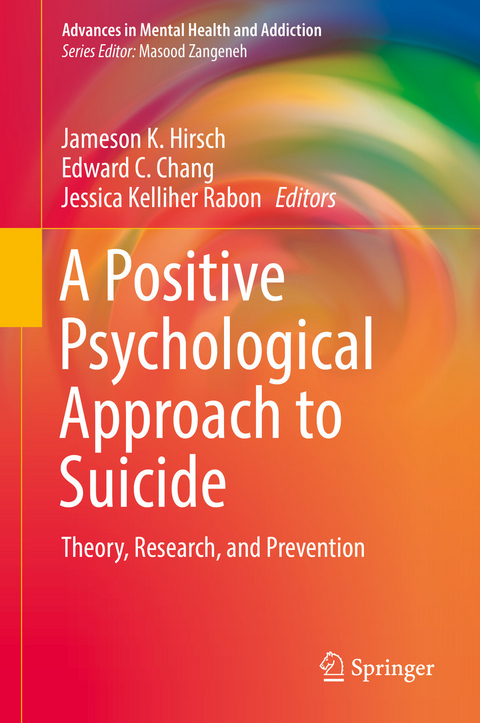
A Positive Psychological Approach to Suicide (eBook)
334 Seiten
Springer International Publishing (Verlag)
978-3-030-03225-8 (ISBN)
This inspiring resource presents theories, findings, and interventions from Positive Suicidology, an emerging strengths-based approach to suicide prevention. Its synthesis of positive psychology and suicidology theories offers a science-based framework for promoting wellbeing to complement or, if appropriate, replace traditional deficit-driven theories and therapies used in reducing suicidal thoughts and behaviors. Coverage reviews interpersonal, intrapersonal, and societal risk factors for suicide, and identifies protective factors, such as hope and resilience, that can be enhanced in therapy. From there, chapters detail a palette of approaches and applications of Positive Suicidology, from the powerful motivating forces described in Self-Determination Theory to meaning-building physical and social activities.
Among the topics covered:
- Future-oriented constructs and their role in suicidal ideation and enactment.
- Gratitude as a protective factor for suicidal ideation and behavior: theory and evidence.
- Considering race and ethnicity in the use of positive psychological approaches to suicide.
- The Six R's framework as mindfulness for suicide prevention.
- Community-based participatory research and empowerment for suicide prevention.
- Applied resiliency and suicide prevention: a strengths-based, risk-reduction framework.
Psychotherapists, counselors, social workers, psychiatrists, and health psychologists, as well as educators, clergy and healthcare professionals, will find A Positive Psychological Approach to Suicide an invaluable source of contemporary evidence-based strategies for their prevention and intervention efforts with suicidal clients.
Jameson K. Hirsch is an Associate Professor of Clinical Psychology, and Assistant Chair, at East Tennessee State University, and maintains faculty appointments in the Department of Psychiatry, University of Rochester Medical Center, the Department of Public Health, East Tennessee State University, and as a Research Scientist at the Mountain Home VAMC. Dr. Hirsch received his Ph.D. from the University of Wyoming, completed his APA-accredited internship at SUNY Upstate Medical Center, and his Post-Doctoral Fellowship at the University of Rochester School of Medicine and Dentistry. His research focuses on protective, positive psychological characteristics that might buffer against psychopathology, particularly depression and suicidal behavior, occurring in the context of medical illness and impairment and in underserved and under-represented groups, including rural, elderly and ethnic minority individuals. Dr. Hirsch has published over 125 peer-reviewed articles on protective factors, and he has presented his research more than 350 times at professional conferences. He currently serves on the Editorial Boards of Suicide and Life-Threatening Behavior, Cognitive Therapy and Research and International Journal of Mental Health and Addiction.
Edward C. Chang is a Professor of Clinical Science in the Department of Psychology and Professor of Social Work in the School of Social Work at the University of Michigan, Ann Arbor. He obtained his M.A. and Ph.D. degrees from the State University of New York at Stony Brook. He completed his APA-accredited clinical internship at Bellevue Hospital Center-New York University Medical Center. Dr. Chang has published nearly 200 works on personality, positive psychology, suicide risk, cultural differences, coping, and psychological adjustment. He has also edited more than a dozen books focused on optimism, personality, social problem solving, cognitive behavioral interventions with ethnoracial groups, psychopathology in Asians, and health in Southeast Asians. Dr. Chang has served as Associate Editor of several leading journals in the field, including Cognitive Therapy and Research, the American Psychologist, Journal of Personality and Social Psychology, Asian American Journal of Psychology, and the Journal of Social and Clinical Psychology. Finally, he has won numerous awards for his research and teaching over the years, including the Theodore Millon Award in Personality Psychology.
Jessica Kelliher Rabon is a post-doctoral fellow at Greenville Hospital System Children's Hospital in Greenville, SC. She received her Ph.D. in Clinical Psychology at East Tennessee State University, her M.A. in clinical psychology from Western Carolina University, and B.S. in psychology from Furman University. She completed her APA-accredited clinical internship at Virginia Treatment for Children in Richmond, VA. Dr. Rabon has conducted, presented, and published research on a wide range of topics including anxiety, depression, suicidal behavior, hopelessness, self-compassion, future orientation, forgiveness, and optimism. Dr. Rabon's current interests focus on identification of positive psychosocial characteristics that protect against depression and suicidal behavior, especially in vulnerable populations.
Jameson K. Hirsch is an Associate Professor of Clinical Psychology, and Assistant Chair, at East Tennessee State University, and maintains faculty appointments in the Department of Psychiatry, University of Rochester Medical Center, the Department of Public Health, East Tennessee State University, and as a Research Scientist at the Mountain Home VAMC. Dr. Hirsch received his Ph.D. from the University of Wyoming, completed his APA-accredited internship at SUNY Upstate Medical Center, and his Post-Doctoral Fellowship at the University of Rochester School of Medicine and Dentistry. His research focuses on protective, positive psychological characteristics that might buffer against psychopathology, particularly depression and suicidal behavior, occurring in the context of medical illness and impairment and in underserved and under-represented groups, including rural, elderly and ethnic minority individuals. Dr. Hirsch has published over 125 peer-reviewed articles on protective factors, and he has presented his research more than 350 times at professional conferences. He currently serves on the Editorial Boards of Suicide and Life-Threatening Behavior, Cognitive Therapy and Research and International Journal of Mental Health and Addiction. Edward C. Chang is a Professor of Clinical Science in the Department of Psychology and Professor of Social Work in the School of Social Work at the University of Michigan, Ann Arbor. He obtained his M.A. and Ph.D. degrees from the State University of New York at Stony Brook. He completed his APA-accredited clinical internship at Bellevue Hospital Center-New York University Medical Center. Dr. Chang has published nearly 200 works on personality, positive psychology, suicide risk, cultural differences, coping, and psychological adjustment. He has also edited more than a dozen books focused on optimism, personality, social problem solving, cognitive behavioral interventions with ethnoracial groups, psychopathology in Asians, and health in Southeast Asians. Dr. Chang has served as Associate Editor of several leading journals in the field, including Cognitive Therapy and Research, the American Psychologist, Journal of Personality and Social Psychology, Asian American Journal of Psychology, and the Journal of Social and Clinical Psychology. Finally, he has won numerous awards for his research and teaching over the years, including the Theodore Millon Award in Personality Psychology. Jessica Kelliher Rabon is a post-doctoral fellow at Greenville Hospital System Children's Hospital in Greenville, SC. She received her Ph.D. in Clinical Psychology at East Tennessee State University, her M.A. in clinical psychology from Western Carolina University, and B.S. in psychology from Furman University. She completed her APA-accredited clinical internship at Virginia Treatment for Children in Richmond, VA. Dr. Rabon has conducted, presented, and published research on a wide range of topics including anxiety, depression, suicidal behavior, hopelessness, self-compassion, future orientation, forgiveness, and optimism. Dr. Rabon’s current interests focus on identification of positive psychosocial characteristics that protect against depression and suicidal behavior, especially in vulnerable populations.
Contents 6
About the Editors 8
Chapter 1: Positive Psychology and Suicide Prevention: An Introduction and Overview of the Literature 10
An Introduction to Positive Psychology 12
Positive Psychology and Health Outcomes 13
Cognitive-Behavioral Framework for Understanding Suicide 14
Brief Overview of Psychosocial Theories of Suicide 15
Positive Psychological Theories Applied to Suicide Prevention 18
References 22
Chapter 2: Future-Oriented Constructs and Their Role in Suicidal Ideation and Enactment 25
Introduction 25
Future-Oriented Constructs Within Contemporary Theoretical Frameworks of Suicide 27
The Interpersonal-Psychological Theory of Suicide (IPT Joiner, 2005
The Integrated Motivational-Volitional Model of Suicide (IMV O’Connor, 2011
The Three Step Theory (3ST Klonsky &
Future Thinking 28
Optimism 31
Hopefulness 33
Future-Oriented Interventions for Suicidal Thoughts and Behaviour 36
Future Directions 37
Conclusions 38
References 40
Chapter 3: Forgiveness, Addiction, and Suicide 45
Spirituality and Forgiveness as Aspects of Positive Psychology 46
Spirituality and Health 46
Forgiveness and Health 47
Modeling the Forgiveness–Addiction/Suicidal Behavior Association 49
The Forgiveness–Addiction/Suicidal Behavior Association: An Initial Study 51
Methods 51
Measures 52
Statistical Analyses 55
Results 55
Sample Characteristics 55
Bivariate Associations 56
Multivariable Associations 56
Discussion 59
Clinical Implications: Treatment and Prevention 59
Future Directions 61
Conclusion 62
References 62
Chapter 4: Reasons for Living 67
Introduction 69
Methods 70
Reasons for Living Assessment Scales 71
Reasons for Living Inventory 71
Review of Additional Scales Developed from the RFLI 81
Review of Chinese RFL Scales 82
Reasons for Living Versus Reasons for Dying Assessment 83
Comparison Between Different RFL Scales 84
Overview of Qualitative Research with RFL 85
Preventive and Therapeutic Interventions 87
Discussion 89
References 91
Chapter 5: Gratitude as a Protective Factor for Suicidal Ideation and Behaviour: The Theory and the Evidence Base 97
What Is “Gratitude”? 97
Gratitude and Suicidal Ideation and Attempts: The Evidence Base 99
Are Gratitude Interventions Effective? 105
Possible Mechanisms for the Positive Effects of Gratitude 108
What Are the Stumbling Blocks and Facilitators for Gratitude? 110
Conclusions and Clinical Applications 112
References 113
Chapter 6: Considering Race and Ethnicity Using Positive Psychological Approaches to Suicide 119
Importance of Including Racially and Ethnically Diverse Groups in Suicidology 120
Do Positive Psychological Constructs Universally Transcend Across Race and Ethnicity? 121
Minority Well-Being Is Likely Impacted by Historical and Ongoing Sociopolitical Contexts 123
Mainstream Positive Psychological Suicide Research with Racial/Ethnic Minorities 127
Minority People Thrive In Spite of Risk: Unique Culture-Specific Protective Factors 130
Positive Psychology: A Well-Positioned Field for Inclusivity 132
Considerations for Future Research 133
Suggestions for Increasing Racial and Ethnic Minority Research in Positive Suicidology 135
Chapter Summary 136
References 137
Chapter 7: Interpersonal Needs and Social Support 144
Risk Factors 145
Interpersonal Theory of Suicide 145
Loneliness 147
Social Isolation 148
Conflict with Others 149
Protective Factors 150
Social Networks 151
Social Support 152
Connectedness to Others 154
Attachment to Others 155
Social Communication and Community Involvement 156
Self-Esteem 157
Conclusion 157
References 158
Chapter 8: Encouraging Health-Promoting Behaviors in Primary Care to Reduce Suicide Rates 168
Physical Activity 171
Behavioral Activation 172
Nutrition 173
Health-Related Quality of Life 175
Stress Reduction 177
Reduction of Substance Use 179
Conclusions and Future Directions 181
References 182
Chapter 9: Future-Oriented Treatments for Suicide: An Overview of Three Modern Approaches 189
Hope Therapy 190
Theoretical Background 190
Application of Hope Therapy 191
Adapting Hope Therapy to Target Suicide Behaviors 193
Future-Directed Therapy for Depression 195
Theoretical Background 195
Application of Future-Directed Therapy 199
Can FDT Help Suicidal Patients? 201
Future-Oriented Group Training for Suicidal Patients 202
Theoretical Foundation/Background Information and Model 202
Application 204
Future Directions for FOGT 205
Future of Future-Oriented Treatments for Suicide 206
References 207
Chapter 10: Meaning-Centered Men’s Groups (MCMG) for the Transition to Retirement 215
Introduction 215
Suicide and Its Prevention in Later Life 216
Suicide Prevention in Men Facing Retirement 217
Psychological Resiliency to Suicide: A Conceptual Framework 219
Meaning in Life and Suicide Prevention 220
Meaning-Centered Interventions 221
Methods 222
Participants 222
Procedures 223
Recruitment 224
Assessments 224
Measures 225
Demographics 225
Cognitive Functioning 226
Diagnostic and Clinical Variables 226
Physical Functioning 226
Health-Related Quality of Life 226
Suicide Ideation 227
Meaning in Life (MIL) 227
Subjective Well-Being 227
Group Process Measures 228
Therapeutic Alliance 228
Group Satisfaction 228
Semi-Structured Group Feedback Questions 228
Intervention 228
Results 230
Acceptability and Tolerability of MCMG 234
Participant Feedback: Session-By-Session Evaluations 235
Group Process Ratings 235
Participant Feedback: Exit Interviews 236
Group Satisfaction 236
Interpersonal Factors 236
Group Facilitators 237
Group Process 237
Benefits of Group Participation 238
Men Only 238
Recommendations for Improving MCMG 238
Duration 239
MCMG Redux 239
Discussion 239
Appendix A: MCMG Session-By-Session Overview 244
References 245
Chapter 11: The Six R’s Framework as Mindfulness for Suicide Prevention 252
Introduction 252
Efficacy and Effectiveness of Mindfulness-Based Interventions for Suicide 253
Mindfulness as Suicide Prevention: The Six R’s Framework 272
Remembering 273
Redirecting 275
Replacing 276
Reflecting 277
Resolving 279
Retracing 280
Wisdom and Insight 282
Beyond Personal Toward Context and Collective 283
References 284
Chapter 12: Community-Based Participatory Research and Community Empowerment for Suicide Prevention 290
A Case Example: An Indigenous Community in the Canadian Arctic 296
Conclusions 298
References 300
Chapter 13: Applied Resiliency and Suicide Prevention: A Strengths-Based, Risk-Reduction Framework 305
Interpersonal Factors 307
Intrapersonal Factors 308
Temporal Factors 308
Humanistic and Existential Factors 310
Self in Context: Sociocultural and Environmental Factors 313
Conclusion 316
References 319
Index 324
| Erscheint lt. Verlag | 25.2.2019 |
|---|---|
| Reihe/Serie | Advances in Mental Health and Addiction | Advances in Mental Health and Addiction |
| Zusatzinfo | VIII, 334 p. 5 illus. |
| Verlagsort | Cham |
| Sprache | englisch |
| Themenwelt | Geisteswissenschaften |
| Medizin / Pharmazie ► Medizinische Fachgebiete ► Psychiatrie / Psychotherapie | |
| Sozialwissenschaften ► Pädagogik ► Sozialpädagogik | |
| Schlagworte | community-based participation and suicide • cultural, racial, ethnic factors and suicide • evidence-based suicide prevention and intervention • forgiveness and suicide • future-directed therapy for suicidal ideation • future-oriented constructs and suicide • health behavior, exercise, nutrition, and suicide • health-related quality of life and suicide • hopefulness, optimism, and suicide • interpersonal and social need satisfaction and suicide • meaning, purpose, and suicide • Mindfulness and suicide prevention • motivational interviewing and suicide • positiv affect, personality, temperament and suicide • positive psychology and suicide prevention • self-determination and suicide • spirituality/religiousness and suicide |
| ISBN-10 | 3-030-03225-6 / 3030032256 |
| ISBN-13 | 978-3-030-03225-8 / 9783030032258 |
| Informationen gemäß Produktsicherheitsverordnung (GPSR) | |
| Haben Sie eine Frage zum Produkt? |
 PDF (Wasserzeichen)
DRM: Digitales Wasserzeichen
Dieses eBook enthält ein digitales Wasserzeichen und ist damit für Sie personalisiert. Bei einer missbräuchlichen Weitergabe des eBooks an Dritte ist eine Rückverfolgung an die Quelle möglich.
Dateiformat: PDF (Portable Document Format)
Mit einem festen Seitenlayout eignet sich die PDF besonders für Fachbücher mit Spalten, Tabellen und Abbildungen. Eine PDF kann auf fast allen Geräten angezeigt werden, ist aber für kleine Displays (Smartphone, eReader) nur eingeschränkt geeignet.
Systemvoraussetzungen:
PC/Mac: Mit einem PC oder Mac können Sie dieses eBook lesen. Sie benötigen dafür einen PDF-Viewer - z.B. den Adobe Reader oder Adobe Digital Editions.
eReader: Dieses eBook kann mit (fast) allen eBook-Readern gelesen werden. Mit dem amazon-Kindle ist es aber nicht kompatibel.
Smartphone/Tablet: Egal ob Apple oder Android, dieses eBook können Sie lesen. Sie benötigen dafür einen PDF-Viewer - z.B. die kostenlose Adobe Digital Editions-App.
Buying eBooks from abroad
For tax law reasons we can sell eBooks just within Germany and Switzerland. Regrettably we cannot fulfill eBook-orders from other countries.
aus dem Bereich