


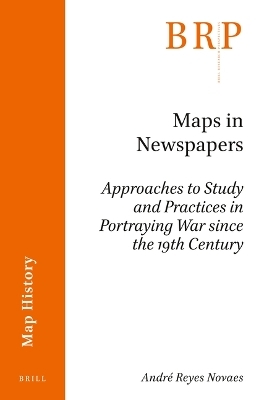
Maps in Newspapers
Approaches of Study and Practices in Portraying War since 19th Century
Seiten
2019
Brill (Verlag)
978-90-04-39882-5 (ISBN)
Brill (Verlag)
978-90-04-39882-5 (ISBN)
This work examines maps in newspapers considering three main questions, namely how maps in the press should be conceptualized, how cartographic images in newspapers have been studied, and how these images changed over time portraying geopolitical conflicts for Brazilian audiences.
Maps in newspapers generated many discussions among cartographers and geographers working from different approaches and theoretical backgrounds. This work examines these maps from a historiographical as well as a historical perspective. It considers three main questions, namely how maps in the press should be conceptualized, how cartographic images in newspapers have been studied, and how these images changed over time. In order to provide a perspective on the origins, development, and impact of war maps in the press, we will explore maps representing three geopolitical conflicts for Brazilian audiences: The War of the Triple Alliance (1864–1870), the World War II (1939–1945) and the War on Drugs in Rio de Janeiro’s favelas (1994–2010). By exploring maps on these wars, we will identify specific cartographic practices used in this genre as well as the connections that this mode has with other types of map production and consumption.
Maps in newspapers generated many discussions among cartographers and geographers working from different approaches and theoretical backgrounds. This work examines these maps from a historiographical as well as a historical perspective. It considers three main questions, namely how maps in the press should be conceptualized, how cartographic images in newspapers have been studied, and how these images changed over time. In order to provide a perspective on the origins, development, and impact of war maps in the press, we will explore maps representing three geopolitical conflicts for Brazilian audiences: The War of the Triple Alliance (1864–1870), the World War II (1939–1945) and the War on Drugs in Rio de Janeiro’s favelas (1994–2010). By exploring maps on these wars, we will identify specific cartographic practices used in this genre as well as the connections that this mode has with other types of map production and consumption.
André Reyes Novaes, Ph.D (2010), Rio de Janeiro Federal University, is Professor at State University of Rio de Janeiro. He is currently a member of the commission on the history of geography at the International Geographical Union.
| Erscheinungsdatum | 31.07.2019 |
|---|---|
| Reihe/Serie | Brill Research Perspectives in Map History |
| Verlagsort | Leiden |
| Sprache | englisch |
| Maße | 155 x 235 mm |
| Gewicht | 206 g |
| Themenwelt | Geisteswissenschaften ► Geschichte ► Hilfswissenschaften |
| Sozialwissenschaften ► Politik / Verwaltung ► Europäische / Internationale Politik | |
| ISBN-10 | 90-04-39882-1 / 9004398821 |
| ISBN-13 | 978-90-04-39882-5 / 9789004398825 |
| Zustand | Neuware |
| Informationen gemäß Produktsicherheitsverordnung (GPSR) | |
| Haben Sie eine Frage zum Produkt? |
Mehr entdecken
aus dem Bereich

aus dem Bereich
die Geburt der Grafiksammlung des Kunstmuseums Stuttgart im …
Buch | Hardcover (2024)
VDG Weimar - Verlag und Datenbank für Geisteswissenschaften
CHF 36,90
kulturelles Erbe und Identität in historischen und jüdischen Museen …
Buch | Hardcover (2025)
De Gruyter Oldenbourg (Verlag)
CHF 41,90
kartografische Wissenskulturen um 1448
Buch | Hardcover (2024)
De Gruyter (Verlag)
CHF 139,90


