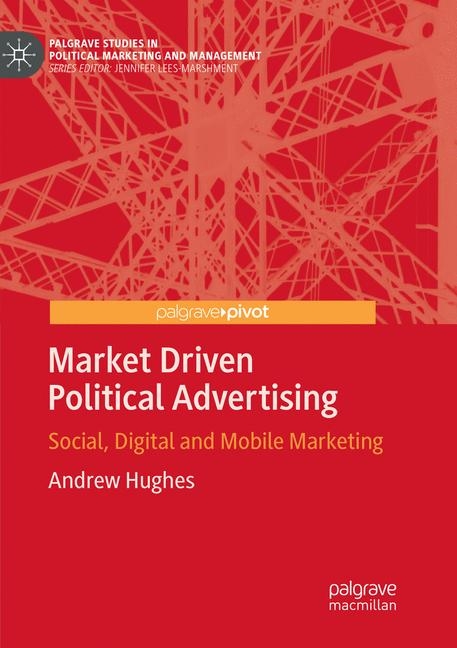
Market Driven Political Advertising
Springer International Publishing (Verlag)
978-3-030-08523-0 (ISBN)
- Titel ist leider vergriffen;
keine Neuauflage - Artikel merken
Andrew Hughes is a lecturer in Marketing at the Australian National University (ANU) in Canberra. His research examines the role of stakeholders in political marketing, political advertising, leader brands, and how consumers respond emotionally to different information types. His thesis was nominated for ANU's prestigious prize, the J.G. Crawford Award.
C hapter 1: Introduction
This chapter will introduce the reader to the overall outline of the book and the content to be covered. It will out
Each chapter will be discussed in brief and provide an overall road map for
the reader. Where necessary these outlines may provide some brief definitions that will help lay the foundation stones in the readers mind of the conceptual,
empirical and practitioner areas that will be covered by the book.
It will conclude by summarising the overall objective of the book and what value the reader should expect to have from it by the conclusion.
Outline:
Introduction
Chapter overview
Conclusion
C hapter 2: The Rebirth and Transformation of Political Advertising
This chapter starts with a very brief overview of political advertising and offers new definition of political advertising that incorporates the use of social media as a new delivery mechanism of the promise of the value exchange.
It will also discuss political exchange and the role< of advertising in communicating the value being offered in this exchange in an actor-to-actor stakeholder model (Hughes 2016), and why this model is relevant to explaining the use of the new methods of politica
It then briefly discusses the role of political advertising in a political branding and CRM context, and how advertising is being used more and more as part of a broader IMC strategy.
It then looks into the role that political system has on the use of political advertising, such as on effectiveness, design or strategies. It also briefly considers the electoral event, be it a referendum or an election.
Next it defines and discusses the different types of media into two categories: heritage or old, or modern or new. A brief discussion and examples of the different perspectives that are considered in political advertising is then provided as this can assist the reader in understanding how even subtle changes in context can alter how political advertising is perceived and evaluated.
Introduction & overview
Political advertising in Political marketing campaigns:
o Background
Use to communicate value offering
Political exchange
The Rise of Stakeholders in Political Advertising
Actor-to-actor stakeholder model (Hughes 2016)
Relationships and branding
o Political branding
o CRM
o Advertising's role in a Political IMC Campaign
Does the system matter?
o Compulsory v non-compulsory
o Voting systems
o Political systems - the sociology perspective
Heritage and New Media: Perspectives on political advertising
C hapter 3: The End of One Era, And the Start of a New
This chapter will start by examining some of the practitioner reasons and timeline in the change in political communication strategies<, such as social media, public relations, public affairs, media management, which have moved away from the older forms of political advertising.
Next it will discuss why, using the latest research findings that utilised psychophysiological methods, that television advertising can no longer be used as the primary means of communication with an audience. There will be an examination and discussion of these implications for practitioners in the context of recent and current campaigns.
Introduction
Is political advertising being replaced or merely displaced?
Why stick with political advertising?
o The role of each type of political advertising
o Previous research and practitioner use.
Is it time to stop political advertising?
o Current research findings using psychophysiological methods.
o Practitioner and recent campaigns contrast: US Presidential, Australia, Europe, and the new fear campaigns such as Brexit.
o Positive: Behaviour change or just smoke and mirrors? The effectiveness of positive messaging in political campaigns.
o Practitioner and recent campaigns contrast: US Presidential, Australia, Europe, and the new fear campaigns
| Erscheinungsdatum | 14.01.2019 |
|---|---|
| Reihe/Serie | Palgrave Studies in Political Marketing and Management |
| Zusatzinfo | XIII, 137 p. 3 illus. |
| Verlagsort | Cham |
| Sprache | englisch |
| Maße | 148 x 210 mm |
| Gewicht | 207 g |
| Themenwelt | Sozialwissenschaften ► Politik / Verwaltung |
| Wirtschaft ► Betriebswirtschaft / Management ► Marketing / Vertrieb | |
| Schlagworte | Brexit campaign • Digital Marketing • lobbyists • political advertising • pressure groups • Social Media • US Presidential Race |
| ISBN-10 | 3-030-08523-6 / 3030085236 |
| ISBN-13 | 978-3-030-08523-0 / 9783030085230 |
| Zustand | Neuware |
| Informationen gemäß Produktsicherheitsverordnung (GPSR) | |
| Haben Sie eine Frage zum Produkt? |
aus dem Bereich