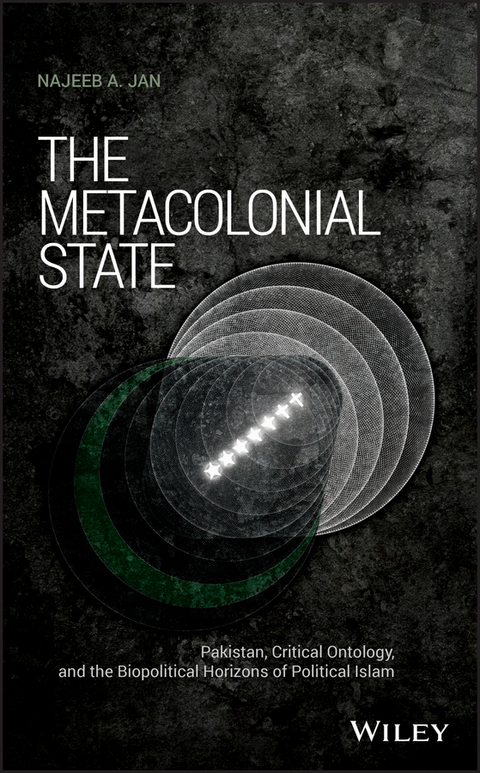
The Metacolonial State (eBook)
John Wiley & Sons (Verlag)
978-1-118-97939-6 (ISBN)
'An urgent and extraordinary book. Weaving a philosophical analysis of Heidegger, Agamben and Foucault, Jan draws out the implications of their thought for a radical analysis of the ontological politics of Islam and Pakistan. Whether writing about the 'Ulama and Deoband schools, blasphemy laws, the military, beards, or the Bamiyan Buddhas, Jan provokes and challenges our thinking while unearthing the ground on which Pakistan-and our world-are built.' -Joel Wainwright, Department of Geography, Ohio State University, USA
'In this exceptionally inventive and important book, Jan shows us that the problems besetting political life in Pakistan are part of a more troubling crisis in modern forms of power. Challenging accounts that cordon off 'political Islam' from 'the West,' Jan discloses their fundamental indistinction and thus, through his practice of critical ontology, reorients our understanding of how power and violence are at work in the world.' -Joshua Barkan, Department of Geography, University of Georgia, USA
The Metacolonial State presents a novel rethinking of the relationship between Islam and the Political. Key to the text is an original argument regarding the 'biopoliticization of Islam' and the imperative need for understanding sovereign power and the state of exception in resolutely ontological terms. Through the formulation of a critical ontology of political violence, The Metacolonial State endeavors to shed new light on the signatures of power undergirding postcolonial life, while situating Pakistan as a paradigmatic site for reflection on the nature of modernity's precarious present.
The cross-disciplinary approach of Dr. Jan's work is certain to have broad appeal among geographers, historians, anthropologists, postcolonial theorists, and political scientists, among others. At the same time, his explication of critical ontology - with its radical reading of the interlacement of history, power and the event - promises to add a bold new dimension to social science research on Islamism and biopolitics.
Najeeb A. Jan is Assistant Professor of Human Geography in the Department of Geography of the University of Colorado, Boulder, Colorado.
'An urgent and extraordinary book. Weaving a philosophical analysis of Heidegger, Agamben and Foucault, Jan draws out the implications of their thought for a radical analysis of the ontological politics of Islam and Pakistan. Whether writing about the 'Ulama and Deoband schools, blasphemy laws, the military, beards, or the Bamiyan Buddhas, Jan provokes and challenges our thinking while unearthing the ground on which Pakistan and our world are built.' Joel Wainwright, Department of Geography, Ohio State University, USA 'In this exceptionally inventive and important book, Jan shows us that the problems besetting political life in Pakistan are part of a more troubling crisis in modern forms of power. Challenging accounts that cordon off "e;political Islam"e; from "e;the West,"e; Jan discloses their fundamental indistinction and thus, through his practice of critical ontology, reorients our understanding of how power and violence are at work in the world.' Joshua Barkan, Department of Geography, University of Georgia, USA The Metacolonial State presents a novel rethinking of the relationship between Islam and the Political. Key to the text is an original argument regarding the "e;biopoliticization of Islam"e; and the imperative need for understanding sovereign power and the state of exception in resolutely ontological terms. Through the formulation of a critical ontology of political violence, The Metacolonial State endeavors to shed new light on the signatures of power undergirding postcolonial life, while situating Pakistan as a paradigmatic site for reflection on the nature of modernity's precarious present. The cross-disciplinary approach of Dr. Jan's work is certain to have broad appeal among geographers, historians, anthropologists, postcolonial theorists, and political scientists, among others. At the same time, his explication of critical ontology with its radical reading of the interlacement of history, power and the event promises to add a bold new dimension to social science research on Islamism and biopolitics.
Najeeb A. Jan is Assistant Professor of Human Geography in the Department of Geography of the University of Colorado, Boulder, Colorado.
Series Editor's Preface
Acknowledgement
Introduction Islamapolis: The Crisis of Islam and the Political in Pakistan
1. Critical Ontology: The Biopolitical Apparatus
2. The Space of Emergency: The Military, Discipline and Political Theology
3. The Space of Law: 'Ulama, Shari'a, and the Technology of Blasphemy
4. The Space of War: Homo Islamicus, Body Politics and Jihad
5. The Space of Exception: Nationalism and Biopolitical Sovereignty
Conclusion: The Metacolonial and The Space of Thinking
Appendix A
Appendix B
Glossary
References
'An urgent and extraordinary book. Weaving a philosophical analysis of Heidegger, Agamben and Foucault, Jan draws out the implications of their thought for a radical analysis of the ontological politics of Islam and Pakistan. Whether writing about the 'Ulama and Deoband schools, blasphemy laws, the military, beards, or the Bamiyan Buddhas, Jan provokes and challenges our thinking while unearthing the ground on which Pakistan--and our world--are built.'
Joel Wainwright, Department of Geography, Ohio State University, USA
'In this exceptionally inventive and important book, Jan shows us that the problems besetting political life in Pakistan are part of a more troubling crisis in modern forms of power. Challenging accounts that cordon off "political Islam" from "the West," Jan discloses their fundamental indistinction and thus, through his practice of critical ontology, reorients our understanding of how power and violence are at work in the world.'
Joshua Barkan, Department of Geography, University of Georgia, USA
| Erscheint lt. Verlag | 4.1.2019 |
|---|---|
| Reihe/Serie | Antipode Book Series | Antipode Book Series |
| Sprache | englisch |
| Themenwelt | Geisteswissenschaften ► Religion / Theologie ► Islam |
| Naturwissenschaften ► Geowissenschaften ► Geografie / Kartografie | |
| Sozialwissenschaften ► Politik / Verwaltung | |
| Sozialwissenschaften ► Soziologie ► Makrosoziologie | |
| Wirtschaft ► Volkswirtschaftslehre ► Wirtschaftspolitik | |
| Schlagworte | Agamben • biopoliticization of Islam • biopolitics of islamic society • critical ontology • critical ontology of global violence • critical ontology of islamic violence • critical ontology of postcolonialism • Economics • focauldian critique of postcolonial islam • foucauldian critique of islamic violence • Foucault • Geographie • Geographie der Globalisierung • Geography • Geography of Globalization • Heidegger • heideggerian analysis of political violence • Historical ontology • historical ontology of postcolonialism • Human geography • Islam • Islamic violence • islamic violence in pakistan • metacolonialism • ontology, violence, and power • political economics • Political Geography • Political Islam • Political ontology • Political violence • Politische Geographie • Politische Ökonomie • Postcolonial Islam • Postcolonialism • postcolonial theory • post-marxist theory • radical islam in pakistan • Religious violence • sociology of political violence • sociology of religious violence • violence, power, and political islam • Volkswirtschaftslehre • what is critical ontology |
| ISBN-10 | 1-118-97939-7 / 1118979397 |
| ISBN-13 | 978-1-118-97939-6 / 9781118979396 |
| Informationen gemäß Produktsicherheitsverordnung (GPSR) | |
| Haben Sie eine Frage zum Produkt? |
 PDF (Adobe DRM)
Kopierschutz: Adobe-DRM
Adobe-DRM ist ein Kopierschutz, der das eBook vor Mißbrauch schützen soll. Dabei wird das eBook bereits beim Download auf Ihre persönliche Adobe-ID autorisiert. Lesen können Sie das eBook dann nur auf den Geräten, welche ebenfalls auf Ihre Adobe-ID registriert sind.
Details zum Adobe-DRM
Dateiformat: PDF (Portable Document Format)
Mit einem festen Seitenlayout eignet sich die PDF besonders für Fachbücher mit Spalten, Tabellen und Abbildungen. Eine PDF kann auf fast allen Geräten angezeigt werden, ist aber für kleine Displays (Smartphone, eReader) nur eingeschränkt geeignet.
Systemvoraussetzungen:
PC/Mac: Mit einem PC oder Mac können Sie dieses eBook lesen. Sie benötigen eine
eReader: Dieses eBook kann mit (fast) allen eBook-Readern gelesen werden. Mit dem amazon-Kindle ist es aber nicht kompatibel.
Smartphone/Tablet: Egal ob Apple oder Android, dieses eBook können Sie lesen. Sie benötigen eine
Geräteliste und zusätzliche Hinweise
Buying eBooks from abroad
For tax law reasons we can sell eBooks just within Germany and Switzerland. Regrettably we cannot fulfill eBook-orders from other countries.
aus dem Bereich