


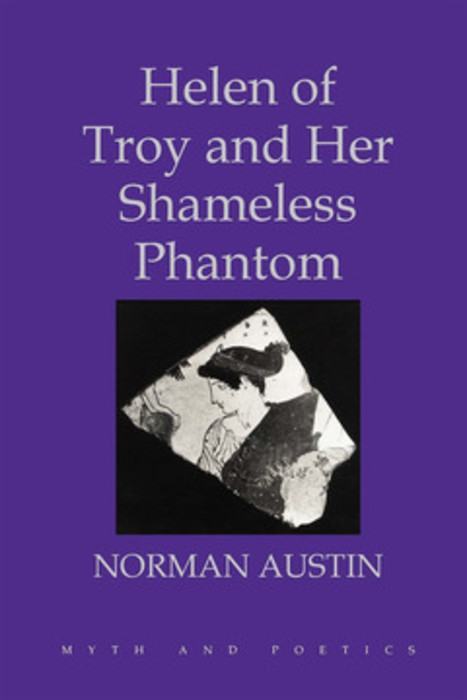
Helen of Troy and Her Shameless Phantom (eBook)
240 Seiten
Cornell University Press (Verlag)
978-1-5017-2070-3 (ISBN)
Like the male heroes of epic poetry, Helen of Troy has been immortalized, but not for deeds of strength and honor; she is remembered as the beautiful woman who disgraced herself and betrayed her family and state. Norman Austin here surveys interpretations of Helen in Greek literature from the Homeric period through later antiquity. He looks most closely at a revisionist myth according to which Helen never sailed to Troy, but remained blameless, while a libertine phantom or ghost impersonated her at Troy. Comparing the functions of contradictory images of Helen, Austin helps to clarify the problematic relations between beauty and honor and between ugliness and shame in ancient Greece.
Austin first discusses the canonical account of the Iliad and the Odyssey: Helen as the archetype of woman without shame. He next considers different versions of Helen in the Homeric tradition. Among these, he shows how Sappho presents Helen as an icon of absolute beauty while she defends her own preference of eros over honor and her choice of woman as the object of desire. Austin then turns to three major authors who repudiated the traditional Helen of Troy: the lyric poet Stesichorus and the dramatist Euripides, who embraced the alternative myth of Helen's phantom; and the historian Herodotus, who claimed to have found in Egypt a Helen story that dispenses with both Helen and the phantom. Austin maintains that the conflicting motives that prompted these writers to rehabilitate Helen led to further revisions of her image, though none have endured as a credible substitute for the Helen of epic tradition.
AustinNorman:
Norman Austin is Professor Emeritus of Classics at the University of Arizona.
Like the male heroes of epic poetry, Helen of Troy has been immortalized, but not for deeds of strength and honor; she is remembered as the beautiful woman who disgraced herself and betrayed her family and state. Norman Austin here surveys interpretations of Helen in Greek literature from the Homeric period through later antiquity. He looks most closely at a revisionist myth according to which Helen never sailed to Troy, but remained blameless, while a libertine phantom or ghost impersonated her at Troy. Comparing the functions of contradictory images of Helen, Austin helps to clarify the problematic relations between beauty and honor and between ugliness and shame in ancient Greece. Austin first discusses the canonical account of the Iliad and the Odyssey: Helen as the archetype of woman without shame. He next considers different versions of Helen in the Homeric tradition. Among these, he shows how Sappho presents Helen as an icon of absolute beauty while she defends her own preference of eros over honor and her choice of woman as the object of desire. Austin then turns to three major authors who repudiated the traditional Helen of Troy: the lyric poet Stesichorus and the dramatist Euripides, who embraced the alternative myth of Helen's phantom; and the historian Herodotus, who claimed to have found in Egypt a Helen story that dispenses with both Helen and the phantom. Austin maintains that the conflicting motives that prompted these writers to rehabilitate Helen led to further revisions of her image, though none have endured as a credible substitute for the Helen of epic tradition.
| Erscheint lt. Verlag | 5.9.2018 |
|---|---|
| Sprache | englisch |
| Themenwelt | Literatur ► Essays / Feuilleton |
| Geisteswissenschaften ► Sprach- / Literaturwissenschaft ► Anglistik / Amerikanistik | |
| Geisteswissenschaften ► Sprach- / Literaturwissenschaft ► Literaturwissenschaft | |
| Sozialwissenschaften ► Soziologie | |
| ISBN-10 | 1-5017-2070-8 / 1501720708 |
| ISBN-13 | 978-1-5017-2070-3 / 9781501720703 |
| Informationen gemäß Produktsicherheitsverordnung (GPSR) | |
| Haben Sie eine Frage zum Produkt? |
 PDF (Adobe DRM)
Kopierschutz: Adobe-DRM
Adobe-DRM ist ein Kopierschutz, der das eBook vor Mißbrauch schützen soll. Dabei wird das eBook bereits beim Download auf Ihre persönliche Adobe-ID autorisiert. Lesen können Sie das eBook dann nur auf den Geräten, welche ebenfalls auf Ihre Adobe-ID registriert sind.
Details zum Adobe-DRM
Dateiformat: PDF (Portable Document Format)
Mit einem festen Seitenlayout eignet sich die PDF besonders für Fachbücher mit Spalten, Tabellen und Abbildungen. Eine PDF kann auf fast allen Geräten angezeigt werden, ist aber für kleine Displays (Smartphone, eReader) nur eingeschränkt geeignet.
Systemvoraussetzungen:
PC/Mac: Mit einem PC oder Mac können Sie dieses eBook lesen. Sie benötigen eine
eReader: Dieses eBook kann mit (fast) allen eBook-Readern gelesen werden. Mit dem amazon-Kindle ist es aber nicht kompatibel.
Smartphone/Tablet: Egal ob Apple oder Android, dieses eBook können Sie lesen. Sie benötigen eine
Geräteliste und zusätzliche Hinweise
Buying eBooks from abroad
For tax law reasons we can sell eBooks just within Germany and Switzerland. Regrettably we cannot fulfill eBook-orders from other countries.
aus dem Bereich


