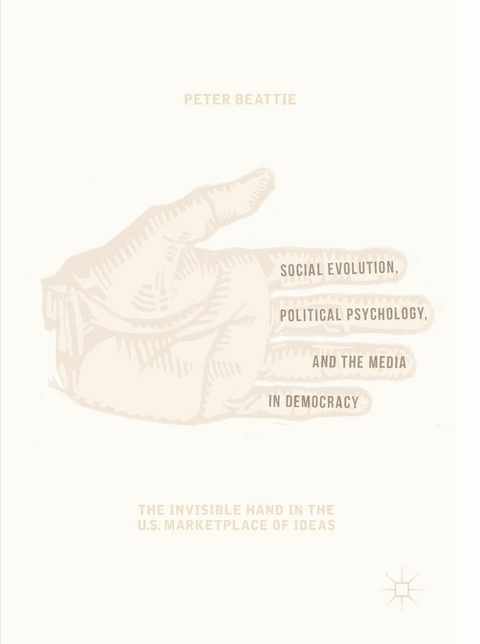
Social Evolution, Political Psychology, and the Media in Democracy (eBook)
X, 363 Seiten
Springer International Publishing (Verlag)
978-3-030-02801-5 (ISBN)

This book analyzes why we believe what we believe about politics, and how the answer affects the way democracy functions. It does so by applying social evolution theory to the relationship between the news media and politics, using the United States as its primary example. This includes a critical review and integration of the insights of a broad array of research, from evolutionary theory and political psychology to the political economy of media. The result is an empirically driven political theory on the media's role in democracy: what role it currently plays, what role it should play, and how it can be reshaped to be more appropriate for its structural role in democracy.
Peter Beattie is Assistant Professor and Assistant Programme Director of the MSSc in Global Political Economy at The Chinese University of Hong Kong, China, where he teaches political economy and political psychology. His published work has focused on the role of ideas in politics, and his research has been presented at conferences in Asia, Europe, South America, and the United States.
Peter Beattie is Assistant Professor and Assistant Programme Director of the MSSc in Global Political Economy at The Chinese University of Hong Kong, China, where he teaches political economy and political psychology. His published work has focused on the role of ideas in politics, and his research has been presented at conferences in Asia, Europe, South America, and the United States.
1. Introduction: Why Democracy Is Not Working.- 2. Information – Evolution, Psychology, and Politics.- 3. Evolution – How We Got the Minds We Have Today.- 4. When Our Evolved Minds Go Wrong – Social Psychological Biases.- 5. The Transition – Information from Media to Mind.- 6. The Supply Side – What Affects the Supply of Information Provided by the Media.- 7. Comparing Media Systems – What a Difference Supply Makes.- 8. Conclusion: The Invisible Hand and the Ecology of Information.
| Erscheint lt. Verlag | 13.12.2018 |
|---|---|
| Zusatzinfo | X, 363 p. 1 illus. |
| Verlagsort | Cham |
| Sprache | englisch |
| Themenwelt | Sozialwissenschaften ► Politik / Verwaltung ► Politische Theorie |
| Schlagworte | Democracy • democratic theory • empirical political theory • Political Cognition • Political Psychology • politics and media • Social/Cultural Evolution |
| ISBN-10 | 3-030-02801-1 / 3030028011 |
| ISBN-13 | 978-3-030-02801-5 / 9783030028015 |
| Informationen gemäß Produktsicherheitsverordnung (GPSR) | |
| Haben Sie eine Frage zum Produkt? |
 PDF (Wasserzeichen)
DRM: Digitales Wasserzeichen
Dieses eBook enthält ein digitales Wasserzeichen und ist damit für Sie personalisiert. Bei einer missbräuchlichen Weitergabe des eBooks an Dritte ist eine Rückverfolgung an die Quelle möglich.
Dateiformat: PDF (Portable Document Format)
Mit einem festen Seitenlayout eignet sich die PDF besonders für Fachbücher mit Spalten, Tabellen und Abbildungen. Eine PDF kann auf fast allen Geräten angezeigt werden, ist aber für kleine Displays (Smartphone, eReader) nur eingeschränkt geeignet.
Systemvoraussetzungen:
PC/Mac: Mit einem PC oder Mac können Sie dieses eBook lesen. Sie benötigen dafür einen PDF-Viewer - z.B. den Adobe Reader oder Adobe Digital Editions.
eReader: Dieses eBook kann mit (fast) allen eBook-Readern gelesen werden. Mit dem amazon-Kindle ist es aber nicht kompatibel.
Smartphone/Tablet: Egal ob Apple oder Android, dieses eBook können Sie lesen. Sie benötigen dafür einen PDF-Viewer - z.B. die kostenlose Adobe Digital Editions-App.
Buying eBooks from abroad
For tax law reasons we can sell eBooks just within Germany and Switzerland. Regrettably we cannot fulfill eBook-orders from other countries.
aus dem Bereich