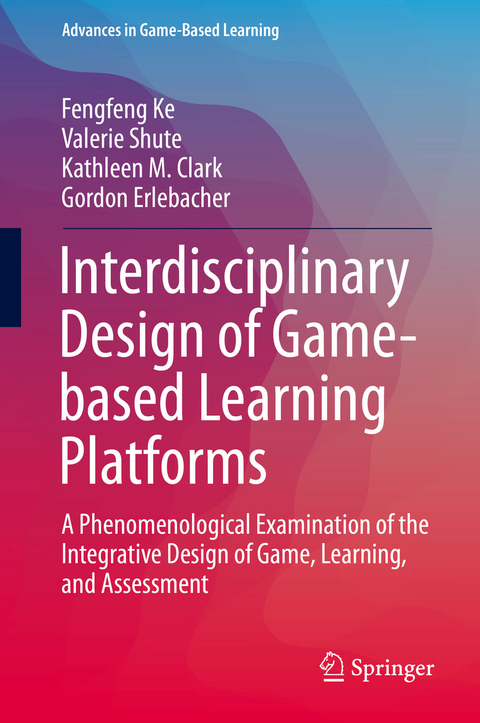
Interdisciplinary Design of Game-based Learning Platforms (eBook)
VII, 156 Seiten
Springer International Publishing (Verlag)
978-3-030-04339-1 (ISBN)
This book represents a four-year research and development project. It presents a phenomenological examination and explanation of a functional design framework for games in education. It furnishes a rich description of the experiences and perceptions of performing interdisciplinary collaborative design among experts of very diverse fields, such as learning systems design, architectural design, assessment design, mathematics education, and scientific computing.
Fenfeng Ke is an Associate Professor of the Educational Psychology and Learning Systems for Florida State University. Her current research focuses on game-based learning, immersive learning, computer supported collaborative learning, and inclusive design of e-learning. She earned her Ph.D. in Instructional Systems from Pennsylvania State University in 2006.
Valerie Shute is the Mack and Effie Campbell Tyner endowed professor of education at Florida State University. Before coming to FSU in 2007, she was a principal research scientist at Educational Testing Service (2001-2007) where she was involved with basic and applied research projects related to assessment, cognitive diagnosis, and learning from advanced instructional systems and where she generally honed her psychometric skills. Prior to ETS, she worked in industry for two years, and before that, she was employed at the Air Force Research Lab in San Antonio, Texas (1986-1999). She earned a Ph.D. in cognitive/educational psychology from the University of California, Santa Barbara (1984), and held a two-year postdoctoral fellowship at the Learning Research and Development Center.
Kathleen M. Clark is an Associate Professor in the School of Teacher Education at Florida State University. Her research focuses on the ways in which prospective and in-service mathematics teachers use history of mathematics in teaching, the ways in which the study of history of mathematics informs teachers' mathematical knowledge for teaching, and the impact of primary historical sources in undergraduate mathematics education. Dr. Clark earned her Ph.D. in Curriculum and Instruction, with a specialization in Mathematics Education, from the University of Maryland, College Park in 2006. Prior to her doctoral work, she taught high school mathematics in a variety of contexts (1987-2001) and spent one year on Capitol Hill as an Albert Einstein Distinguished Educator Fellow (2001-2002).
Gordon Erlebacher is currently Professor and Chair in the Department of Scientific Computing at Florida State University. His current research revolves around deep learning and its uses in both supervised and unsupervised contexts. Prior to joining FSU in 1996 to become part of the newly created School of Computational Science, he spent 13 years at NASA Langley Research Center and at the Institute for Computer Applications in Science and Engineering working in the fields of visualization, and flow simulations. He earned his Ph.D. in Plasma Physics at Columbia University in 1983.
Fenfeng Ke is an Associate Professor of the Educational Psychology and Learning Systems for Florida State University. Her current research focuses on game-based learning, immersive learning, computer supported collaborative learning, and inclusive design of e-learning. She earned her Ph.D. in Instructional Systems from Pennsylvania State University in 2006. Valerie Shute is the Mack and Effie Campbell Tyner endowed professor of education at Florida State University. Before coming to FSU in 2007, she was a principal research scientist at Educational Testing Service (2001-2007) where she was involved with basic and applied research projects related to assessment, cognitive diagnosis, and learning from advanced instructional systems and where she generally honed her psychometric skills. Prior to ETS, she worked in industry for two years, and before that, she was employed at the Air Force Research Lab in San Antonio, Texas (1986-1999). She earned a Ph.D. in cognitive/educational psychology from the University of California, Santa Barbara (1984), and held a two-year postdoctoral fellowship at the Learning Research and Development Center. Kathleen M. Clark is an Associate Professor in the School of Teacher Education at Florida State University. Her research focuses on the ways in which prospective and in-service mathematics teachers use history of mathematics in teaching, the ways in which the study of history of mathematics informs teachers’ mathematical knowledge for teaching, and the impact of primary historical sources in undergraduate mathematics education. Dr. Clark earned her Ph.D. in Curriculum and Instruction, with a specialization in Mathematics Education, from the University of Maryland, College Park in 2006. Prior to her doctoral work, she taught high school mathematics in a variety of contexts (1987-2001) and spent one year on Capitol Hill as an Albert Einstein Distinguished Educator Fellow (2001-2002). Gordon Erlebacher is currently Professor and Chair in the Department of Scientific Computing at Florida State University. His current research revolves around deep learning and its uses in both supervised and unsupervised contexts. Prior to joining FSU in 1996 to become part of the newly created School of Computational Science, he spent 13 years at NASA Langley Research Center and at the Institute for Computer Applications in Science and Engineering working in the fields of visualization, and flow simulations. He earned his Ph.D. in Plasma Physics at Columbia University in 1983.
Chapter 1. Introduction and Prior Research Review.- Chapter 2. Chronicle of Designing a Game-based Learning Platform.- Chapter 3. Interdisciplinary Design Activities and Patterns-.Chapter 4. Design of Gameplay for Learning.- Chapter 5.Interweaving Task Design and In-Game Measurement.- Chapter 6. Designing Dynamic Support for Game-based Learning.- Chapter 7.An Evolving Design Framework for Game-based Learning Platforms.
| Erscheint lt. Verlag | 7.12.2018 |
|---|---|
| Reihe/Serie | Advances in Game-Based Learning | Advances in Game-Based Learning |
| Zusatzinfo | VII, 156 p. 66 illus., 60 illus. in color. |
| Verlagsort | Cham |
| Sprache | englisch |
| Themenwelt | Sozialwissenschaften ► Pädagogik ► Schulpädagogik / Grundschule |
| Schlagworte | Design communication • Game-based Learning • Game Design • Interdisciplinary design • Phenomenology • Scientific Computing |
| ISBN-10 | 3-030-04339-8 / 3030043398 |
| ISBN-13 | 978-3-030-04339-1 / 9783030043391 |
| Informationen gemäß Produktsicherheitsverordnung (GPSR) | |
| Haben Sie eine Frage zum Produkt? |
 PDF (Wasserzeichen)
DRM: Digitales Wasserzeichen
Dieses eBook enthält ein digitales Wasserzeichen und ist damit für Sie personalisiert. Bei einer missbräuchlichen Weitergabe des eBooks an Dritte ist eine Rückverfolgung an die Quelle möglich.
Dateiformat: PDF (Portable Document Format)
Mit einem festen Seitenlayout eignet sich die PDF besonders für Fachbücher mit Spalten, Tabellen und Abbildungen. Eine PDF kann auf fast allen Geräten angezeigt werden, ist aber für kleine Displays (Smartphone, eReader) nur eingeschränkt geeignet.
Systemvoraussetzungen:
PC/Mac: Mit einem PC oder Mac können Sie dieses eBook lesen. Sie benötigen dafür einen PDF-Viewer - z.B. den Adobe Reader oder Adobe Digital Editions.
eReader: Dieses eBook kann mit (fast) allen eBook-Readern gelesen werden. Mit dem amazon-Kindle ist es aber nicht kompatibel.
Smartphone/Tablet: Egal ob Apple oder Android, dieses eBook können Sie lesen. Sie benötigen dafür einen PDF-Viewer - z.B. die kostenlose Adobe Digital Editions-App.
Buying eBooks from abroad
For tax law reasons we can sell eBooks just within Germany and Switzerland. Regrettably we cannot fulfill eBook-orders from other countries.
aus dem Bereich