Contested World Orders
Oxford University Press (Verlag)
978-0-19-884304-7 (ISBN)
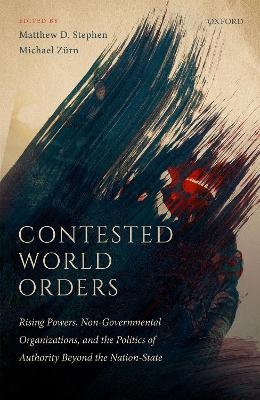
World orders are increasingly contested. As international institutions have taken on ever more ambitious tasks, they have been challenged by rising powers dissatisfied with existing institutional inequalities, by non-governmental organizations worried about the direction of global governance, and even by some established powers no longer content to lead the institutions they themselves created. For the first time, this volume examines these sources of contestation under a common and systematic institutionalist framework. While the authority of institutions has deepened, at the same time it has fuelled contestation and resistance.
In a series of rigorous and empirically revealing chapters, the authors of Contested World Orders examine systematically the demands of key actors in the contestation of international institutions. Ranging in scope from the World Trade Organization and the Nuclear Non-proliferation Regime to the Kimberley Process on conflict diamonds and the climate finance provisions of the UNFCCC, the chapters deploy a variety of methods to reveal just to what extent, and along which lines of conflict, rising powers and NGOs contest international institutions. Contested World Orders seeks answers to the key questions of our time: Exactly how deeply are international institutions contested? Which actors seek the most fundamental changes? Which aspects of international institutions have generated the most transnational conflicts? And what does this mean for the future of world order?
Matthew D. Stephen is Senior Research Fellow at the WZB Berlin Social Science Center. From 2018 to 2019, he was Interim Professor for Political Science at the Helmut Schmidt University/University of the Federal Armed Forces, Hamburg and Senior Research Fellow at the GIGA German Institute for Global and Area Studies, Hamburg. He also lectures part time at the Stanford University Berlin Program. His research concentrates on international power shifts and international institutions. Michael Zürn is Director at the WZB Berlin Social Science Center, and Professor of International Relations at the Freie Universität Berlin. He is a member of the Berlin-Brandenburg Academy of Sciences as well of the European Academy and was the founding rector of the Hertie School of Governance. His research examines governance beyond the nation state, and the legitimacy and authority of global governance institutions. He has - among other themes - most extensively written on the emergence and functioning of inter- and supranational institutions, as well as on the normative tensions and political conflicts that these developments unfold.
List of figures
List of tables
List of contributors
1: Matthew D. Stephen and Michael Zürn: Rising Powers, NGOs and Demands for New World Orders: An Introduction
Part 1 - World Economic Orders
2: Matthew D. Stephen: Contestation Overshoot: Rising Powers, NGOs and the Failure of the WTO Doha Round,
3: Alexandros Tokhi: The Contestation of the IMF
4: Dirk Peters: Exclusive Club Under Stress: The G7 between Rising Powers and Non-state Actors after the Cold War
Part 2 - World Security Orders
5: Anja Jetschke and Pascal Abb: The Devil is in the Detail: The Positions of the BRICS Countries towards UN Security Council Reform and the Responsibility to Protect
6: Harald Müller and Alexandros Tokhi: The Contestation of the Nuclear Nonproliferation Regime
Part 3 - Human Rights and Environment
7: Martin Binder and Sophie Eisentraut: Negotiating the UN Human Rights Council: Rising powers, established powers and NGOs
8: Miriam Prys-Hansen, Kristina Hahn, Malte Lellmann, and Milan Röseler: Contestation in the UNFCCC: The Case of Climate Finance
Part 4 - Cross-Cutting Cases
9: Melanie Coni-Zimmer, Annegret Flohr, and Klaus Dieter Wolf: Transnational Private Authority and Its Contestation
10: Martin Binder and Autumn Lockwood Payton: Cleavages in World Politics. Analysing Rising Power Voting Behaviour in the UN General Assembly
11: Michael Zürn, Klaus Dieter Wolf, and Matthew D. Stephen: Conclusion: Contested World Orders-Continuity or Change?
Index
| Erscheinungsdatum | 31.08.2019 |
|---|---|
| Verlagsort | Oxford |
| Sprache | englisch |
| Maße | 160 x 241 mm |
| Gewicht | 762 g |
| Themenwelt | Sozialwissenschaften ► Politik / Verwaltung ► Europäische / Internationale Politik |
| Sozialwissenschaften ► Politik / Verwaltung ► Politische Theorie | |
| ISBN-10 | 0-19-884304-6 / 0198843046 |
| ISBN-13 | 978-0-19-884304-7 / 9780198843047 |
| Zustand | Neuware |
| Informationen gemäß Produktsicherheitsverordnung (GPSR) | |
| Haben Sie eine Frage zum Produkt? |
aus dem Bereich