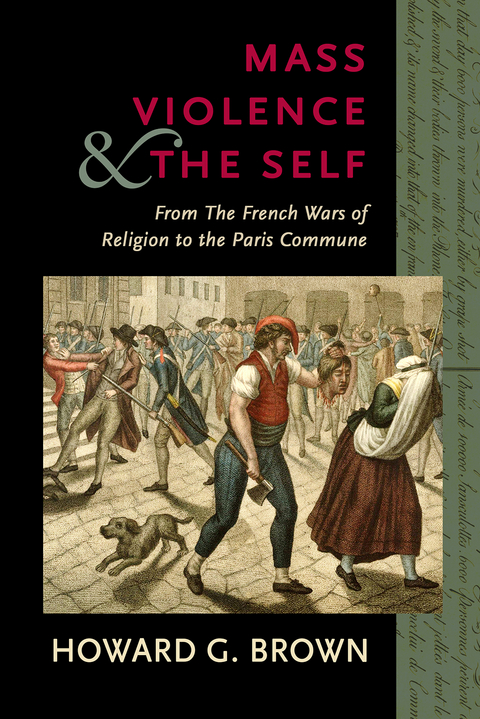
Mass Violence and the Self (eBook)
296 Seiten
Cornell University Press (Verlag)
978-1-5017-3072-6 (ISBN)
Mass Violence and the Self explores the earliest visual and textual depictions of personal suffering caused by the French Wars of Religion of 1562–98, the Fronde of 1648–52, the French Revolutionary Terror of 1793–94, and the Paris Commune of 1871.
Mass Violence and the Self explores the earliest visual and textual depictions of personal suffering caused by the French Wars of Religion of 1562–98, the Fronde of 1648–52, the French Revolutionary Terror of 1793–94, and the Paris Commune of 1871. The development of novel media from pamphlets and woodblock printing to colored lithographs, illustrated newspapers, and collodion photography helped to determine cultural, emotional, and psychological responses to these four episodes of mass violence.
Howard G. Brown's richly illustrated and conceptually innovative book shows how the increasingly effective communication of the suffering of others combined with interpretive bias to produce what may be understood as collective traumas. Seeing these responses as collective traumas reveals their significance in shaping new social identities that extended beyond the village or neighborhood. Moreover, acquiring a sense of shared identity, whether as Huguenots, Parisian bourgeois, French citizens, or urban proletarians, was less the cause of violent conflict than the consequence of it. Combining neuroscience, art history, and biography studies, Brown explores how collective trauma fostered a growing salience of the self as the key to personal identity. In particular, feeling empathy and compassion in response to depictions of others' emotional suffering intensified imaginative self-reflection. Protestant martyrologies, revolutionary "autodefenses," and personal diaries are examined in the light of cultural trends such as the interiorization of piety, the culture of sensibility, and the birth of urban modernism to reveal how representations of mass violence helped to shape the psychological processes of the self.
Mass Violence and the Self explores the earliest visual and textual depictions of personal suffering caused by the French Wars of Religion of 1562–98, the Fronde of 1648–52, the French Revolutionary Terror of 1793–94, and the Paris Commune of 1871. The development of novel media from pamphlets and woodblock printing to colored lithographs, illustrated newspapers, and collodion photography helped to determine cultural, emotional, and psychological responses to these four episodes of mass violence.
Howard G. Brown's richly illustrated and conceptually innovative book shows how the increasingly effective communication of the suffering of others combined with interpretive bias to produce what may be understood as collective traumas. Seeing these responses as collective traumas reveals their significance in shaping new social identities that extended beyond the village or neighborhood. Moreover, acquiring a sense of shared identity, whether as Huguenots, Parisian bourgeois, French citizens, or urban proletarians, was less the cause of violent conflict than the consequence of it. Combining neuroscience, art history, and biography studies, Brown explores how collective trauma fostered a growing salience of the self as the key to personal identity. In particular, feeling empathy and compassion in response to depictions of others' emotional suffering intensified imaginative self-reflection. Protestant martyrologies, revolutionary "autodefenses," and personal diaries are examined in the light of cultural trends such as the interiorization of piety, the culture of sensibility, and the birth of urban modernism to reveal how representations of mass violence helped to shape the psychological processes of the self.
Howard G. Brown is Professor of History at Binghamton University, State University of New York. He is the author of a number of books, including Ending the French Revolution: Violence, Justice and Repression from the Terror to Napoleon, winner of the American Historical Association’s 2006 Leo Gershoy Award.
List of Illustrations
Acknowledgments
Introduction: A Discourse on Method
1. Massacres in the French Wars of Religion
2. The Fronde and the Crisis of 1652
3. The Thermidorians' Terror
4. The Paris Commune and the "Bloody Week" of 1871
Conclusion
Notes
Index
| Erscheint lt. Verlag | 15.1.2019 |
|---|---|
| Zusatzinfo | 20 b&w halftones, 29 color halftones |
| Verlagsort | Ithaca |
| Sprache | englisch |
| Maße | 150 x 150 mm |
| Themenwelt | Kunst / Musik / Theater ► Kunstgeschichte / Kunststile |
| Geisteswissenschaften ► Geschichte ► Regional- / Ländergeschichte | |
| Geschichte ► Teilgebiete der Geschichte ► Kulturgeschichte | |
| Sozialwissenschaften ► Soziologie | |
| Schlagworte | Violence, self, France, trauma, massacre, history of the self, history of emtions, collective trauma |
| ISBN-10 | 1-5017-3072-X / 150173072X |
| ISBN-13 | 978-1-5017-3072-6 / 9781501730726 |
| Informationen gemäß Produktsicherheitsverordnung (GPSR) | |
| Haben Sie eine Frage zum Produkt? |
 EPUB (Adobe DRM)
Kopierschutz: Adobe-DRM
Adobe-DRM ist ein Kopierschutz, der das eBook vor Mißbrauch schützen soll. Dabei wird das eBook bereits beim Download auf Ihre persönliche Adobe-ID autorisiert. Lesen können Sie das eBook dann nur auf den Geräten, welche ebenfalls auf Ihre Adobe-ID registriert sind.
Details zum Adobe-DRM
Dateiformat: EPUB (Electronic Publication)
EPUB ist ein offener Standard für eBooks und eignet sich besonders zur Darstellung von Belletristik und Sachbüchern. Der Fließtext wird dynamisch an die Display- und Schriftgröße angepasst. Auch für mobile Lesegeräte ist EPUB daher gut geeignet.
Systemvoraussetzungen:
PC/Mac: Mit einem PC oder Mac können Sie dieses eBook lesen. Sie benötigen eine
eReader: Dieses eBook kann mit (fast) allen eBook-Readern gelesen werden. Mit dem amazon-Kindle ist es aber nicht kompatibel.
Smartphone/Tablet: Egal ob Apple oder Android, dieses eBook können Sie lesen. Sie benötigen eine
Geräteliste und zusätzliche Hinweise
Buying eBooks from abroad
For tax law reasons we can sell eBooks just within Germany and Switzerland. Regrettably we cannot fulfill eBook-orders from other countries.
aus dem Bereich