


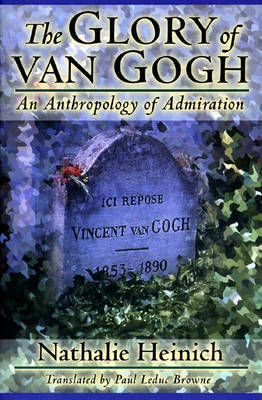
The Glory of van Gogh
An Anthropology of Admiration
Seiten
1996
Princeton University Press (Verlag)
978-0-691-03269-6 (ISBN)
Princeton University Press (Verlag)
978-0-691-03269-6 (ISBN)
- Titel ist leider vergriffen;
keine Neuauflage - Artikel merken
This work examines the invention of the great artist as a suffering visionary, seeing its roots in the "canonization" of Vincent van Gogh. It discusses efforts to celebrate van Gogh, aiming to show that his life has been reconstructed according to the patterns of a Christian saint's life.
The image of the great artist as a suffering visionary is a recent invention, observes sociologist Nathalie Heinich - an invention rooted in the "canonisation" of Vincent van Gogh as a cultural hero for the twentieth century. Heinich explores how and why the impoverished and mentally tormented van Gogh came to be glorified shortly after his suicide at the age of 37. Did the secular art world need a rebel-saint of its own? In considering this possibility, the author explores the history of efforts to celebrate van Gogh, whether in biographies or on T-shirts, showing how the details of his life have been constructed according to the pattern of a Christian saint's rise to recognition. These biographical details circulated first as anacdotes, then as historical truths, and finally became legendary motifs defining individual greatness. At the time of van Gogh's death, early modernists hailed the work of this young self-taught painter as that of a reforming prophet. Public interest stirred when the unique and tragic aspect of the artist's personal life came to light.
In these stories, the figure of van Gogh oscillated between godlike asceticism (he lived on very little, did not get married, did not eat much, and devoted his life to his work) and demonic frenzy (he drank, went to brothels, and offered a piece of his own flesh, his severed ear, to a prostitute). His legend became one of victim and sacrificer, of an accursed artist who gave the world great paintings but paid the heavy price of society's ignorance. Heinich organises her book around the stages that characterise the life of a saint - deviation, renewal, reconciliation, and pilgrimage, the latter culminating in visits to van Gogh's burial site and the competition to buy his paintings or "relics. Heinich explores the economics of the art market and the themes that make up the van Gogh myth, such as the person-alisation of artistic grandeur, the celebration of the inte-riority of the creator, and the glorification of abnormality. By examining the mythology that helps drive artistic investment, she forces us to reconsider the nature of admiration and particularly the notion that obscurity during an artist's lifetime is a guarantee of true genius.
The image of the great artist as a suffering visionary is a recent invention, observes sociologist Nathalie Heinich - an invention rooted in the "canonisation" of Vincent van Gogh as a cultural hero for the twentieth century. Heinich explores how and why the impoverished and mentally tormented van Gogh came to be glorified shortly after his suicide at the age of 37. Did the secular art world need a rebel-saint of its own? In considering this possibility, the author explores the history of efforts to celebrate van Gogh, whether in biographies or on T-shirts, showing how the details of his life have been constructed according to the pattern of a Christian saint's rise to recognition. These biographical details circulated first as anacdotes, then as historical truths, and finally became legendary motifs defining individual greatness. At the time of van Gogh's death, early modernists hailed the work of this young self-taught painter as that of a reforming prophet. Public interest stirred when the unique and tragic aspect of the artist's personal life came to light.
In these stories, the figure of van Gogh oscillated between godlike asceticism (he lived on very little, did not get married, did not eat much, and devoted his life to his work) and demonic frenzy (he drank, went to brothels, and offered a piece of his own flesh, his severed ear, to a prostitute). His legend became one of victim and sacrificer, of an accursed artist who gave the world great paintings but paid the heavy price of society's ignorance. Heinich organises her book around the stages that characterise the life of a saint - deviation, renewal, reconciliation, and pilgrimage, the latter culminating in visits to van Gogh's burial site and the competition to buy his paintings or "relics. Heinich explores the economics of the art market and the themes that make up the van Gogh myth, such as the person-alisation of artistic grandeur, the celebration of the inte-riority of the creator, and the glorification of abnormality. By examining the mythology that helps drive artistic investment, she forces us to reconsider the nature of admiration and particularly the notion that obscurity during an artist's lifetime is a guarantee of true genius.
Nathalie Heinich is a sociologist at the Centre National de la Recherche Scientifique in Paris.
| Übersetzer | Paul Leduc Browne |
|---|---|
| Zusatzinfo | 3 tables |
| Verlagsort | New Jersey |
| Sprache | englisch |
| Maße | 197 x 254 mm |
| Gewicht | 539 g |
| Themenwelt | Kunst / Musik / Theater ► Kunstgeschichte / Kunststile |
| Kunst / Musik / Theater ► Malerei / Plastik | |
| Sozialwissenschaften ► Soziologie | |
| ISBN-10 | 0-691-03269-6 / 0691032696 |
| ISBN-13 | 978-0-691-03269-6 / 9780691032696 |
| Zustand | Neuware |
| Informationen gemäß Produktsicherheitsverordnung (GPSR) | |
| Haben Sie eine Frage zum Produkt? |
Mehr entdecken
aus dem Bereich


aus dem Bereich
kleine Kulturgeschichte einer brillanten Allianz
Buch | Softcover (2025)
Iudicium (Verlag)
CHF 33,90


