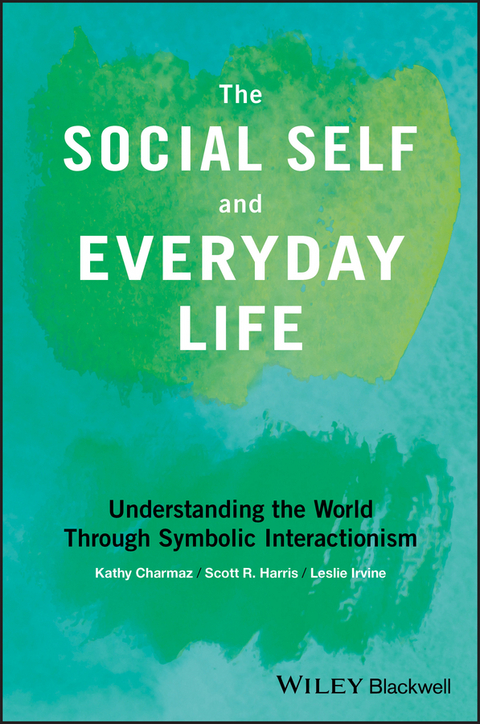
The Social Self and Everyday Life (eBook)
John Wiley & Sons (Verlag)
978-1-118-64540-6 (ISBN)
An engaging text that enables readers to understand the world through symbolic interactionism
This lively and accessible book offers an introduction to sociological social psychology through the lens of symbolic interactionism. It provides students with an accessible understanding of this perspective to illuminate their worlds and deepen their knowledge of other people's lives, as well as their own. Written by noted experts in the field, the book explores the core concepts of social psychology and examines a collection of captivating empirical studies. The book also highlights everyday life-putting the focus on the issues and concerns that are most relevant to the readers' social context.
The Social Self and Everyday Life bridges classical theories and contemporary ideas, joins abstract concepts with concrete examples, and integrates theory with empirical evidence. It covers a range of topics including the body, emotions, health and illness, the family, technology, and inequality. Best of all, it gets students involved in applying concepts in their daily lives.
- Demonstrates how to use students' social worlds, experiences, and concerns to illustrate key interactionist concepts in a way that they can emulate
- Develops key concepts such as meaning, self, and identity throughout the text to further students' understanding and ability to use them
- Introduces students to symbolic interactionism, a major theoretical and research tradition within sociology
- Helps to involve students in familiar experiences and issues and shows how a symbolic interactionist perspective illuminates them
- Combines the best features of authoritative summaries, clear definitions of key terms, with enticing empirical excerpts and attention to popular ideas
Clear and inviting in its presentation, The Social Self and Everyday Life: Understanding the World Through Symbolic Interactionism is an excellent book for undergraduate students in sociology, social psychology, and social interaction.
Kathy Charmaz, is Emerita Professor of Sociology at Sonoma State University, USA, and a consultant providing professional development workshops on qualitative methods, symbolic interactionism, and academic writing globally. She has written, co-authored, or co-edited 14 books including two award-winning books, Good Days, Bad Days: The Self in Illness and Time (1991), and Constructing Grounded Theory (2006, 2014).
Scott R. Harris, is Professor of Sociology at Saint Louis University, USA. He is Editor-in-Chief of the journal Symbolic Interaction and author of Invitation to the Sociology of Emotions (2015) and How to Critique Journal Articles in the Social Sciences (2014). His book What Is Constructionism? (2010) received the Cooley Award from the Society for the Study of Symbolic Interaction.
Leslie Irvine, is Professor of Sociology at the University of Colorado at Boulder, USA. Her main research focuses on the roles of animals in society. She has written several books including My Dog Always Eats First: Homeless People and their Animals (2015) and Filling the Ark: Animal Welfare in Disasters (2009).
An engaging text that enables readers to understand the world through symbolic interactionism This lively and accessible book offers an introduction to sociological social psychology through the lens of symbolic interactionism. It provides students with an accessible understanding of this perspective to illuminate their worlds and deepen their knowledge of other people s lives, as well as their own. Written by noted experts in the field, the book explores the core concepts of social psychology and examines a collection of captivating empirical studies. The book also highlights everyday life putting the focus on the issues and concerns that are most relevant to the readers social context. The Social Self and Everyday Life bridges classical theories and contemporary ideas, joins abstract concepts with concrete examples, and integrates theory with empirical evidence. It covers a range of topics including the body, emotions, health and illness, the family, technology, and inequality. Best of all, it gets students involved in applying concepts in their daily lives. Demonstrates how to use students social worlds, experiences, and concerns to illustrate key interactionist concepts in a way that they can emulate Develops key concepts such as meaning, self, and identity throughout the text to further students understanding and ability to use them Introduces students to symbolic interactionism, a major theoretical and research tradition within sociology Helps to involve students in familiar experiences and issues and shows how a symbolic interactionist perspective illuminates them Combines the best features of authoritative summaries, clear definitions of key terms, with enticing empirical excerpts and attention to popular ideas Clear and inviting in its presentation, The Social Self and Everyday Life: Understanding the World Through Symbolic Interactionism is an excellent book for undergraduate students in sociology, social psychology, and social interaction.
Kathy Charmaz, is Emerita Professor of Sociology at Sonoma State University, USA, and a consultant providing professional development workshops on qualitative methods, symbolic interactionism, and academic writing globally. She has written, co-authored, or co-edited 14 books including two award-winning books, Good Days, Bad Days: The Self in Illness and Time (1991), and Constructing Grounded Theory (2006, 2014). Scott R. Harris, is Professor of Sociology at Saint Louis University, USA. He is Editor-in-Chief of the journal Symbolic Interaction and author of Invitation to the Sociology of Emotions (2015) and How to Critique Journal Articles in the Social Sciences (2014). His book What Is Constructionism? (2010) received the Cooley Award from the Society for the Study of Symbolic Interaction. Leslie Irvine, is Professor of Sociology at the University of Colorado at Boulder, USA. Her main research focuses on the roles of animals in society. She has written several books including My Dog Always Eats First: Homeless People and their Animals (2015) and Filling the Ark: Animal Welfare in Disasters (2009).
Preface
Acknowledgements
1 An Invitation to Learn about Self, Situation, and Society
2 Looking at Life from the Symbolic Interactionist Perspective
3 Socialization: Becoming Ourselves
4 The Social Body: Appearances and Experience
5 Health, Illness, and Disability
6 Emotion Norms, Emotion Management, and Emotional Labor
7 All Our Families: Diverse Forms, Diverse Meanings
8 "Always On/Always on Us:" Technology, Interaction, and the Self
9 Amplifying Social Problems: Claimsmakers and their Contexts
10 Individuals and Institutions
11 Inequality in Interaction
12 Conclusion: The Benefits of Studying Symbolic Interaction
Index
Kathy Charmaz, Scott Harris and Leslie Irvine's The Social Self and Everyday Life: Understanding the World Through Symbolic Interactionism is a wonderful--but also very timely--introduction to the interactionist perspective in social psychology. They introduce the classic masters of interactionist thought--such as Mead, Blumer, Strauss and Goffman--by applying their insights to today's social issues. A major innovation in this text is the discussion of contemporary interactionists' writing on timely topics such as the body, emotions, health, music and social media. The authors make symbolic interactionism meaningful, relevant--and fun!--for students of social psychology--a great scholarly as well as pedagogical accomplishment!
Joseph A. Kotarba, Ph.D., Texas State University, USA and University of Texas Medical Branch, Galveston, USA.
1
An Invitation to Learn about Self, Situation, and Society
“This past winter, Sara Fader, a 37‐year‐old social media consultant in Brooklyn who has generalized anxiety disorder, texted a friend in Oregon about an imprending visit, and when a quick response failed to materialize, she posted on Twitter to her 16,000‐plus followers, ‘I don't hear from my friend for a day – my thought, they don't want to be my friend anymore,’ she wrote, appending the hashtag #ThisIsWhatAnxietyFeelsLike.”
(Williams 2017:1)
“One student, who has A.D.H.D, anxiety, and depression, said the pressure began building in middle school when she realized she had to be at the top of her class to get into high school honors classes, which she needed to get into Advanced Placement classes, which she needed to get into college. ‘In sixth grade,’ she said, ‘kids were freaking out.’”
(Williams 2017:2)
“In most ways, Kim looks like a well‐adjusted college student. She dates her high school sweetheart and is studying psychology at a university in the Midwest. For the past five years, however, Kim has struggled with severe depression. When it was at its worst, she could not force herself to get out of bed to go to class. After hours of therapy and courses of antidepressant drugs, Kim was stable and ready to graduate; then she had a relapse. Now it will take her another year to finish college as she tries to manage her depression.”
(Twenge 2014:117)
“Jill, 23, describes her overachieving family as ‘a recipe for quiet terror.’ Although she's done well in school, ‘always, always before those grades come out, I struggle under the weight of a cloud of fear and depression,’ she says. ‘Every year I'm silently convinced that this will be the one – this time I'll actually screw it all up. It's a scary way to live.’”
(Twenge 2014:131)
Each fall, two professors at Beloit College in Wisconsin amass approximately 50 facts, events, and figures into a list describing the experiences and assumptions of students entering college for the first time.1 This “Mindset List” began as an email circulating among faculty members, providing an amusing reminder of how students change over time and how quickly cultural references become outdated. This point is especially relevant for professors because they grow older each year but the students they teach remain (more or less) within the same age bracket. References to “Seinfeld,” the popular 1990s TV sitcom, would bring on blank looks rather than the intended laughter. For professors who recall life before the invention of microwave ovens, it can be helpful to recognize that, for students, popcorn has always been made in the microwave.
Beginning with the Class of 2007, students did not know a time when computers would not fit in their backpacks. Students in the Class of 2020 grew up “connected.” As “digital natives,” they have “spent their entire lives surrounded by and using computers, videogames, digital music players, video cams, cell phones, and all the other toys and tools of the digital age” (Prensky 2001:1). They take a networked world for granted.
By creating composite portraits of generations of students, the Beloit College Mindset List shows how deeply the social context influences people's perspectives and experiences. Along with the social class into which we are born, and along with our race, ethnicity, gender, religion, and other social categories, the events and inventions of an era also shape our perspectives (Elder 1994). Cultural developments, such as information technology, economic trends, such as the Great Recession of 2008, and historical events, such as 9/11 influence people's thoughts, feelings, and actions.
#ThisIsWhatAnxietyFeelsLike
The excerpts that begin this chapter describe a set of experiences not included on the Mindset List. Among young people in the United States (US) today, anxiety has become the new normal. The college years and the transition to early adulthood have long been a time when young people face many uncertainties, often without the familiar social support of families. However, research documents a dramatic change. One 2016 survey of American college students found that 62% reported experiencing “overwhelming anxiety,” a 12% increase in five years (American College Health Association 2017). Another survey asks incoming college students whether they feel overwhelmed by all they had to do (Eagan et al. 2017). When the survey first included this question in 1985, 18% of students reported feeling overwhelmed. By 2016, the figure had risen to 41%.
Living with anxiety, “freaking out,” and feeling constantly overwhelmed will have a profound impact on how one thinks about oneself and interacts with others. The increase in the numbers of young people reporting anxiety and stress did not occur in a vacuum. As sociologists, we look to the larger social context for insight into this change. We also ask how this change will affect the social context.
Social psychology is a branch or subfield of sociology that focuses on the interplay between what's “out there” and what's “in here.” Social psychologists address two important questions: How are people created by social order? And, in turn, how do people create the social orders that shape and mold their behavior? (Lindesmith, Strauss, and Denzin 1988:2).
As you'll see, social psychologists approach these questions about the relationship between society and individuals from different perspectives. The symbolic interactionist perspective used in this book provides a particularly useful set of tools for investigating these questions.
Sociology, Psychology, and Social Psychology
You will find social psychology courses, and social psychologists, in departments of sociology and psychology. However, symbolic interactionism has its home in sociology. Of course, scholars in both fields have long been interested in studying the relationship between the mind and social behavior. In 1908, sociologist Edward Alsworth Ross wrote Social Psychology, and psychologist William McDougall published Introduction to Social Psychology. The texts differed in how much they emphasized the mind or society. McDougall grounded mental activity in biological processes and in what he referred to as “instincts.” Ross, in contrast, emphasized the effects of the social world on the individual.
Psychology and sociology co‐existed well at first but went their separate ways after World War II. This resulted in two social psychologies. Psychological social psychology examines how intrapersonal psychological processes, or those thought to exist “within” individuals, such as traits and dispositions, influence people's behavior within their social surroundings. Social psychologists working in psychology departments typically use experiments to conduct their research. Sociological social psychology examines interpersonal processes, or relations between people. It emphasizes both the influence of society on individuals and how individuals influence society. Sociological social psychologists use a variety of methods in their research.
Psychological social psychology tends to examine how intrapersonal psychological processes, or those thought to exist “within” individuals, such as traits and dispositions, influence people's behavior within their social surroundings.
Sociological social psychology tends to examine interpersonal processes, or relations between people. It emphasizes the influence of social structures such as institutions, groups, and organizations on the individual.
Symbolic Interactionism and Other Perspectives
Sociological social psychology has several perspectives, branches, or “faces” within it (House 1977; Smith‐Lovin and Molm 2000).
One of social psychology's “faces” is the “social structure and personality” perspective, or SSP. Although SSP originates in sociology, it has much in common with psychological social psychology. Its very name reveals its hybrid nature. Its ties to psychology give it an emphasis on the importance of personality. Through its ties to sociology, SSP also recognizes the importance of the “macro” level processes that exist on a large, society‐wide scale. Researchers using the SSP perspective investigate “relationships between macro‐social systems or processes and individual feelings, attitudes, and behaviors” (House 1992; McLeod and Lively 2003:77).
Classic research in the SSP perspective comes from studies of the reproduction of social inequality (Kohn 1969; Kohn and Schooler 1973, 1978; Lareau 2011). This refers to how class differences are transmitted to new generations. SSP research finds that social class, as measured by occupation, influences the values people hold and pass on to their children. When children grow up and begin working, they usually seek jobs that are, for the most part, consistent with the values they learned from their parents.
For example, middle‐class occupations typically require employees to make decisions,...
| Erscheint lt. Verlag | 1.11.2018 |
|---|---|
| Sprache | englisch |
| Themenwelt | Sozialwissenschaften ► Soziologie ► Allgemeines / Lexika |
| Schlagworte | always on/always on us technology • amplifying social problems • becoming ourselves • claimsmakers and their contexts • Einführung in die Soziologie • Emotional Labor • Emotion Management • emotion norms • guide to symbolic interactionism • guide to the social self • individuals and institutions • inequality in interaction • interaction and the self • Introduction to Sociology • learning about self, situation, and society • <p>the social self • psychological study of self • Psychology • self and society • self awareness • Socialization • Social Psychology • Sociological Social Psychology • Sociology • sociology guide • Soziologie • studying symbolic interaction • Symbolic Interactionism • the social body experience • The Social Self and Everyday Life: Understanding the World through Symbolic Interactionism</p> • the symbolic interactionist perspective • understanding oneself • understanding the world through social interactionism |
| ISBN-10 | 1-118-64540-5 / 1118645405 |
| ISBN-13 | 978-1-118-64540-6 / 9781118645406 |
| Informationen gemäß Produktsicherheitsverordnung (GPSR) | |
| Haben Sie eine Frage zum Produkt? |
 EPUB (Adobe DRM)
Kopierschutz: Adobe-DRM
Adobe-DRM ist ein Kopierschutz, der das eBook vor Mißbrauch schützen soll. Dabei wird das eBook bereits beim Download auf Ihre persönliche Adobe-ID autorisiert. Lesen können Sie das eBook dann nur auf den Geräten, welche ebenfalls auf Ihre Adobe-ID registriert sind.
Details zum Adobe-DRM
Dateiformat: EPUB (Electronic Publication)
EPUB ist ein offener Standard für eBooks und eignet sich besonders zur Darstellung von Belletristik und Sachbüchern. Der Fließtext wird dynamisch an die Display- und Schriftgröße angepasst. Auch für mobile Lesegeräte ist EPUB daher gut geeignet.
Systemvoraussetzungen:
PC/Mac: Mit einem PC oder Mac können Sie dieses eBook lesen. Sie benötigen eine
eReader: Dieses eBook kann mit (fast) allen eBook-Readern gelesen werden. Mit dem amazon-Kindle ist es aber nicht kompatibel.
Smartphone/Tablet: Egal ob Apple oder Android, dieses eBook können Sie lesen. Sie benötigen eine
Geräteliste und zusätzliche Hinweise
Buying eBooks from abroad
For tax law reasons we can sell eBooks just within Germany and Switzerland. Regrettably we cannot fulfill eBook-orders from other countries.
aus dem Bereich