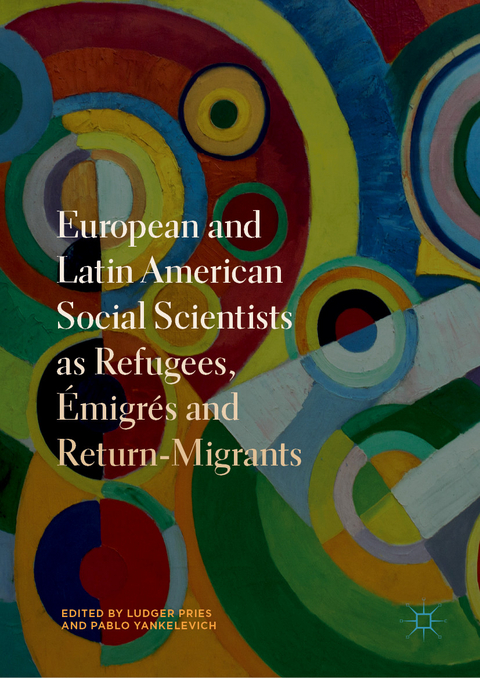
European and Latin American Social Scientists as Refugees, Émigrés and Return‐Migrants (eBook)
XI, 301 Seiten
Springer International Publishing (Verlag)
978-3-319-99265-5 (ISBN)
During the 1930s, thousands of social scientists fled the Nazi regime or other totalitarian European regimes, mainly towards the Americas. The New School for Social Research (NSSR) in New York City and El Colegio de México (Colmex) in Mexico City both were built based on receiving exiled academics from Europe.
Comparing the first twenty years of these organizations, this book offers a deeper understanding of the corresponding institutional contexts and impacts of emigrated, exiled and refugeed academics. It analyses the ambiguities of scientists' situations between emigration, return-migration and transnational life projects and examines the corresponding dynamics of application, adaptation or amalgamation of (travelling) theories and methods these academics brought. Despite its institutional focus, it also deals with the broader context of forced migration of intellectuals and scientists in the second half of the last century in Europe and Latin America. In so doing, the book invites a deeper understanding of the challenges of forced migration for scholars in the 21st century.
Ludger Pries is Chair for Sociology at Ruhr-Universität Bochum, Germany. His recent books include Refugees, Civil Society and the State. European Experiences and Global Challenges (2018), Refugee Protection and Civil Society in Europe (2018, Cross-border Staff Mobility. German and Mexican Profit- and Non-Profit-Organisations between Centre-Periphery and Transnationalization (2015), Shifting Boundaries of Belonging and New Migration Dynamics in Europe and China (2013).
Pablo Yankelevich is Professor at the Centro de Estudios Históricos of El Colegio de México, México. He is the editor of the Journal Historia Mexicana; the author of more than a hundred journal articles and book chapters; and author, coauthor, or editor of more than twenty books in English and Spanish.
Ludger Pries is Chair for Sociology at Ruhr-Universität Bochum, Germany. His recent books include Refugees, Civil Society and the State. European Experiences and Global Challenges (2018), Refugee Protection and Civil Society in Europe (2018, Cross-border Staff Mobility. German and Mexican Profit- and Non-Profit-Organisations between Centre-Periphery and Transnationalization (2015), Shifting Boundaries of Belonging and New Migration Dynamics in Europe and China (2013). Pablo Yankelevich is Professor at the Centro de Estudios Históricos of El Colegio de México, México. He is the editor of the Journal Historia Mexicana; the author of more than a hundred journal articles and book chapters; and author, coauthor, or editor of more than twenty books in English and Spanish.
Chapter 1. Exile Dynamics and Impacts of European Social Scientists since the 1930s: Transnational Lives and Travelling Theories at El Colegio de México and the New School for Social Research in New York Chapter 2. Crossroads: US and Mexican Reactions to Repression in Europe 1930-1939Chapter 3. Reflections on the New School’s Founding Moments, 1919 and 1933 Chapter 4. Refugee Scholars and the New School for Social Research in New York after 1933: Intellectual Transfer and ImpactChapter 5. Agents” of “Westernization”?: The Impact of German Refugees of the Nazi RegimeChapter 6. The Holocaust and German-Jewish Culture in ExileChapter 7. Waves of Exile: The Reception of Émigrés in Mexico, 1920-1980Chapter 8. International Rescue of Academics, Intellectuals and Artists from Nazism during the Second World War: The Experience of MexicoChapter 9.The Institutional Reception of Spanish Émigré Intellectuals in Mexico: The Pioneering Role of La Casa de España, 1938-1940. Chapter 10. Two Aspects of Exile Chapter 11. José Gaos and José Medina Echavarría: The Intellectual VocationChapter 12. The Constitution of Sociology at El Colegio de México: Two Key Intellectual Cohorts of Refugees and the Legacies They Left for Mexico and Latin America Chapter 13. Comparing Contexts, Institutions and Periods of the Émigrés’ Arrival and Possible Return
| Erscheint lt. Verlag | 28.10.2018 |
|---|---|
| Zusatzinfo | XI, 301 p. 11 illus. |
| Verlagsort | Cham |
| Sprache | englisch |
| Themenwelt | Sozialwissenschaften ► Soziologie ► Spezielle Soziologien |
| Schlagworte | academic emigres • Integration • Migration • scientists in exile • trajectories of ideas and concepts • transnationalism • Travelling theories |
| ISBN-10 | 3-319-99265-1 / 3319992651 |
| ISBN-13 | 978-3-319-99265-5 / 9783319992655 |
| Informationen gemäß Produktsicherheitsverordnung (GPSR) | |
| Haben Sie eine Frage zum Produkt? |
 PDF (Wasserzeichen)
DRM: Digitales Wasserzeichen
Dieses eBook enthält ein digitales Wasserzeichen und ist damit für Sie personalisiert. Bei einer missbräuchlichen Weitergabe des eBooks an Dritte ist eine Rückverfolgung an die Quelle möglich.
Dateiformat: PDF (Portable Document Format)
Mit einem festen Seitenlayout eignet sich die PDF besonders für Fachbücher mit Spalten, Tabellen und Abbildungen. Eine PDF kann auf fast allen Geräten angezeigt werden, ist aber für kleine Displays (Smartphone, eReader) nur eingeschränkt geeignet.
Systemvoraussetzungen:
PC/Mac: Mit einem PC oder Mac können Sie dieses eBook lesen. Sie benötigen dafür einen PDF-Viewer - z.B. den Adobe Reader oder Adobe Digital Editions.
eReader: Dieses eBook kann mit (fast) allen eBook-Readern gelesen werden. Mit dem amazon-Kindle ist es aber nicht kompatibel.
Smartphone/Tablet: Egal ob Apple oder Android, dieses eBook können Sie lesen. Sie benötigen dafür einen PDF-Viewer - z.B. die kostenlose Adobe Digital Editions-App.
Buying eBooks from abroad
For tax law reasons we can sell eBooks just within Germany and Switzerland. Regrettably we cannot fulfill eBook-orders from other countries.
aus dem Bereich