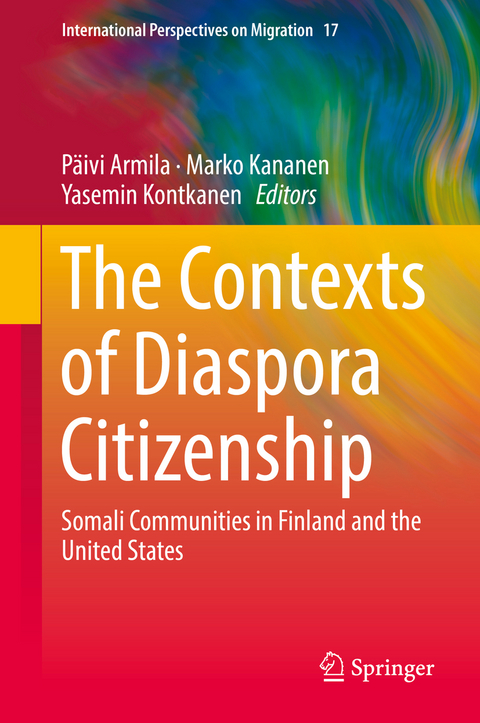
The Contexts of Diaspora Citizenship (eBook)
XIX, 231 Seiten
Springer International Publishing (Verlag)
978-3-319-94490-6 (ISBN)
Päivi Armila, PhD, works as a university lecturer for sociology at the University of Eastern Finland and as an adjunct professor for Sociology of Education at the University of Tampere. Her research interests deal with social inequality defined by age, ethnicity, and place of residence.
Marko Kananen, PhD, is a researcher at Juvenia - Youth Research and Development Centre at the South Eastern Finland University of Applied Sciences. His research interests include immigration, civic participation and transnational identities.
Yasemin Kontkanen is a PhD candidate in the Department of Social Sciences at the University of Eastern Finland. Her current research focus is Somali entrepreneurs in Finland and in the United States where her research interests are societal membership of immigrants, diasporic identities and entrepreneurship.
Päivi Armila, PhD, works as a university lecturer for sociology at the University of Eastern Finland and as an adjunct professor for Sociology of Education at the University of Tampere. Her research interests deal with social inequality defined by age, ethnicity, and place of residence. Marko Kananen, PhD, is a researcher at Juvenia – Youth Research and Development Centre at the South Eastern Finland University of Applied Sciences. His research interests include immigration, civic participation and transnational identities.Yasemin Kontkanen is a PhD candidate in the Department of Social Sciences at the University of Eastern Finland. Her current research focus is Somali entrepreneurs in Finland and in the United States where her research interests are societal membership of immigrants, diasporic identities and entrepreneurship.
Prologue 6
Contents 8
Contributors 10
About the Authors 11
Introduction: About This Collection 13
A Statement of Aims 13
Chapter Synopsis 15
Facts and Figures: Somalis in Finland and in the United States 15
The Newest African-Americans? Somali Struggles for Belonging 15
Mainstream or Margins? How Somalis Perceive Their Status and Possibilities in Finnish and American Societies? 16
The Call of the Homeland: ‘My Relationship to Somalia Is Difficult to Explain’ 16
Subject, Object or Predicate? Somali Migrants’ Subject Positions in a Local Finnish Integration Scene 16
Somalis in America’s Heartland: Columbus, Ohio 17
Integration, Finnish Somalis and Their Right to Everyday Life 17
Somali Diaspora Women and Sense of Identity and Belonging 17
Diaspora Citizenship: Silenced, Stigmatized, Outlying and Campaigning 18
Proximity to Natives: A Frame, a Resource and a Platform for Somali Entrepreneurs 18
Of Premises for Cross-national Comparisons 19
Notions About Cross-national Comparative Social Sciences and the Societal Role of Researchers 19
Part I Perspectives to Diaspora Citizenship: Contexts 20
Chapter 1: Facts and Figures: Somalis in Finland and in the United States 22
1.1 Introduction 23
1.2 Legal Status 24
1.3 Integration 26
1.3.1 Employment 27
1.3.2 Education 29
1.3.3 Economic Well-Being 30
1.3.4 Health and Health Care Access 30
1.3.5 Housing 31
1.3.6 Participation in Decision-Making Communities and Organizations 32
1.4 Conclusions 33
References 35
Chapter 2: The Newest African-Americans?: Somali Struggles for Belonging 38
2.1 Introduction 39
2.2 Migration Waves: Assimilation, Alienation, and In-between 39
2.3 Portrait: Somali Migration to America 42
2.4 Refugee Status, Family Obligations, and Relative Poverty 43
2.5 Federal and State Refugee Assistance Laws 44
2.6 Conclusion 49
References 50
Chapter 3: Mainstream or Margins? How Somalis Perceive Their Status and Possibilities in Finnish and American Societies? 52
3.1 Background and Introduction 52
3.2 Questions, Data and Methodological Considerations 54
3.3 Discrimination against Somalis According to Existing Research and Statistics 56
3.4 Findings 57
3.4.1 Identifications: I’m Somali/I’m Going to Make This Country Home 57
3.4.2 Immigration: We all Came from Somewhere / you Still Remain Immigrant 59
3.4.3 Race: It’s Up to You/I’m Not Blonde 62
3.4.4 Religion: It’s a Bad Time/Such a Contradictory Topic 64
3.5 Concluding Remarks: You Just Work Hard / Find a Solution Together 65
References 68
Chapter 4: The Call of the Homeland: “My Relationship to Somalia Is Difficult to Explain” 71
4.1 Introduction 71
4.2 Findings 73
4.2.1 The Call of the Homeland 73
4.2.2 The Constructive Call 75
4.2.3 The Utopian Call 76
4.2.4 The Destructive Call 77
4.3 The Antidotes of the Call 79
4.4 Concluding Remarks 81
References 82
Part II: Acting As Diaspora Citizens: Agencies 84
Chapter 5: Subject, Object, Predicate? Somali Migrants’ Subject Positions in a Local Finnish Integration Scene 86
5.1 Introduction 86
5.2 The Frame: Welcome to My World…? 88
5.3 With Me or Under My Rule? 90
5.4 A New Member of the Local Town Community: Tension in the Shared Environments 91
5.4.1 Municipal Economy and Politics 91
5.4.2 Difference, Racism, and Mistrust 93
5.4.3 Incarnation of the ‘Culture’: Good and Bad Somaliness 95
5.5 An Ignorant Member of a Weird Somalian Family 96
5.6 A Member of a Diasporic Somali Network: Controlling the ‘Own’ Ones and Controlled by Them 98
5.7 An Autonomous and Competent Individual 100
5.8 Concluding Remarks 101
References 103
Chapter 6: Somalis in America’s Heartland: Columbus, Ohio 105
6.1 Introduction 105
6.2 Methodology 106
6.3 Bureaucratic Incorporation Literature 108
6.4 Somalia to Columbus: Adaptation and Discrimination 111
6.5 Government Incorporation: A Challenge for State and Municipal Governments 113
6.6 Economic Policy: Somali Position in Columbus’ Economy 115
6.7 The Role of Community-Based Groups 118
6.8 Education Policy: The Somali Experience with Education in Columbus 119
6.9 Housing Policy: A Clash of Cultures 121
6.10 Bureaucratic Incorporation and Somalis in Columbus 121
6.11 Recommendations for Increasing Somali Incorporation 123
References 125
Chapter 7: Integration, Finnish Somalis and Their Right to Everyday Life 127
7.1 Introduction 127
7.2 Theoretical Framework: Everyday as Contested 129
7.3 Fieldwork Context and Methods 131
7.4 Integration into Finnish Everyday 133
7.4.1 Learning to Walk, Talk and Eat 134
7.4.2 Internalising the National Order of Things 135
7.5 Discussion and Implications 137
7.6 Conclusions 139
References 140
Chapter 8: Somali Diaspora Women and Sense of Identity and Belonging 144
8.1 Introduction 145
8.2 The Study and Participants 146
8.3 Transnational and Cosmopolitan Concepts 147
8.4 Situating the Somali Diaspora in Minneapolis 149
8.5 Transnationalism Identity and Belonging: First Generation 150
8.6 Establishing Patterns of Settlement – Building Mosques 150
8.7 Remaining Connected 153
8.8 1.5 Generation Experience 154
8.9 Strangers in Their Own Home 155
8.10 Discrimination in Primary School and Beyond 157
8.11 Everyday Cosmopolitanism 159
8.12 Conclusion 160
References 162
Chapter 9: Diaspora Citizenship: Silenced, Stigmatized, Outlying – And Campaigning 165
9.1 Introduction 165
9.2 The Conceptual Frame: Transnationalism and Diaspora as Contexts for Societal Memberships 167
9.3 Diaspora People of This Article: Somalis in Finland 169
9.4 Diaspora Citizenship: In, Out, and In-Between 170
9.5 Transborder Life-Histories: Traumas, Exclusion and Transnational Knowhow 171
9.6 Formal Citizenship Status: A Paper with Promises and Cheats 173
9.7 Transnational Aspirations: Peacemakers for Different Environments 175
9.8 Diaspora Possibilities: If There Only Were Space and Recognition 177
References 178
Chapter 10: Proximity to Natives: A Frame, a Resource and a Platform for Somali Entrepreneurs 180
10.1 Introduction 180
10.2 Background: Somalis in Different Domiciles 182
10.3 Translating Social Location to Social Capital 185
10.4 Concerns with Content: Methods and Data, Findings and Discussion 188
10.4.1 Data and Methodology 188
10.4.2 Profiling Somali Entrepreneurs 189
10.4.3 Somali Entrepreneurs Contextualizing 190
10.4.4 Proximity as a Frame 191
10.4.5 Proximity as a Resource 192
10.4.6 Proximity as a Platform of Inclusion and Exclusion 194
10.5 Concluding Remarks 196
References 197
Part III: Studying Diaspora Citizenship: Theoretical and Methodological Notions 201
Chapter 11: Of Premises for Cross-National Comparisons 202
11.1 Introduction 202
11.2 Grounds and Caveats: Modelling the United States and Finland 204
11.3 On the Origins of Discourse of National Models of Integration 208
11.4 Laissez-Faire Multiculturalism and the United States 211
11.5 Multiculturalism as a State Policy in Finland 216
11.6 Of Premises for Cross-National Comparisons 222
References 227
Chapter 12: Notions About Cross-National Comparative Social Sciences and the Societal Role of Researchers 232
12.1 Critics Towards Methodological Nationalism 232
12.2 Cross-National Research or Comparative Cross-National Research? 235
12.3 What Social Scientists Can – Or Have to – Do? 237
References 238
Epilogue 240
| Erscheint lt. Verlag | 24.10.2018 |
|---|---|
| Reihe/Serie | International Perspectives on Migration | International Perspectives on Migration |
| Zusatzinfo | XIX, 231 p. 1 illus. |
| Verlagsort | Cham |
| Sprache | englisch |
| Themenwelt | Sozialwissenschaften ► Soziologie ► Spezielle Soziologien |
| Schlagworte | Citizenship • diaspora populations • Homeland • Migration and Integration • Sending and receiving countries • Social participation • Sociology of Citizenship • Somali migrants |
| ISBN-10 | 3-319-94490-8 / 3319944908 |
| ISBN-13 | 978-3-319-94490-6 / 9783319944906 |
| Informationen gemäß Produktsicherheitsverordnung (GPSR) | |
| Haben Sie eine Frage zum Produkt? |
 PDF (Wasserzeichen)
DRM: Digitales Wasserzeichen
Dieses eBook enthält ein digitales Wasserzeichen und ist damit für Sie personalisiert. Bei einer missbräuchlichen Weitergabe des eBooks an Dritte ist eine Rückverfolgung an die Quelle möglich.
Dateiformat: PDF (Portable Document Format)
Mit einem festen Seitenlayout eignet sich die PDF besonders für Fachbücher mit Spalten, Tabellen und Abbildungen. Eine PDF kann auf fast allen Geräten angezeigt werden, ist aber für kleine Displays (Smartphone, eReader) nur eingeschränkt geeignet.
Systemvoraussetzungen:
PC/Mac: Mit einem PC oder Mac können Sie dieses eBook lesen. Sie benötigen dafür einen PDF-Viewer - z.B. den Adobe Reader oder Adobe Digital Editions.
eReader: Dieses eBook kann mit (fast) allen eBook-Readern gelesen werden. Mit dem amazon-Kindle ist es aber nicht kompatibel.
Smartphone/Tablet: Egal ob Apple oder Android, dieses eBook können Sie lesen. Sie benötigen dafür einen PDF-Viewer - z.B. die kostenlose Adobe Digital Editions-App.
Buying eBooks from abroad
For tax law reasons we can sell eBooks just within Germany and Switzerland. Regrettably we cannot fulfill eBook-orders from other countries.
aus dem Bereich