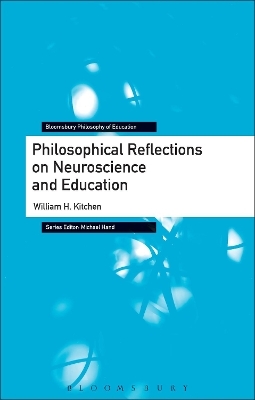
Philosophical Reflections on Neuroscience and Education
Bloomsbury Academic (Verlag)
978-1-350-11092-2 (ISBN)
William H. Kitchen is a freelance educational researcher. He currently teaches mathematics at post-primary level in Northern Ireland, and has previously authored Authority and the Teacher (2014) with Bloomsbury.
Series Editor Foreword
Preface
Acknowledgements
Wittgentsteinian Abbreviations
Part I: An Introduction to Neuroscience and Education
1. Neuroscience, Brain Based Learning and Education
2. Collaborative Reports in Neuroscience and Education
3. A Local Paradigmatic Example, Founded on an International Research Phenomenon
Part II: The Philosophical Critique of Neuroeducation and Brain-Based Learning: Mereology, Asymmetry and Irreducible Uncertainty
4. The Mereological Fallacy
5. First-Person/Third-Person Asymmetry
6. Neuroscience and Irreducible Uncertainty
Part III: The Philosophy of the Inner and the Outer: Neuroscience, Cartesianism and Mind-Brain Identity Theory
7. Inner and Outer: The Epistemology of the Mind
8. Inner and Outer: The Challenges of Crypto-Cartesianism, Materialism and Reductionism
Part IV: Intrinsic and Relational Models of Education: Unifying the Philosophy of Mind and the Philosophy of Quantum Physics
9. Intrinsic and Relational Models of Education
10. Education, Psychology and Physics
11. Bohr’s Philosophy of Physics and its Application to Psychology and Education
Part V: The Wittgenstein-Bohr Model of Education
12. A New Educational Philosophy Based on Bohr’s Interpretation of Quantum Physics
13. Conclusions: Wittgenstein-Bohr Model of Education
Concluding Remarks
Bibliography
Index
| Erscheinungsdatum | 10.06.2019 |
|---|---|
| Reihe/Serie | Bloomsbury Philosophy of Education |
| Verlagsort | London |
| Sprache | englisch |
| Maße | 152 x 232 mm |
| Gewicht | 800 g |
| Themenwelt | Sozialwissenschaften ► Pädagogik ► Allgemeines / Lexika |
| Sozialwissenschaften ► Pädagogik ► Bildungstheorie | |
| ISBN-10 | 1-350-11092-2 / 1350110922 |
| ISBN-13 | 978-1-350-11092-2 / 9781350110922 |
| Zustand | Neuware |
| Informationen gemäß Produktsicherheitsverordnung (GPSR) | |
| Haben Sie eine Frage zum Produkt? |
aus dem Bereich