Police Integrity in the Developing World (eBook)
VII, 47 Seiten
Springer International Publishing (Verlag)
978-3-030-00413-2 (ISBN)
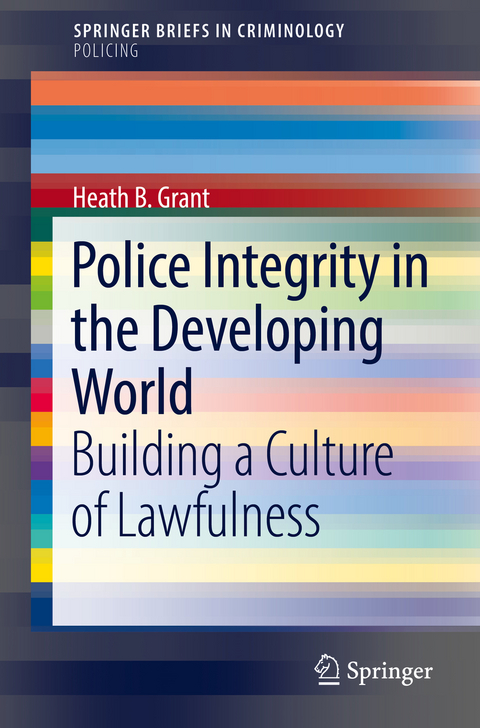
This Brief explores the problem of creating organizational change and a culture of lawfulness within police organizations in the developing world. In many countries where police are charged with responding to crime, they are themselves entrenched in histories of corruption, human rights abuses, inefficiency as well as a lack of public trust. While police corruption can happen anywhere, areas of political transition tend to have a more entrenched cultural history of corruption.
However, the author argues that even in the most challenged forces, there remains hope for organizational change. This brief demonstrates how understanding the local socio-political context, and applying evidence-based best practices for police integrity training can bring about change. The brief summarizes the current state of knowledge on police integrity training, strategies for rethinking corruption and community policing, as well as two case studies in Bangladesh and Mexico with applications for other regions.
This work will be of interest to students and researchers in criminology and criminal justice, particularly with an interest in police studies and corruption, as well as related fields such as political science, international studies and human rights.
Prior to returning to the full-time faculty of John Jay College of Criminal Justice in 2013, Dr. Grant was most recently the Director of Research of the Police Executive Research Forum, a leading Washington DC organization dedicated to advancing law enforcement and crime prevention internationally. Formerly, as CEO, of Success for Kids (SFK), he oversaw the planning, implementation, curriculum development, partnerships& strategic program alliances and evaluation of the organization's international programs and services. A 15 year program executive, his experience and innovative style has positioned SFK's unique approach to Social Emotional Learning as one of the most sought after program partnership opportunities throughout Africa, the Middle East, Europe, and the Americas. On behalf of the Asia Foundation, he also recently developed training curricula for the Bangladesh National Police on community policing. He subsequently conducted an assessment there related to the status of community policing in the country.
Prior to returning to the full-time faculty of John Jay College of Criminal Justice in 2013, Dr. Grant was most recently the Director of Research of the Police Executive Research Forum, a leading Washington DC organization dedicated to advancing law enforcement and crime prevention internationally. Formerly, as CEO, of Success for Kids (SFK), he oversaw the planning, implementation, curriculum development, partnerships& strategic program alliances and evaluation of the organization’s international programs and services. A 15 year program executive, his experience and innovative style has positioned SFK’s unique approach to Social Emotional Learning as one of the most sought after program partnership opportunities throughout Africa, the Middle East, Europe, and the Americas. On behalf of the Asia Foundation, he also recently developed training curricula for the Bangladesh National Police on community policing. He subsequently conducted an assessment there related to the status of community policing in the country.
Contents 6
About the Author 8
Chapter 1: Antecedents and the Nature of Police Corruption and Impunity in Postcolonial and/or Developing Countries 9
Back to the Basics – The Bad Apple in the Bunch 12
References 13
Chapter 2: Integrity Training: The Importance of a Moral Resoning and Rigorous Evaluations 15
Defining Police Integrity 15
Individual Level Integrity 15
Organizational Level Integrity 16
Scope of Integrity Training 16
Pedagogical Techniques in Integrity Training 17
Content of Integrity Training 17
Moral Reasoning as an Integrity Promotion Tool 18
References 20
Chapter 3: Change in Police Organizations – Towards a Top Down/Bottom Up Strategy 21
References 23
Chapter 4: Why Civilian Oversight is NOT the Answer – Addressing Use of Force and Other Human Rights Violations 25
References 27
Chapter 5: Rethinking Community Policing – Collective Efficacy First 28
References 30
Chapter 6: The Not So Exemplary Example – Bangladesh National Police 31
Politics and the Police in Bangladesh 32
The Ever-Present History of Partition 32
Varied Attempts at Police Reform 35
Community Policing: Strengths, Flaws, Implementation and the Importance of Local Context 37
Key Lessons for Implementing Community Policing Models in the Developing World 37
The Need for a Moderate Level of Police Legitimacy 39
Collective Efficacy as a Starting Point 41
Summary and Recommendations Moving Forward 42
References 42
Chapter 7: Tying It All Together – I’m Smarter than a Ninth Grader – The Culture of Lawfulness Model and Its Origins in the Schools 44
Taking It to the Police 45
Education in the Rule of Law for Police 46
Conclusion 49
References 50
Correction to: The Not So Exemplary Example – Bangladesh National Police 51
| Erscheint lt. Verlag | 11.10.2018 |
|---|---|
| Reihe/Serie | SpringerBriefs in Criminology |
| SpringerBriefs in Criminology | |
| SpringerBriefs in Policing | SpringerBriefs in Policing |
| Zusatzinfo | VII, 47 p. 1 illus. |
| Verlagsort | Cham |
| Sprache | englisch |
| Themenwelt | Recht / Steuern ► Strafrecht |
| Sozialwissenschaften ► Soziologie | |
| Schlagworte | Community Policing • Corruption • Police Integrity • Police Legitimacy • policing • Policing and the Developing World • Post-Colonialism • Social Structure and Organization |
| ISBN-10 | 3-030-00413-9 / 3030004139 |
| ISBN-13 | 978-3-030-00413-2 / 9783030004132 |
| Informationen gemäß Produktsicherheitsverordnung (GPSR) | |
| Haben Sie eine Frage zum Produkt? |
 PDF (Wasserzeichen)
DRM: Digitales Wasserzeichen
Dieses eBook enthält ein digitales Wasserzeichen und ist damit für Sie personalisiert. Bei einer missbräuchlichen Weitergabe des eBooks an Dritte ist eine Rückverfolgung an die Quelle möglich.
Dateiformat: PDF (Portable Document Format)
Mit einem festen Seitenlayout eignet sich die PDF besonders für Fachbücher mit Spalten, Tabellen und Abbildungen. Eine PDF kann auf fast allen Geräten angezeigt werden, ist aber für kleine Displays (Smartphone, eReader) nur eingeschränkt geeignet.
Systemvoraussetzungen:
PC/Mac: Mit einem PC oder Mac können Sie dieses eBook lesen. Sie benötigen dafür einen PDF-Viewer - z.B. den Adobe Reader oder Adobe Digital Editions.
eReader: Dieses eBook kann mit (fast) allen eBook-Readern gelesen werden. Mit dem amazon-Kindle ist es aber nicht kompatibel.
Smartphone/Tablet: Egal ob Apple oder Android, dieses eBook können Sie lesen. Sie benötigen dafür einen PDF-Viewer - z.B. die kostenlose Adobe Digital Editions-App.
Buying eBooks from abroad
For tax law reasons we can sell eBooks just within Germany and Switzerland. Regrettably we cannot fulfill eBook-orders from other countries.
aus dem Bereich