
Syria: From National Independence to Proxy War (eBook)
296 Seiten
Springer International Publishing (Verlag)
978-3-319-98458-2 (ISBN)
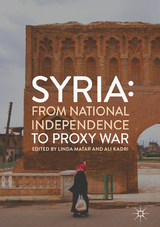
This edited collection aims to analytically reconceptualise the Syrian crisis by examining how and why the country has moved from a stable to a war-torn society. It is written by scholars from a variety of disciplinary backgrounds, all of whom make no attempt to speculate on the future trajectory of the conflict, but aim instead to examine the historical background that has laid the objective conditions for Syria’s descent to its current situation. Their work represents an attempt to dissect the multi-layered foundation of the Syrian conflict and to make understanding its complex inner workings accessible to a broader readership. The book is divided into four parts, each of which elaborates on the origins and dynamics of today’s crisis from the perspective of a different discipline. When put together, the four parts provide a holistic picture of Syria’s developmental trajectory from the early twentieth century through to the present day. Themes addressed include Syria’s postcolonialdevelopment efforts, its leap into socialism and then into neoliberalism in the late twentieth century, its politics within the resistance front, and finally its food and health security concerns.
Linda Matar is Senior Research Fellow at the National University of Singapore (NUS). She is also Lecturer at the NUS’s College of Alice and Peter Tan. Her research interests include the political economy of the Arab Near East and Southeast Asia. She is the author of The Political Economy of Investment in Syria (2016).Ali Kadri is Senior Fellow at the NUS and Visiting Fellow at the London School of Economics, UK. His recent publications include The Cordon Sanitaire: A Single Law Governing Development in East Asia and the Arab World (2018).
Contents 5
Notes on Contributors 7
Abbreviations 9
List of Figures 12
List of Tables 13
Chapter 1: Introduction: Syria in the Imperialist Cyclone 14
Leading Indicators of Syria’s Descent 17
Global Imbalances and Syria 23
The Syria Debate 24
War as a Value Relationship 25
Purpose and Structure of This Endeavour 28
Bibliography 37
Part I: A Historical Perspective of the Syrian Conflict 39
Chapter 2: What Went Wrong: Understanding the Trajectory of Syria’s Conflict 40
Introduction 40
A Historical Sociology Lens for Understanding the Syrian Conflict 40
The Junctures of the Syrian Conflict’s Trajectory 41
Historical Context 42
State Formation Under Hafez al-Asad: Neo-patrimonial Regime Consolidation 43
Syria Under Bashar al-Asad 45
The Syrian Uprising: From Non-violent Protest to Proxy War 47
Juncture 1: The Spread of the Arab Uprisings to Syria 47
Juncture 2: The Failure of Non-violent Protest to Enable Democratic Transition 49
Juncture 3: Failure of Revolution from Below 51
Juncture 4: Toward Proxy War: Between Failed Revolution and Failed Counter-insurgency 54
Features of State Failure 56
Governance Fragmentation, Security Dilemma 57
Competitive Regime Formation 57
Trans-state Spillover and State Remaking 59
Conclusion 60
Bibliography 61
Chapter 3: The New Struggle for Syria and the Nature of the Syrian State 64
The Old Struggle for Syria 64
Parallels with Today 66
Contrast with the Reign of Hafez al-Asad 68
The Struggle as a Mirror of the State 73
Differences Between the Old and the New Struggle for Syria 75
Concluding Remarks: From Old to New 78
Bibliography 79
Chapter 4: Syria: Strong State Versus Social Cleavages 82
Introduction 82
The Generation of Social Cleavages 84
The History of the Relationship Between Politics and Social Cleavages 88
Parliamentary Democracy (April 1946–March 1963) 88
One-Party Authoritarian Rule (March 1963–November 1970) 91
Authoritarianism Based on “Two-Tier Power Structure” (November 1970 Onwards) 94
The Pitfall Surrounding Social Cleavages 98
Bibliography 101
Part II: Macroeconomy and Society 104
Chapter 5: Macroeconomic Framework in Pre-conflict Syria 105
Introduction 105
A Snapshot of Syria’s Macroeconomy During 2000–2010 106
Fiscal Policy 108
Income Disparity Between Wage Earners 112
Monetary Policy 113
Trade and Capital Account Policies 115
A Synthesis of Macroeconomic Performance 117
Concluding Remarks: Syria in Conflict 119
Bibliography 121
Chapter 6: The Syrian Conflict: Selective Socioeconomic Indicators 124
Introduction 124
Socioeconomic Development in Modern Syria 125
Sectoral Development 127
Syria’s Labour Market 129
Syria’s Human Development Index 129
Enlarged Poverty 130
Greater Regional Disparities 131
The Social and Economic Impacts of the Crisis 131
Economic Loss 131
Structural Changes 132
Demand Deterioration 133
Fiscal Policy 134
Collapse in Job Opportunities 135
Population Dispersion 135
Diminishing Human Development Dimensions 136
Expanded Poverty 137
Concluding Remarks: Towards an Alternative Scenario 138
Bibliography 139
Chapter 7: Lebanon Can’t Give Him a Future: Revolutionary Subjectivity and Syrian Rebel-Workers in Beirut 141
Introduction 141
Revolution from a Distance 144
Exams and the Future 145
A New Tradition 149
Revolutionary Subjectivity11 154
Conclusion: Labour Migration Pattern—From Consent to Coercion? 158
Bibliography 164
Part III: The Politics of the Syrian Conflict 167
Chapter 8: Syria in the ‘Resistance Front’: Persistence Through Reconfiguration? 168
Introduction 168
Syria’s ‘Strategic Balance’ with Israel 170
Hafez al-Asad’s Regional and International Balancing Strategy 172
Hafez al-Asad’s Balancing of Domestic Threats 173
Succession and Foreign Policy Under Bashar al-Asad 175
A Building Storm During Bashar al-Asad’s Rule 176
Syria in the ‘Resistance Front’ 178
The ‘Resistance Front’ in the Syrian Uprising 180
Conclusion 183
Bibliography 188
Part IV: Sectoral Analysis 190
Chapter 9: The Political Economy of Public Health in Syria: Some Global and Regional Considerations 191
Introduction 191
Political Economy Background and the Health Sector 192
The Impact of Neoliberal Policies on the Health Sector 196
Health Services in Pre-conflict Syria 198
Official Narrative of the Health Sector’s Modernisation Programme (2003–2010) 202
User Fees 204
The Impact of the Modernisation Programme on Syria’s Health Sector 204
Conclusion 206
Current Crisis 206
Bibliography 209
Chapter 10: The Political Economy of Thermidor in Syria: National and International Dimensions 214
Introduction 214
Putting Ba’athism and Revolution in World-Systemic Perspective 216
The Early and Mid-Ba’athist Social Compact 218
Early Stages of Thermidor: Confrontation with Israel and the Geopolitical Origins of the Ba’ath’s Corrective Movement 223
Thermidor and Petrodollars in Syria 224
Rural Ba’athism: The Growth of Capitalist Middle Peasants (1963–2000) 226
Further Dynamics of Rural Capitalism 229
Food Security and State Embedding Through Pricing Policy: Further Dynamics of Rural Capitalist Growth 233
Rural Immiseration in Syria and the Erosion of the Populist Pact 236
Social Consequences: Drought to Uprising 237
Conclusion 241
Bibliography 247
Chapter 11: Syria’s Food Security: From Self-Sufficiency to Hunger as a Weapon 251
The Socialist Objective of Promoting Food Self-Sufficiency 252
Self-Sufficiency Through Subsidies (A Costly Policy) 253
Private Sector Production and Market 254
Syria’s Bread Basket: The Jazira Region 255
Water Mismanagement 256
Agrarian Counter-Reforms and the Drought Effects in Late 2000s 257
Agrarian Relations: Law 56 of 2004 257
The Effects of the Drought on Production and Livelihoods (2006–2010) 258
Food as a Weapon and Hunger Policy in the Time of War (2011–2016) 260
Syria’s Agricultural Geography During War 260
Syria Agricultural Production Under War 263
Hunger as a Weapon of War 265
Food Production in Besieged Areas and Coping Mechanisms 266
Conclusion 267
Bibliography 268
Chapter 12: Conclusion: China’s Role in Syria’s National Security 272
War Implications 277
Chinese Outward Investment Plans in Conflict Syria 279
Concluding Remarks 285
Bibliography 287
Index 292
| Erscheint lt. Verlag | 9.10.2018 |
|---|---|
| Zusatzinfo | XV, 296 p. 7 illus., 1 illus. in color. |
| Verlagsort | Cham |
| Sprache | englisch |
| Themenwelt | Sozialwissenschaften ► Politik / Verwaltung ► Politische Systeme |
| Sozialwissenschaften ► Soziologie | |
| Schlagworte | Arab nationalism • Beirut • China • French Imperialism • Heterodox economics • Hezbollah • Iran • Lebanon • Neoliberalism • Proxy war • Russia • Security and Development • Syria • Syrian Agriculture • Syria's Macroeconomic Framework • The Arab Spring • The Ba’ath Party • The Middle East • The Political Economy of War • The Syrian Conflict |
| ISBN-10 | 3-319-98458-6 / 3319984586 |
| ISBN-13 | 978-3-319-98458-2 / 9783319984582 |
| Informationen gemäß Produktsicherheitsverordnung (GPSR) | |
| Haben Sie eine Frage zum Produkt? |
 PDF (Wasserzeichen)
DRM: Digitales Wasserzeichen
Dieses eBook enthält ein digitales Wasserzeichen und ist damit für Sie personalisiert. Bei einer missbräuchlichen Weitergabe des eBooks an Dritte ist eine Rückverfolgung an die Quelle möglich.
Dateiformat: PDF (Portable Document Format)
Mit einem festen Seitenlayout eignet sich die PDF besonders für Fachbücher mit Spalten, Tabellen und Abbildungen. Eine PDF kann auf fast allen Geräten angezeigt werden, ist aber für kleine Displays (Smartphone, eReader) nur eingeschränkt geeignet.
Systemvoraussetzungen:
PC/Mac: Mit einem PC oder Mac können Sie dieses eBook lesen. Sie benötigen dafür einen PDF-Viewer - z.B. den Adobe Reader oder Adobe Digital Editions.
eReader: Dieses eBook kann mit (fast) allen eBook-Readern gelesen werden. Mit dem amazon-Kindle ist es aber nicht kompatibel.
Smartphone/Tablet: Egal ob Apple oder Android, dieses eBook können Sie lesen. Sie benötigen dafür einen PDF-Viewer - z.B. die kostenlose Adobe Digital Editions-App.
Buying eBooks from abroad
For tax law reasons we can sell eBooks just within Germany and Switzerland. Regrettably we cannot fulfill eBook-orders from other countries.
aus dem Bereich