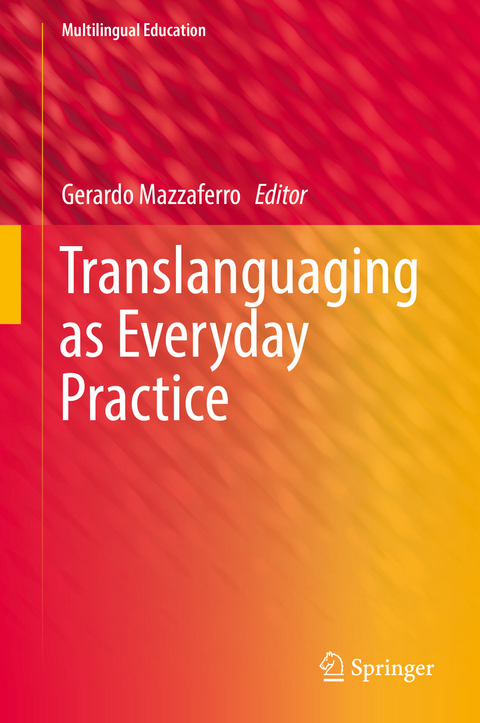
Translanguaging as Everyday Practice (eBook)
X, 273 Seiten
Springer International Publishing (Verlag)
978-3-319-94851-5 (ISBN)
This volume offers empirically grounded perspectives on translanguaging as a locally situated, interactional accomplishment of practical action, and its significance within different domains of social life-school, education, diasporic families and communities, workplaces, urban linguistic landscapes, advertising practices and mental health centres - focusing on case studies from different countries and continents.
The 14 chapters contribute to the understanding of translanguaging as a communicative and discursive practice, which is relationally constructed and strategically deployed by individuals during everyday encounters with language and cultural diversity.
The contributions testify to translanguaging as an interdisciplinary and critical research paradigm by assembling scholars working on translanguaging from different perspectives, and a wide range of social, cultural, and geographical contexts.
This volume contributes to the further development of new theoretical and analytical tools for the investigation of translanguaging as everyday practice, and how and why language practices are constructed, negotiated, opposed or subverted by social actors.
Gerardo Mazzaferro is a Researcher in English Language and Linguistics at the University of Turin (Italy). He has carried out research in several fields of the sociolinguistics of English as a global language and the sociolinguistics of immigration. He taught, published and took part in numerous international conferences on all these subjects. He is the organizer of the International Conference on the Sociolinguistics of Immigration. His current research includes the study of language and immigration in Italy.
Gerardo Mazzaferro is a Researcher in English Language and Linguistics at the University of Turin (Italy). He has carried out research in several fields of the sociolinguistics of English as a global language and the sociolinguistics of immigration. He taught, published and took part in numerous international conferences on all these subjects. He is the organizer of the International Conference on the Sociolinguistics of Immigration. His current research includes the study of language and immigration in Italy.
Acknowledgments 6
Contents 7
Contributors 9
Chapter 1: Translanguaging as Everyday Practice. An Introduction 11
1.1 Translanguaging as Theory and Practice 12
1.2 Translanguaging and the Everyday 14
1.3 Translanguaging: Old, New or What? 15
1.4 Overview of the Chapters 17
1.5 Conclusion 20
References 21
Chapter 2: Translanguaging in a Monoglot Context: Children Mobilising and (Re) Positioning their Multilingual Repertoires as Resources for Learning 23
2.1 Introduction 24
2.2 Conceptual Framework: Translanguaging and Ecological Perspectives 26
2.3 Data Collection and Analysis 29
2.4 Findings and Discussion 31
2.5 Implications and Conclusion 37
References 38
Chapter 3: Translanguaging as Playful Subversion of a Monolingual Norm in the Classroom 41
3.1 Background 42
3.2 Data and Method 44
3.3 Analysis 46
3.4 Discussion 54
References 56
Chapter 4: “We Know the Same Languages and Then We Can Mix Them”: A Child’s Perspectives on Everyday Translanguaging in the Family 59
4.1 Translanguaging and the Family 60
4.1.1 Family Language Policy 61
4.1.2 Key Concepts 62
4.2 The Present Study 63
4.2.1 Laura and Her Family 63
4.2.2 Methodology and Ethical Considerations 64
4.3 Laura’s Perspectives on Translanguaging 66
4.3.1 People 67
4.3.2 Spaces 71
4.3.3 Purpose 72
4.4 Discussion 74
4.4.1 Implications 75
4.4.2 Final Comments 76
References 76
Chapter 5: Translanguaging in a Birmingham Chinese Complementary School: Ideology and Identity 79
5.1 Introduction 80
5.2 Translanguaging and Chinese Complementary Schools 80
5.3 Chinese Complementary Schools in the UK 82
5.4 Methodology 83
5.5 Translanguaging Practices in a Birmingham Chinese Complementary School 84
5.5.1 Translanguaging as a ‘Classed’ Language Ideology 84
5.5.2 Translanguaging and Chinese Teachers’ Identity 87
5.5.3 Translanguaging and Discourses of Chineseness 90
5.6 Conclusion 93
References 94
Chapter 6: Language Maintenance and Shift Within New Linguistic Minorities in Italy: A Translanguaging Perspective 97
6.1 Language Maintenance and Shift 97
6.2 Language Maintenance and Shift: Expanding the Paradigm 99
6.3 Multilingual Language Practices 100
6.4 Method 103
6.4.1 Context 103
6.4.2 Sample 103
6.4.3 Data 104
6.5 Findings 105
6.5.1 Mediating Voices Within Filipino Families 105
6.5.2 Identity (Re)negotiation in Interaction with Peers 110
6.6 Conclusion 112
References 113
Chapter 7: Translanguaging: A Vital Resource for First Nations Peoples 117
7.1 Introduction 117
7.2 Lexical Change, Language Attrition, Language Switching and Translanguaging 118
7.2.1 Language for Modernity and Lexical Innovation 119
7.2.2 Language Attrition and Lexical Loss 120
7.2.3 Language Switching 120
7.2.4 Translanguaging 121
7.3 Background on the Cree Community 122
7.3.1 The Context of the Data Collection 122
7.4 Unpacking the Layers within the Discourse 126
7.4.1 English as Lexical Innovation in a Modern World 127
7.4.2 English for Clarity in Cases of Lexical Attrition 128
7.4.3 Language Switching: English for Purpose 128
7.4.4 Translanguaging: Resources to Move Between Worlds 130
7.5 Conclusion 131
References 133
Chapter 8: Translanguaging and Hybrid Spaces: Boundaries and beyond in North Central Arnhem Land 135
8.1 Introduction 136
8.2 Translanguaging in Hybrid Spaces in Maningrida 140
8.2.1 At the Book Launch 141
8.2.2 At the Footy 147
8.3 Discussion 150
8.4 Conclusion 153
References 154
Chapter 9: Translingual Practices in Global Business. A Longitudinal Study of a Professional Communicative Repertoire 159
9.1 Introduction 159
9.2 Theoretical Framework 161
9.2.1 Individual Repertoires and Translingual Practices 161
9.2.2 Translanguaging 162
9.3 Data and Analytical Focus 164
9.4 Findings 164
9.4.1 Project Manager’s Translingual Practices 165
9.4.2 The Operations Manager’s Translingual Practices 169
9.5 Discussion 179
References 180
Chapter 10: Communicative Repertoires in Advertising Space in Lesotho: The Translanguaging and Commodification Nexus 185
10.1 Introduction 186
10.2 Globalisation and Advertising 187
10.3 Brief Sociolinguistic Profile of Lesotho 188
10.4 Research Questions 188
10.5 Space and Spatial Repertoires in Superdiversity 188
10.6 Literature Review 189
10.7 Theoretical Framework 191
10.7.1 Translanguaging as a Construct 191
10.7.2 Language as an Economic Resource 192
10.7.3 Notion of Commodification 193
10.8 Methodology and Analysis 194
10.9 Discussion 201
10.10 Conclusion 201
References 202
Chapter 11: Translanguaging and Collaborative Creative Practices: Communication and Performance in an Intercultural Theatre Group 205
11.1 Introduction 206
11.2 Transnationalizing Modern Languages: Methodology 206
11.3 Cantieri Meticci: Translanguaging and Affinity Spaces 207
11.4 The Theatre Workshop as a Translanguaging Space 209
11.4.1 Translation Acts and Invoking Named Languages 210
11.4.2 Multimodality and the Body 212
11.4.3 Miscommunication, Engagement and Conviviality 214
11.5 From Process to Production 216
11.5.1 Languages of Performance and Playtexts 216
11.5.2 Translation and Performance 218
11.6 Conclusion 220
References 222
Chapter 12: Translanguaging and Language Creativity in Drama Staging 224
12.1 Introduction 224
12.2 The Epistemological Debate 225
12.3 Languaging in the Enactive Paradigm 227
12.4 What Is Enactive Translanguaging Pedagogy? 228
12.5 Using Theatre to Learn Translanguaging 229
12.6 Background of the Research 230
12.7 The Translanguaging Creation Approach 231
12.8 Background and Methodology 232
12.9 Analysis 233
12.9.1 Increasing Complexity of Base Material 233
12.9.2 Sequence AS1: The Communicative Dance of Translanguaging 234
12.9.3 Sequence AS2. Incarnation of the Perceived 235
12.9.4 Sequence AS3. Improvisational Balance 236
12.10 Conclusion 239
References 240
Chapter 13: Translanguaging and the Negotiation of Meaning. Multilingual Signage in a Swiss Linguistic Landscape 243
13.1 Introduction: Official and Unofficial Multilingualisms in the Linguistic Landscape 243
13.2 Merging Paradigms: Translanguaging and Linguistic Landscape – Semiotic Practices in Socialised Space 245
13.3 The Study: Translanguaging and the Negotiation of Meaning 246
13.3.1 Research Questions 247
13.3.2 Sample of Signs, Methods, and Participants in Focus Groups 248
13.3.2.1 Sample of Signs 248
13.3.2.2 Method 249
13.3.2.3 Participants in the Two Focus Groups 251
13.4 Results and Discussion: Analysis of the Negotiation of the Linguistic Meaning of Multilingual Signs 252
13.4.1 Negotiating the Linguistic Meaning of Multilingual Signs: Translingual Practices 252
13.4.2 Negotiating Meaning: Language and Non-iconic Signs 255
13.4.3 Negotiating the Social Meaning of Multilingual Signs: Inclusion and Exclusion 256
13.5 Conclusion: Negotiating the Linguistic and Social Meanings of Multilingual Signs 259
13.5.1 Using Translingual Practices to Negotiate the Linguistic Meaning of Multilingual Signs 259
13.5.2 Negotiating the Social Meaning of the Multilingual Sign 260
References 262
Chapter 14: What Shapes Everyday Translanguaging? Insights from a Global Mental Health Project in Northern Uganda 264
14.1 Introduction 265
14.2 Translanguaging in Research 266
14.2.1 Defining Translanguaging 266
14.2.2 Translanguaging as Expression of Identity 267
14.2.3 Translanguaging in Everyday Practice in Research Teams 267
14.3 An Ecological Frame for Understanding Translingual Practice 268
14.4 GMH Fieldwork in Lira (Northern Uganda) 270
14.5 Translanguaging in the Fieldwork 272
14.5.1 Translingual Practice Within the Team 272
14.5.2 Translingal Practice as the DIME Methodology Was Operationalised 275
14.5.3 Possible Shaping Influences on Translingual Practice in the Field 277
14.6 Some Concluding Observations 277
References 278
| Erscheint lt. Verlag | 4.10.2018 |
|---|---|
| Reihe/Serie | Multilingual Education | Multilingual Education |
| Zusatzinfo | X, 273 p. 28 illus. |
| Verlagsort | Cham |
| Sprache | englisch |
| Themenwelt | Sozialwissenschaften ► Pädagogik ► Schulpädagogik / Grundschule |
| Schlagworte | Communicative repertoire and professional migration • Culturally and linguistically diverse workplaces • Heteroglossia, ideology and identity • Linguistic Landscapes • Multilingual repertoires • Translanguaging as transformative social practice • Translanguaging practices |
| ISBN-10 | 3-319-94851-2 / 3319948512 |
| ISBN-13 | 978-3-319-94851-5 / 9783319948515 |
| Informationen gemäß Produktsicherheitsverordnung (GPSR) | |
| Haben Sie eine Frage zum Produkt? |
 PDF (Wasserzeichen)
DRM: Digitales Wasserzeichen
Dieses eBook enthält ein digitales Wasserzeichen und ist damit für Sie personalisiert. Bei einer missbräuchlichen Weitergabe des eBooks an Dritte ist eine Rückverfolgung an die Quelle möglich.
Dateiformat: PDF (Portable Document Format)
Mit einem festen Seitenlayout eignet sich die PDF besonders für Fachbücher mit Spalten, Tabellen und Abbildungen. Eine PDF kann auf fast allen Geräten angezeigt werden, ist aber für kleine Displays (Smartphone, eReader) nur eingeschränkt geeignet.
Systemvoraussetzungen:
PC/Mac: Mit einem PC oder Mac können Sie dieses eBook lesen. Sie benötigen dafür einen PDF-Viewer - z.B. den Adobe Reader oder Adobe Digital Editions.
eReader: Dieses eBook kann mit (fast) allen eBook-Readern gelesen werden. Mit dem amazon-Kindle ist es aber nicht kompatibel.
Smartphone/Tablet: Egal ob Apple oder Android, dieses eBook können Sie lesen. Sie benötigen dafür einen PDF-Viewer - z.B. die kostenlose Adobe Digital Editions-App.
Buying eBooks from abroad
For tax law reasons we can sell eBooks just within Germany and Switzerland. Regrettably we cannot fulfill eBook-orders from other countries.
aus dem Bereich