


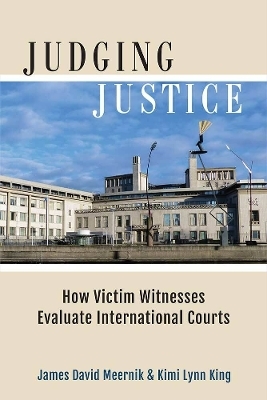
Judging Justice
How Victim Witnesses Evaluate International Courts
Seiten
2019
The University of Michigan Press (Verlag)
978-0-472-13126-6 (ISBN)
The University of Michigan Press (Verlag)
978-0-472-13126-6 (ISBN)
Shows how witness experiences of testimony give credence to perceptions of justice in international courts
Some injustices are so massive, so heinous, and so extraordinary that ordinary courts are no longer adequate. The creation of international courts and tribunals to confront major violations of human rights sought to bring justice to affected communities as well as to the entire world. Yet if justice is a righting of the imbalance between what has happened and what is reflected in the law, no amount of punishment and no judgment could compensate for that suffering and loss.
In order to understand the meaning of justice, James David Meernik and Kimi Lynn King studied the perspective of witnesses who have testified before the International Criminal Tribunal for the Former Yugoslavia (ICTY). Using a unique survey, Meernik and King look at the identity of the victims and their perception of the fairness of ICTY. Because of the need to justify the practical and emotional difficulties involved in testifying before an international tribunal, witnesses look not just to the institution to judge its effectiveness, but also to their own contribution, by testifying effectively. The central elements of the theory Meernik and King develop—identity, fairness, and experience—transcend specific conflicts and specific countries and are of importance to people everywhere.
Some injustices are so massive, so heinous, and so extraordinary that ordinary courts are no longer adequate. The creation of international courts and tribunals to confront major violations of human rights sought to bring justice to affected communities as well as to the entire world. Yet if justice is a righting of the imbalance between what has happened and what is reflected in the law, no amount of punishment and no judgment could compensate for that suffering and loss.
In order to understand the meaning of justice, James David Meernik and Kimi Lynn King studied the perspective of witnesses who have testified before the International Criminal Tribunal for the Former Yugoslavia (ICTY). Using a unique survey, Meernik and King look at the identity of the victims and their perception of the fairness of ICTY. Because of the need to justify the practical and emotional difficulties involved in testifying before an international tribunal, witnesses look not just to the institution to judge its effectiveness, but also to their own contribution, by testifying effectively. The central elements of the theory Meernik and King develop—identity, fairness, and experience—transcend specific conflicts and specific countries and are of importance to people everywhere.
James David Meernik is Regents Professor of Political Science and Director of the Castleberry Peace Institute at the University of North Texas. Kimi Lynn King is Distinguished Teaching Professor of Political Science at the University of North Texas.
| Erscheinungsdatum | 26.02.2019 |
|---|---|
| Zusatzinfo | 10 charts, 48 tables |
| Verlagsort | Ann Arbor |
| Sprache | englisch |
| Maße | 152 x 229 mm |
| Themenwelt | Recht / Steuern ► EU / Internationales Recht |
| Recht / Steuern ► Strafrecht ► Strafverfahrensrecht | |
| Sozialwissenschaften ► Politik / Verwaltung ► Europäische / Internationale Politik | |
| ISBN-10 | 0-472-13126-5 / 0472131265 |
| ISBN-13 | 978-0-472-13126-6 / 9780472131266 |
| Zustand | Neuware |
| Informationen gemäß Produktsicherheitsverordnung (GPSR) | |
| Haben Sie eine Frage zum Produkt? |
Mehr entdecken
aus dem Bereich


aus dem Bereich
mit EinführungsG, GerichtsverfassungsG, EGGVG, Jugendgerichtsgesetz, …
Buch | Softcover (2025)
dtv Verlagsgesellschaft
CHF 19,45
eine Anleitung für Klausur und Praxis
Buch | Softcover (2024)
Franz Vahlen (Verlag)
CHF 29,25


