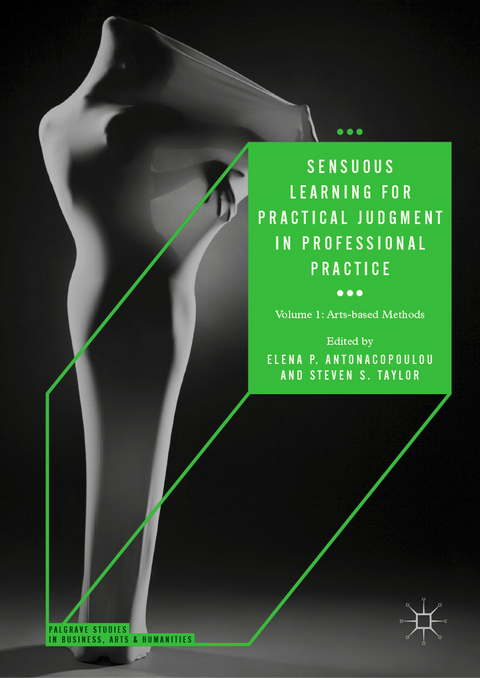
Sensuous Learning for Practical Judgment in Professional Practice (eBook)
282 Seiten
Springer International Publishing (Verlag)
9783319988634 (ISBN)
The first volume of this ground-breaking book critically examines how and why arts-based methods such as choir conducting workshops and dialogue improvisation can make a difference in improving professional practice. Taking a 'human-centred' approach, it delivers an insightful account of what these approaches do differently to achieve a new mode of learning - 'sensuous learning' - that cultivates professional judgment to serve the common good, simultaneously supporting personal and collective growth. The chapters present cutting edge examples of multiple ways arts-based methods underpin learning arenas for expanding leadership and improving professional practice. The reflexivity cultivated through these learning arenas has the unique potential to improve professional practice, not merely by enhancing competence but also by cultivating character and conscience, which is central in making judgments that serve the common good. These benefits are relevant for professional practitioners sharpening the skills and behaviours needed in organisations, including creativity, diversity, imagination, and improvisation.
Steven S. Taylor is Professor of Leadership and Creativity at the Foisie School of Business, Worcester Polytechnic Institute, USA. His research is focused in two areas: organizational aesthetics and reflective practice. The former applies art-based scholarship and practice to management and organizations. The latter focuses on the ability to analyse our own actions and learn how to be more effective, ethical, and artful as managers and leaders.
Elena P. Antonacopoulou is Professor of Organizational Behaviour at the Management School at the University of Liverpool, UK, where she leads GNOSIS - a research initiative advancing impactful collaborative research in management and organization studies. Her principal research expertise lies in the areas of organisational change and learning and knowledge management, with a focus on the leadership implications. Her research continues to advance cutting edge ideas and thought leadership, as well as new methodologies for studying social complexity.
Steven S. Taylor is Professor of Leadership and Creativity at the Foisie School of Business, Worcester Polytechnic Institute, USA. His research is focused in two areas: organizational aesthetics and reflective practice. The former applies art-based scholarship and practice to management and organizations. The latter focuses on the ability to analyse our own actions and learn how to be more effective, ethical, and artful as managers and leaders. Elena P. Antonacopoulou is Professor of Organizational Behaviour at the Management School at the University of Liverpool, UK, where she leads GNOSIS – a research initiative advancing impactful collaborative research in management and organization studies. Her principal research expertise lies in the areas of organisational change and learning and knowledge management, with a focus on the leadership implications. Her research continues to advance cutting edge ideas and thought leadership, as well as new methodologies for studying social complexity.
Contents 7
Notes on Contributors 9
List of Figures 17
List of Tables 19
Sensuous Learning Through Arts-Based Methods: An Introduction 20
References 30
Sensuous Learning: What It Is and Why It Matters in Addressing the Ineptitude in Professional Practice 32
Introduction 32
Ineptitude in Professional Practice: Professionalism Revisited 33
Practising Phronesis: A Critical Mode of Knowing and Sensemaking in Professional Practice 34
Cultivating Character 37
The Voice of Conscience 40
Reflexivity: Reconnecting Ways of Seeing, Being, and Becoming 42
Sensuous Learning: CQ and the GNOSIS 4R Framework 48
Professionals Are You Realising Y-OUR Impact?
References 57
Using Music to Activate and Develop Leader Character 63
Introduction 63
Conceptual Framing 64
Leader Character and Sustained Excellence 64
Music Stimulates 68
Music and Character 72
ABM Through Music 73
Learning Arising from the Use of Music as an ABM 75
Discussion and Conclusions 83
Reflections 84
References 85
Using Choir Conducting to Improve Leadership Practice 88
Conceptual Framing 91
Analogically Mediated Inquiry 93
Embodied Performance 94
Data Collection and a Description of Choir Conducting Workshops 95
Process of Learning 97
Analogically Mediated Inquiry 98
Embodied Performance 103
Evidence of Impacts 106
Lessons Learnt 109
References 110
Using Choral Singing to Improve Employee Well-Being and Social Cohesion in the Norwegian Public Sector 114
Introduction 114
Conceptual Framing: Learning, Emotions and Choral Singing as an Arts-Based Method 116
Context and Content 120
The Process of Learning 122
Impacts 126
Lessons Learned 127
References 129
Using Body Sounds as a Coaching Tool to Promote Individual Growth in Brazil 133
Introduction 133
Arts-Based Methods, Coaching, and Leadership 134
Coaching and Leadership 134
ABM in Context—Body Sound Theory 136
The Case of Andrew—Using Body Sound Theory in Coaching 138
Andrew and the First Meeting 139
The “Contract”—First Meeting 140
Andrew—Second Meeting 141
Andrew—The Third Meeting 143
Andrew—The Fourth Meeting 145
Andrew—The Fifth Meeting 146
ABM Process of Fostering Learning—Using Body Sounds to Elicit Change 147
The Difference This ABM Made—Relationship Building Between Coach/Coachee 149
Reflections—Our Own Learning 150
Conclusion 152
References 152
Using Arts-Based Inquiry as a Way to Communicate Creatively in Uncovering the Future 155
Introduction 155
Conceptual Framing 157
The Power of Symbolising and Play 157
Sensuous Learning, Vulnerability and the Arts 159
Different Approaches to Inquiry 161
Arts-Based Inquiry 162
Content and Context 163
Developing Arts-Based Inquiry 163
The Course Creative Communication 165
The Different Steps in an Arts-Based Inquiry 166
Establishing Working Pairs and Outlining the Theme 166
Choosing a Symbol and Getting Started 167
Embodying and Speaking from the Symbol 167
Sharing and Reflecting on the Process 169
Process of Learning 169
Using Arts-Based Inquiry as an Integral Part of the Teaching 170
Evidence of Impacts 171
Case 1: Discovering Embodied Feelings and Senses 172
Images Providing Learners with New Perspectives 174
Scores After the Course Creative Communication 177
Reflections and Lessons Learned 178
References 180
Using Epic Poems and Creative Drama to Develop Realistic Optimism Among Undergraduate Students in Greece 183
Epic Poems and Creative Drama as Learning Spaces for Developing Realistic Optimism 185
Epic Poetry 186
Time 187
Totality and Multiplicity 188
Creative Drama 189
The Context 190
Designing the Content 191
Objectives 191
Pre-Training Educational Methods 193
Creative Drama Session 194
The Process of Learning 196
Setting the Stage for the Drama to Take Place: Lessons from Odyssey 196
The Play Session 199
Exploring the Play and Linking It to Real Life 201
Some Evidence: The Impact of Odyssey and Creative Drama on Realistic Optimism 202
Lessons Learned 205
References 207
Using “The Staged Cocktail Party” to Improve Leaders’ Social Interaction in the Norwegian Military 210
Introduction 210
Conceptual Framing 212
Theatre 213
Drama 214
Play 214
Playing for Mentalisation 215
Context and Content 216
The Staged Cocktail Party 217
Process of Learning 218
Step 1: Warming Up—Getting the Role 218
Step 2: The Activity—Playing the Role 219
Step 3: Reflection—Stepping Out of the Role 220
The First Level of Reflection 220
The Second Level of Reflection 221
The Third Level of Reflection 222
Impacts 223
Human Interaction 223
Emotional Reactions 224
Leaders’ Mentalisation 226
Lessons Learned 227
Closing Comments 230
References 231
Learning from Arts: Using Abstract Painting to Discover New Understandings and Approaches That Are Relevant for Both Personal Development and Consulting Practice 235
Introduction 235
Learning from Within 236
Initiating and Developing Artistic Inquiry 238
From Visual Journaling to Painting 238
Reimagining Dancer and Shadow 240
Integration of Art and Inquiry 246
Learning Through Art: A Process of Being and Becoming 247
Emergence of a Painter 248
An Arts-Based Approach to Reflexive Learning 249
Artistic Dwelling 250
Growth-in-Connection: Creative Confrontation 252
The Impact of an Arts-Based Inquiry on My Professional Practice 253
Lessons Learned 255
References 257
Using Arts-Based Methods to Explore Learning in an Individual with Systemizing Bias 259
Introduction 259
Discovering a Method for Systemizers 260
The Challenge of First-Person Inquiry 262
The Value of Examining Other People’s Art Work 265
The Challenge of Making Art Myself 268
The Challenge of Using Art with Others 275
Summary and Conclusions 278
References 279
Conclusion—Arts-Based Methods for Sensuous Learning: Questions and Quality 281
Sensuousness as a Choice for Engagement 282
Facilitator Skill 284
Energy 286
Divergence of Outcomes 288
Quality 290
References 292
Index 294
| Erscheint lt. Verlag | 1.10.2018 |
|---|---|
| Reihe/Serie | Palgrave Studies in Business, Arts and Humanities | Palgrave Studies in Business, Arts and Humanities |
| Zusatzinfo | XIX, 282 p. 23 illus. |
| Verlagsort | Cham |
| Sprache | englisch |
| Themenwelt | Sozialwissenschaften ► Pädagogik |
| Wirtschaft ► Betriebswirtschaft / Management ► Personalwesen | |
| Wirtschaft ► Betriebswirtschaft / Management ► Unternehmensführung / Management | |
| Schlagworte | art in business • arts-based learning • Cognition • Leadership • organization • organizational art • Personal development • sensual learning |
| ISBN-13 | 9783319988634 / 9783319988634 |
| Informationen gemäß Produktsicherheitsverordnung (GPSR) | |
| Haben Sie eine Frage zum Produkt? |
 PDF (Wasserzeichen)
DRM: Digitales Wasserzeichen
Dieses eBook enthält ein digitales Wasserzeichen und ist damit für Sie personalisiert. Bei einer missbräuchlichen Weitergabe des eBooks an Dritte ist eine Rückverfolgung an die Quelle möglich.
Dateiformat: PDF (Portable Document Format)
Mit einem festen Seitenlayout eignet sich die PDF besonders für Fachbücher mit Spalten, Tabellen und Abbildungen. Eine PDF kann auf fast allen Geräten angezeigt werden, ist aber für kleine Displays (Smartphone, eReader) nur eingeschränkt geeignet.
Systemvoraussetzungen:
PC/Mac: Mit einem PC oder Mac können Sie dieses eBook lesen. Sie benötigen dafür einen PDF-Viewer - z.B. den Adobe Reader oder Adobe Digital Editions.
eReader: Dieses eBook kann mit (fast) allen eBook-Readern gelesen werden. Mit dem amazon-Kindle ist es aber nicht kompatibel.
Smartphone/Tablet: Egal ob Apple oder Android, dieses eBook können Sie lesen. Sie benötigen dafür einen PDF-Viewer - z.B. die kostenlose Adobe Digital Editions-App.
Buying eBooks from abroad
For tax law reasons we can sell eBooks just within Germany and Switzerland. Regrettably we cannot fulfill eBook-orders from other countries.
aus dem Bereich