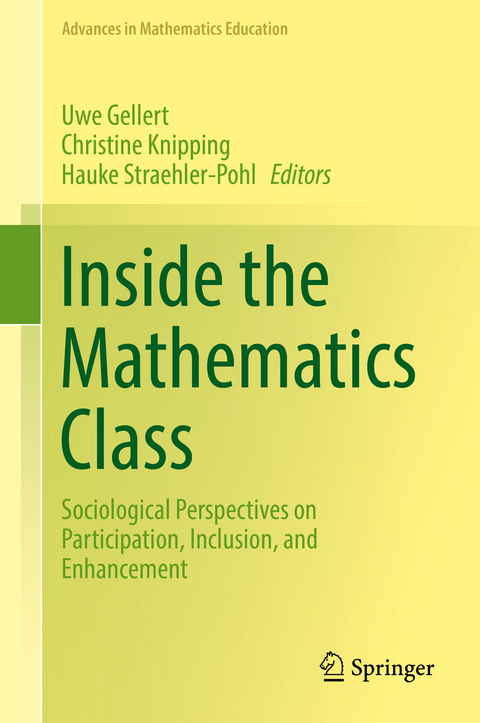
Inside the Mathematics Class (eBook)
341 Seiten
Springer International Publishing (Verlag)
978-3-319-79045-9 (ISBN)
This volume is a forward-looking intersection of Sociological perspectives on mathematics classrooms and socio-political perspectives on mathematics education. The first perspective has generated a substantial body of knowledge in the mathematics education. Interactionist research has deepened our understanding of interaction processes, socio-mathematical norms and the negotiation of meaning, generating a 'micro-sociology' or a 'micro-ethnography' of the mathematics classroom. More recently, socio-political perspectives on mathematics education interrelate educational practices in mathematics with macro-social issues of social equity, class, and race and with the policies that regulate institutionalized mathematics education.
This book documents, strings together and juxtaposes research that uses ethnographical classroom data to explain, on the one hand, how socio-political issues play out in the mathematics class. On the other hand, it illuminates how class, race etc. affect the micro-sociology of the mathematics classroom. The volume advances the knowledge in the field by providing an empirical grounding of socio-political research on mathematics education, and it extends the frame in which mathematical classroom cultures are conceived.
Uwe Gellert is a Professor of Mathematics Education in the Faculty of Education and Psychology at the Freie Universität, Berlin. His research interests include social inequalities in mathematics education, cross-cultural studies, microanalysis of classroom interaction, sociological perspectives on mathematics, and mathematics teacher education.
Christine Knipping is Professor of Mathematics Education at the Faculty of Mathematics and Computer Science at the University of Bremen. Her research interests include argumentation and proving, discursive and interactional mechanisms in mathematics classrooms, sociological perspectives on stratification in school and international comparisons.
Hauke Straehler-Pohl is a post-doctoral researcher in Sociology of Education and Mathematics Education in the Faculty of Education and Psychology at the Freie Universität, Berlin. His research interests include social inequalities in the school system, sociology of (pedagogic) evaluation, documentary method, performative approaches to school mathematics, and mathematics teacher education.
Uwe Gellert is a Professor of Mathematics Education in the Faculty of Education and Psychology at the Freie Universität, Berlin. His research interests include social inequalities in mathematics education, cross-cultural studies, microanalysis of classroom interaction, sociological perspectives on mathematics, and mathematics teacher education.Christine Knipping is Professor of Mathematics Education at the Faculty of Mathematics and Computer Science at the University of Bremen. Her research interests include argumentation and proving, discursive and interactional mechanisms in mathematics classrooms, sociological perspectives on stratification in school and international comparisons. Hauke Straehler-Pohl is a post-doctoral researcher in Sociology of Education and Mathematics Education in the Faculty of Education and Psychology at the Freie Universität, Berlin. His research interests include social inequalities in the school system, sociology of (pedagogic) evaluation, documentary method, performative approaches to school mathematics, and mathematics teacher education.
Preface Steven Lerman.- Zooming-In: The Sociological Gaze and the Mathematics Classroom (Uwe Gellert).- The Recognition of Pedagogic Rights in Mathematics Classrooms: A Framework for Reflecting Implicit Normative Assumptions in the Sociology of Mathematics Education (Hauke Straehler-Pohl and Michael Sertl).- Part 1: Enhancement: Facilitating Possible Futures.- Resistance from within the Mathematics Classroom: Silences, Strategies, and Subjectivities (Lisa Björklund Boistrup and Joakim Samuelsson).- “What might really happen?” – Reflections on Implicit Practices and Teachers’ Perspectives in the Context of ‘Realistic’ School Mathematics (Nikola Leufer and Nina Bohlmann).- Language Diversity Builds Mathematics Learning as much as Mathematics Learning Builds Language Diversity (Núria Planas).- Differential Enhancement in Mathematical Pre-School Class Activities (Ola Helenius, Maria L. Johansson, Troels Lange, Tamsin Meaney and Anna Wernberg).- Agency, Materiality, and Mathematics Learning in a Preschool Classroom (Eva Norén).- Part 2: Inclusion and Exclusion in Social Practices.- Racism and Mathematics Education in a Racial Democracy: Views from the Classroom (Luz Valoyes-Chávez).- Storytelling in a Fifth Grade Mathematics Classroom: Matters of Content and Personhood (Kara Jackson).- Deaf Students Learning Mathematics: Interactive Patterns, Participation, and Inclusion (Inês Borges).- Participation in Argumentation (Jenny Christine Cramer and Christine Knipping).- Part 3: Participation in Classroom Culture and Beyond.- Humanizing and Dehumanizing Trends in a Critical Math Classroom (Andrew Brantlinger).- Gendered Positions and Participation in Whole Class Discussions in the Mathematics Classroom (Laura Black and Darinka Radovic).- A Discourse-Based Framework for Identifying Authority Structures in Mathematics Classrooms (David Wagner and Beth Herbel-Eisenmann).- Meta-Rules of Discursive Practice in Mathematics Classrooms from Seoul, Shanghai and Tokyo (Lihua Xu and David Clarke).- Commentary: In Search for Common Ground (Eva Jablonka).
| Erscheint lt. Verlag | 26.9.2018 |
|---|---|
| Reihe/Serie | Advances in Mathematics Education | Advances in Mathematics Education |
| Zusatzinfo | X, 341 p. 38 illus. |
| Verlagsort | Cham |
| Sprache | englisch |
| Themenwelt | Sozialwissenschaften ► Pädagogik ► Schulpädagogik / Grundschule |
| Schlagworte | classroom analysis • distributive strategies • language diversity in maths • Learning and Instruction • learn mathematics • mathematical education • mathematics practices • micro-ethnography • pedagogic practice • pedagogic rights • Preschool mathematics • Social Relationships • teaching school mathematics |
| ISBN-10 | 3-319-79045-5 / 3319790455 |
| ISBN-13 | 978-3-319-79045-9 / 9783319790459 |
| Informationen gemäß Produktsicherheitsverordnung (GPSR) | |
| Haben Sie eine Frage zum Produkt? |
 PDF (Wasserzeichen)
DRM: Digitales Wasserzeichen
Dieses eBook enthält ein digitales Wasserzeichen und ist damit für Sie personalisiert. Bei einer missbräuchlichen Weitergabe des eBooks an Dritte ist eine Rückverfolgung an die Quelle möglich.
Dateiformat: PDF (Portable Document Format)
Mit einem festen Seitenlayout eignet sich die PDF besonders für Fachbücher mit Spalten, Tabellen und Abbildungen. Eine PDF kann auf fast allen Geräten angezeigt werden, ist aber für kleine Displays (Smartphone, eReader) nur eingeschränkt geeignet.
Systemvoraussetzungen:
PC/Mac: Mit einem PC oder Mac können Sie dieses eBook lesen. Sie benötigen dafür einen PDF-Viewer - z.B. den Adobe Reader oder Adobe Digital Editions.
eReader: Dieses eBook kann mit (fast) allen eBook-Readern gelesen werden. Mit dem amazon-Kindle ist es aber nicht kompatibel.
Smartphone/Tablet: Egal ob Apple oder Android, dieses eBook können Sie lesen. Sie benötigen dafür einen PDF-Viewer - z.B. die kostenlose Adobe Digital Editions-App.
Buying eBooks from abroad
For tax law reasons we can sell eBooks just within Germany and Switzerland. Regrettably we cannot fulfill eBook-orders from other countries.
aus dem Bereich