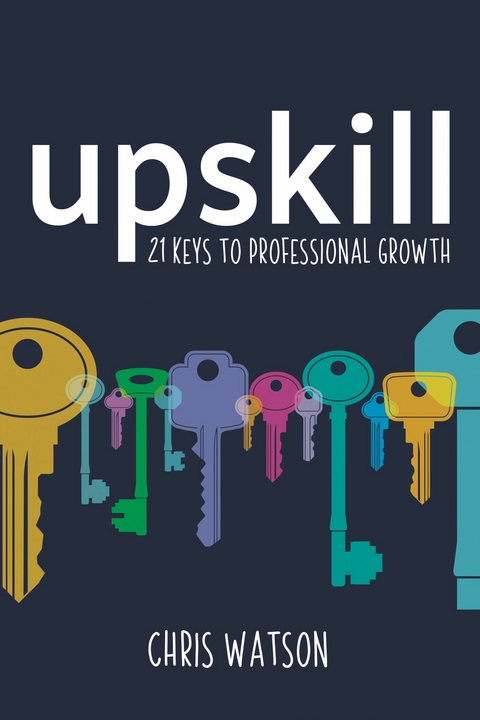
Upskill (eBook)
272 Seiten
Crown House Publishing (Verlag)
978-1-78583-373-1 (ISBN)
Chris Watson is an award-winning specialist in the promotion of adaptive skills who founded Endor Learn & Develop in 2002 following a successful career in publishing and higher education. Incurably curious about all aspects of organisational behaviour, his aim is to strengthen relationships in the workplace by sharing straightforward solutions which people can relate to on a personal level.
Brimming with punchy, practical ideas to improve your day-to-day effectiveness, Upskill: 21 keys to professional growth is the definitive guide to developing the adaptive skills essential for success at work. In Upskill, adaptive skills specialist Chris Watson delivers a dynamic snapshot of easy-to-access development possibilities providing you with: 840 user-friendly tools and techniques reflecting the latest thinking on how to extend capability, boost professional growth and take charge of your career; a rich resource of reliable solutions, grouped around the twenty-one adaptive skills most valued by today's employers including creativity, collaboration and communication; an abundance of proven approaches, topical insights, time-saving apps and inspirational videos, as well as helpful signposts to relevant quotes, books and other resources. Each chapter focuses on one of the twenty-one skills, and begins with examples of how the individual skills which can be practised and refined throughout a career, and have all been shown to be associated with greater operational agility may be observed in the work environment. This brief introduction is then followed by forty practical ideas to develop the performance of people. Although there is no formal hierarchy to the list of suggestions, all of the ideas have been categorised into three inter-related clusters for ease of use encompassing ideas for personal development, for delivering results and for long-term gain. Within each of the three clusters, all of the ideas for professional growth have been laid out in terms of how they can help you respond and adjust to the requirements of your role and the ever-changing world of work. Some of the suggestions are tools apps, templates, downloads and inventories which can be picked up and used/introduced straightaway. Some of the suggestions are techniques methods, approaches and procedures for you to try out, investigate and explore. The final set of suggestions indicate where to look for further inspiration including films, podcasts, related research and a wide range of suggested reading materials. The majority of the hints, tips and techniques can be actioned without having to access any external support or invest in any additional outlay, and are as useful for new starters in an organisation as they are for experienced managers. Suitable for anyone who is committed to developing themselves and their colleagues, but may not have the time, the resources, the budget or the inspiration to know where to start.
This book has been designed for anyone who is committed to developing themselves and their colleagues, but may not have the time, the resources, the budget or the inspiration to know where to start. It provides a compendium of resources for you to pick up and refer to in your own time and at your own pace: 840 practical ideas reflecting the latest thinking on how to extend personal performance. The suggestions have all been grouped around a set of twenty-one adaptive skills associated with successful outcomes at work and beyond. These key skills can be practised and refined throughout a career and are as relevant for new starters in an organisation as they are for experienced managers.
This handbook of development ideas will help you to adapt and adjust to new approaches and work methods. It can be used to support upskilling through the identification of relevant and realistic options for your professional growth. You will discover a host of proven techniques: relevant articles, quotes and resources, carefully selected videos, novel approaches, time saving apps, topical insights and engaging websites. You can action the majority of the hints, tips and techniques without having to access any external support or invest in any additional outlay.
The material can help with personal development, performance reviews, goal setting, career counselling, constructive feedback, coaching and training needs analysis. The content has been used to add value during management development, team building, project planning, remote working, induction programmes and on-boarding, and has also been picked up by institutions wishing to help students gain a clearer understanding of the world of work. The development options contained in the book are most commonly used to encourage open communication around the recognition of potential talent and evolving work requirements.
Focusing on adaptive skills
The term ‘adaptive skills’ describes a range of transferable abilities and work approaches which enable people to operate effectively within different environments and work situations. These flexible skills have been found to be an accurate predictor of many life outcomes, often providing similar results to those of traditional measures of intelligence.1 They are not role specific and can be applied across different settings to provide greater operational agility. Adaptive skills can be developed throughout a lifetime and add value by promoting operational versatility and building personal resilience. As a result, they are increasingly recognised by organisations as being one of the critical drivers of success in today’s rapidly changing workplace.
A recent survey of 91,000 employers revealed that the most common skills lacking among existing staff were all related adaptive skills, including management skills, influencing others, work prioritisation and teamwork.2 Across the pond, a study undertaken by the Wall Street Journal showed that 92 per cent of senior managers believe that transferable abilities are either as important as, or more important than, technical skills, with 89 per cent stating they had difficulty finding people who were able to demonstrate these attributes.3
Twenty-one key skills
Every skill featured in this book has been included following a ten-year independent study into adaptive work practices.4 Over 8,000 managers from all business sectors including private, public and not-for-profit provided feedback between 2006 and 2016 to confirm which adaptive skills they valued most in their employees. The research was undertaken by Performance Talks Ltd, with support from the Knowledge Transfer Project (co-financed through the European Regional Development Fund).
The project identified a set of key ‘transferable currencies’. These are the workplace skills which are believed to add value to an employee across multiple work situations at any stage in their career, regardless of position. The twenty-one simple, straightforward attributes that resonated with employers are:
- Ability to influence
- Commercial thinking
- Commitment to change and adaptation
- Constructive communication
- Creativity and innovation
- Direction and purpose
- Effective planning and organisation
- Enthusiasm for customer service
- Focus on developing others
- Interpersonal awareness and diplomacy
- Intuitive thought
- Motivation to succeed
- Ownership of self-development
- People management and leadership potential
- Positive decisions
- Professional ethics and social responsibility
- Resilience and emotional control
- Results through action
- Specialist knowledge and ability
- Teamwork and collaboration
- Use of information and data
This set of transferable currencies was robustly tested to ensure its applicability in the workplace. While the labels used to describe each of the skills varied from company to company, the scope and coverage of every one was both familiar and relevant within each organisational setting. Feedback demonstrated that these were the skills which had the greatest potential to provide sustainable value for the majority of employees. However, it is worth noting that while all of the twenty-one items were acknowledged as universally applicable, some organisations prioritised certain skills over others, based on their own customs and/or strategic intentions. Interestingly, the study found no evidence that defined work sectors were consistently prizing the same skills at any one time. For example, while a high proportion of not-for-profit organisations might be expected to emphasise the development of ‘professional ethics and social responsibility’, there were also large numbers of respondents from this same sector who favoured ‘commercial thinking’ – demonstrating the fluidity of organisational culture.
The outputs of the study have provided the framework for this book and reinforce the findings of other research into this area, such as recent projects by the University of Kent (which included surveys by Microsoft, Target Jobs, the BBC, Prospects, NACE and the Association of Graduate Recruiters) and other organisations.5 For example, an analysis of 2.3 million LinkedIn profiles demonstrated that 58 per cent of employees who listed ‘communication skills’ on the site during 2014–2015 were hired, making this adaptive skill one of the most transferable across all sectors of the job market.6 ‘Communication skills’ were closely followed by ‘organisational skills’, ‘teamwork’, ‘interpersonal skills’, ‘creativity’ and ‘adaptability’.
Additionally, there is evidence to suggest that consciously upskilling around these more flexible themes may help with future-proofing careers. A report by the World Economic Forum has identified ten skills which it believes will be in the highest demand by all employers as we move into the 2020s.7 Their list contains many of the items used to develop the Upskill framework, including judgement and decision making, service orientation, emotional intelligence, people management, coordinating with others, creativity, problem solving, critical thinking, cognitive flexibility and negotiation skills. The global report represents the views of fifteen major developed and emerging economies and concludes by saying:
Overall, social skills – such as persuasion, emotional intelligence and teaching others – will be in higher demand across industries than narrow technical skills, such as programming or equipment operation and control. In essence, technical skills will need to be supplemented with strong social and collaboration skills.8
Reliable content
While there is growing consensus around the actual skills needed to support operational agility, there is also an increasing frustration among management groups with regard to the way that any upskilling is currently taking place. According to the Chartered Management Institute, over 70 per cent of UK managers would like to provide their staff with easy-to-access, easy-to-consume and easy-to-implement development opportunities which can be integrated into everyday work experiences.9 However, for this to happen, managers need to know how to access reliable and proven content.
For this reason, thousands of potential options to develop capability were initially considered for inclusion in this book, before being whittled down to a more manageable number. Business owners, employees, human resources (HR) professionals, learning and development (L&D) specialists, management consultants, line managers, team leaders, supervisors and representatives from support agencies, including Business Link and Yorkshire Forward, all contributed to this process, providing practical observations and constructive feedback. Academics from the University of Hull were also brought in to assist with the organisation of the data and to make it easier to access. Every development idea was sense-checked and...
| Erscheint lt. Verlag | 5.1.2019 |
|---|---|
| Verlagsort | London |
| Sprache | englisch |
| Themenwelt | Sachbuch/Ratgeber ► Beruf / Finanzen / Recht / Wirtschaft ► Bewerbung / Karriere |
| Sozialwissenschaften ► Pädagogik ► Berufspädagogik | |
| Wirtschaft ► Betriebswirtschaft / Management ► Personalwesen | |
| Wirtschaft ► Betriebswirtschaft / Management ► Unternehmensführung / Management | |
| ISBN-10 | 1-78583-373-1 / 1785833731 |
| ISBN-13 | 978-1-78583-373-1 / 9781785833731 |
| Informationen gemäß Produktsicherheitsverordnung (GPSR) | |
| Haben Sie eine Frage zum Produkt? |
 EPUB (Wasserzeichen)
DRM: Digitales Wasserzeichen
Dieses eBook enthält ein digitales Wasserzeichen und ist damit für Sie personalisiert. Bei einer missbräuchlichen Weitergabe des eBooks an Dritte ist eine Rückverfolgung an die Quelle möglich.
Dateiformat: EPUB (Electronic Publication)
EPUB ist ein offener Standard für eBooks und eignet sich besonders zur Darstellung von Belletristik und Sachbüchern. Der Fließtext wird dynamisch an die Display- und Schriftgröße angepasst. Auch für mobile Lesegeräte ist EPUB daher gut geeignet.
Systemvoraussetzungen:
PC/Mac: Mit einem PC oder Mac können Sie dieses eBook lesen. Sie benötigen dafür die kostenlose Software Adobe Digital Editions.
eReader: Dieses eBook kann mit (fast) allen eBook-Readern gelesen werden. Mit dem amazon-Kindle ist es aber nicht kompatibel.
Smartphone/Tablet: Egal ob Apple oder Android, dieses eBook können Sie lesen. Sie benötigen dafür eine kostenlose App.
Geräteliste und zusätzliche Hinweise
Buying eBooks from abroad
For tax law reasons we can sell eBooks just within Germany and Switzerland. Regrettably we cannot fulfill eBook-orders from other countries.
aus dem Bereich