


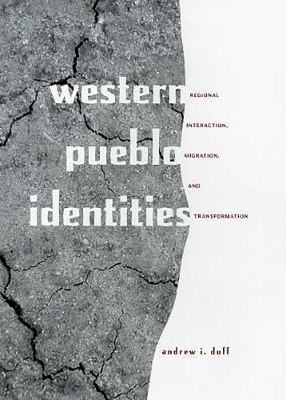
Western Pueblo Identities
Regional Interaction, Migration, and Transformation
Seiten
2002
University of Arizona Press (Verlag)
978-0-8165-2218-7 (ISBN)
University of Arizona Press (Verlag)
978-0-8165-2218-7 (ISBN)
- Titel z.Zt. nicht lieferbar
- Versandkostenfrei
- Auch auf Rechnung
- Artikel merken
Identifying distinct social groups of the past has always challenged archaeologists because understanding how people perceived their identity is critical to the reconstruction of social organization. Material culture has been the standard measure of distinction between groups, and the distribution of ceramics and other artifacts has often been used to define group boundaries. Western Pueblo Identities argues that such an approach is not always appropriate: demographic and historical factors may affect the extent to which material evidence can define such boundaries. Andrew Duff now examines a number of other factors relationships among settlement size, regional population densities, the homogeneity of material culture, and local and long-distance exchange in order to trace the history of interaction and the formation of group identity in east-central Arizona and west-central New Mexico from A.D. 1275 to 1400. Using comparative data from the Upper Little Colorado and Zuni regions, Duff demonstrates differences in patterns of interaction within and between regions with different population densities.
He then links these differences to such factors as occupational history, immigrant populations, the negotiation of social identities, and the emergence of new ritual systems. Following abandonments in the Four Corners area in the late 1200s, immigrants with different historical backgrounds occupied many Western Pueblo regions in contrast to the Hopi and Zuni regions, which had more stable populations and deeper historical roots. Duff uses chemical analyses of ceramics to document exchange among several communities within these regions, showing that people in less densely settled regions were actively recruited by residents of the Hopi and Zuni regions to join their settlements. By the time of the arrival of the Spaniards, two distinct social and territorial groups the Hopi and Zuni peoples had emerged from this scattering of communities. Duff's new interpretations, along with new data on ceramic exchange patterns, suggest that interaction is a better way to measure identity than more commonly used criteria.
His work offers new perspectives on the role of ritual in social organization and on identity formation in Pueblo IV society and is rich in implications for the study of other sedentary, middle-range societies.
He then links these differences to such factors as occupational history, immigrant populations, the negotiation of social identities, and the emergence of new ritual systems. Following abandonments in the Four Corners area in the late 1200s, immigrants with different historical backgrounds occupied many Western Pueblo regions in contrast to the Hopi and Zuni regions, which had more stable populations and deeper historical roots. Duff uses chemical analyses of ceramics to document exchange among several communities within these regions, showing that people in less densely settled regions were actively recruited by residents of the Hopi and Zuni regions to join their settlements. By the time of the arrival of the Spaniards, two distinct social and territorial groups the Hopi and Zuni peoples had emerged from this scattering of communities. Duff's new interpretations, along with new data on ceramic exchange patterns, suggest that interaction is a better way to measure identity than more commonly used criteria.
His work offers new perspectives on the role of ritual in social organization and on identity formation in Pueblo IV society and is rich in implications for the study of other sedentary, middle-range societies.
Andrew I. Duff is Assistant Professor of Anthropology at Washington State University and Research Associate at the Crow Canyon Archaeological Center in Cortez, Colorado. His articles have appeared in the Cambridge Archaeological Journal and American Antiquity.
| Erscheint lt. Verlag | 28.2.2002 |
|---|---|
| Zusatzinfo | illustrations |
| Verlagsort | Tucson |
| Sprache | englisch |
| Maße | 160 x 235 mm |
| Gewicht | 527 g |
| Themenwelt | Geisteswissenschaften ► Archäologie |
| Sozialwissenschaften ► Ethnologie | |
| Sozialwissenschaften ► Soziologie | |
| ISBN-10 | 0-8165-2218-9 / 0816522189 |
| ISBN-13 | 978-0-8165-2218-7 / 9780816522187 |
| Zustand | Neuware |
| Informationen gemäß Produktsicherheitsverordnung (GPSR) | |
| Haben Sie eine Frage zum Produkt? |
Mehr entdecken
aus dem Bereich



aus dem Bereich
maternal health science and the reproduction of harm
Buch | Softcover (2024)
University of California Press (Verlag)
CHF 52,35
long-lasting legacies of colonialism and nationalism in Israel, …
Buch | Softcover (2025)
Vernon Press (Verlag)
CHF 109,95
Holocaust heritage, noncitizen futures, and black power in Berlin
Buch | Softcover (2022)
University of California Press (Verlag)
CHF 52,35


