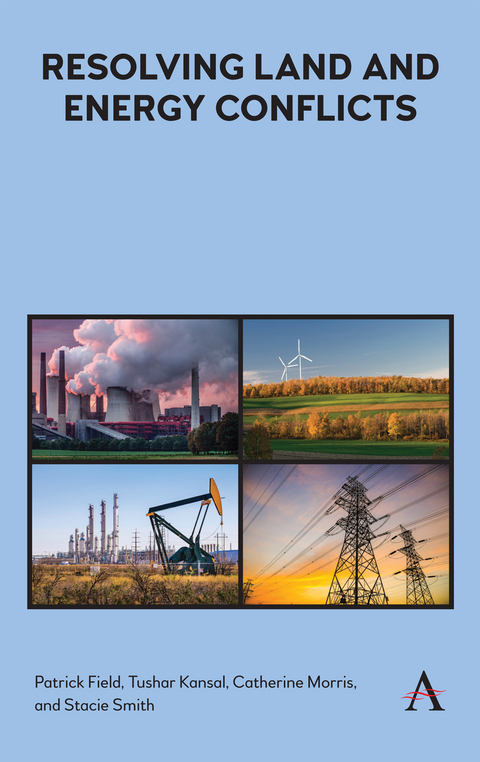
Based on decades of experience in addressing energy-siting conflicts, the authors of ‘Resolving Land and Energy Conflicts’ provide details of a host of tools, strategies and principles for tackling them.
Unlike almost any other kind of land use – from dumps to houses to factories – state and sometimes even the federal government actively preempt local decision-making regarding the siting of energy extraction and production. The Consensus Building Institute looked at conflicts over land and found in the last ten years that rapid advances in technology in both renewables (primarily wind and solar) and gas and oil extraction have created a host of new and intensive land-use conflicts across the United States. Wind turbines, for instance, seemingly clean, lean and ‘sustainable’, have stirred intense conflicts among abutters, developers, and communities. A resurgence in US gas and oil production via hydraulic fracturing technology, resulting in lower costs, more domestic production and less dependence on unstable supplies of foreign oil, has created statewide bans, protest films and national debate about ‘fracking’.
‘Resolving Land and Energy Conflicts’ seeks to develop a view of energy in the landscape across gas and oil, wind, transmission and nuclear waste disposal. The first three create conflict because of rapid or the need for rapid development or expansion. Each of these energy types or facilities are generally considered a public good and expansion promises future benefit, but they have concentrated impacts that can cause localized adverse effects and controversy. The last, nuclear waste, creates conflict because it is a public ‘bad’ and a legacy of choices made decades ago for benefit that, in some ways, has already been delivered (affordable electricity through nuclear power coupled with a reliable base load generating source).
The authors are particularly interested in the conflicts that emerge from specific sites and proposals, as well as how this unique land use plays out in terms of conflict and resolution across scales and jurisdictions while touching on broader issues of policy and values. Though each energy type and its production (or disposal) is governed between various jurisdictions, with different impacts and benefits, each shares commonalities that can be explored further. ‘Resolving Land and Energy Conflicts’ briefly explains the general context around the energy type; the impacts and conflicts that have arisen given this context; the role laws, rules and jurisdictions play in mitigating, resolving or creating more conflict; and the ways in which communication, collaboration and conflict resolution have been or could be used to ameliorate the conflicts that inevitably arise.
lt;p>Patrick Field is managing director at the Consensus Building Institute and associate director of the MIT-Harvard Public Disputes Program.
Tushar Kansal is a senior associate at the Consensus Building Institute with several years of experience as a facilitator, mediator and trainer in collaborative problem solving and negotiation within and across organizations.
Catherine Morris is a senior mediator at the Consensus Building Institute. She has more than 15 years of experience as a mediator and consensus builder and over 20 years of experience in energy and environmental regulation and policy.
Stacie Smith is a senior mediator and director of workable peace at the Consensus Building Institute.
Introduction: The Complexity and Conflicts of Energy in the US Landscape; 1. Land-Based Wind Energy Siting: The Not-So-Silent Wind; 2. Nuclear Waste Siting: Getting Good People to Accept the Bad; 3. Gas and Oil and Unconventional Shale: The New, Old Frontier; 4. The Linear Challenge: Transmission and Natural Gas Pipelines; Conclusions and Recommendations; Index.
| Erscheint lt. Verlag | 28.9.2018 |
|---|---|
| Reihe/Serie | Anthem Environment and Sustainability Initiative |
| Anthem Environment and Sustainability Initiative (AESI) | |
| Strategies for Sustainable Development Series | Strategies for Sustainable Development Series |
| Verlagsort | London |
| Sprache | englisch |
| Maße | 150 x 150 mm |
| Gewicht | 454 g |
| Themenwelt | Sozialwissenschaften ► Politik / Verwaltung |
| ISBN-10 | 1-78308-854-0 / 1783088540 |
| ISBN-13 | 978-1-78308-854-6 / 9781783088546 |
| Informationen gemäß Produktsicherheitsverordnung (GPSR) | |
| Haben Sie eine Frage zum Produkt? |
 EPUB (Adobe DRM)
Kopierschutz: Adobe-DRM
Adobe-DRM ist ein Kopierschutz, der das eBook vor Mißbrauch schützen soll. Dabei wird das eBook bereits beim Download auf Ihre persönliche Adobe-ID autorisiert. Lesen können Sie das eBook dann nur auf den Geräten, welche ebenfalls auf Ihre Adobe-ID registriert sind.
Details zum Adobe-DRM
Dateiformat: EPUB (Electronic Publication)
EPUB ist ein offener Standard für eBooks und eignet sich besonders zur Darstellung von Belletristik und Sachbüchern. Der Fließtext wird dynamisch an die Display- und Schriftgröße angepasst. Auch für mobile Lesegeräte ist EPUB daher gut geeignet.
Systemvoraussetzungen:
PC/Mac: Mit einem PC oder Mac können Sie dieses eBook lesen. Sie benötigen eine
eReader: Dieses eBook kann mit (fast) allen eBook-Readern gelesen werden. Mit dem amazon-Kindle ist es aber nicht kompatibel.
Smartphone/Tablet: Egal ob Apple oder Android, dieses eBook können Sie lesen. Sie benötigen eine
Geräteliste und zusätzliche Hinweise
Buying eBooks from abroad
For tax law reasons we can sell eBooks just within Germany and Switzerland. Regrettably we cannot fulfill eBook-orders from other countries.
aus dem Bereich