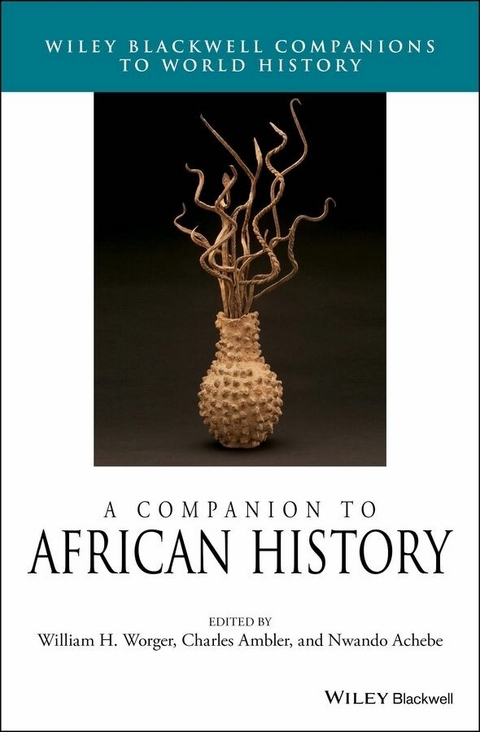
A Companion to African History (eBook)
John Wiley & Sons (Verlag)
978-1-119-06350-6 (ISBN)
Covers the history of the entire African continent, from prehistory to the present day
A Companion to African History embraces the diverse regions, subject matter, and disciplines of the African continent, while also providing chronological and geographical coverage of basic historical developments. Two dozen essays by leading international scholars explore the challenges facing this relatively new field of historical enquiry and present the dynamic ways in which historians and scholars from other fields such as archaeology, anthropology, political science, and economics are forging new directions in thinking and research.
Comprised of six parts, the book begins with thematic approaches to African history-exploring the environment, gender and family, medical practices, and more. Section two covers Africa's early history and its pre-colonial past-early human adaptation, the emergence of kingdoms, royal power, and warring states. The third section looks at the era of the slave trade and European expansion. Part four examines the process of conquest-the discovery of diamonds and gold, military and social response, and more. Colonialism is discussed in the sixth section, with chapters on the economy transformed due to the development of agriculture and mining industries. The last section studies the continent from post World War II all the way up to modern times.
- Aims at capturing the enthusiasms of practicing historians, and encouraging similar passion in a new generation of scholars
- Emphasizes linkages within Africa as well as between the continent and other parts of the world
- All chapters include significant historiographical content and suggestions for further reading
- Written by a global team of writers with unique backgrounds and views
- Features case studies with illustrative examples
In a field traditionally marked by narrow specialisms, A Companion to African History is an ideal book for advanced students, researchers, historians, and scholars looking for a broad yet unique overview of African history as a whole.
William H. Worger, PhD, is Professor of History at the University of California, Los Angeles. He specializes in the social and economic history of southern Africa.
Charles Ambler, PhD, is Professor of History and Dean of the Graduate School at the University of Texas at El Paso. He is the author of a number of articles on mass media and popular culture in Africa.
Nwando Achebe, PhD, is the Jack and Margaret Sweet Endowed Professor of History and an award-winning historian at Michigan State University. Her research interests involve the use of oral history in the study of women, gender, and sexuality in Nigeria.
Covers the history of the entire African continent, from prehistory to the present day A Companion to African History embraces the diverse regions, subject matter, and disciplines of the African continent, while also providing chronological and geographical coverage of basic historical developments. Two dozen essays by leading international scholars explore the challenges facing this relatively new field of historical enquiry and present the dynamic ways in which historians and scholars from other fields such as archaeology, anthropology, political science, and economics are forging new directions in thinking and research. Comprised of six parts, the book begins with thematic approaches to African history exploring the environment, gender and family, medical practices, and more. Section two covers Africa s early history and its pre-colonial past early human adaptation, the emergence of kingdoms, royal power, and warring states. The third section looks at the era of the slave trade and European expansion. Part four examines the process of conquest the discovery of diamonds and gold, military and social response, and more. Colonialism is discussed in the sixth section, with chapters on the economy transformed due to the development of agriculture and mining industries. The last section studies the continent from post World War II all the way up to modern times. Aims at capturing the enthusiasms of practicing historians, and encouraging similar passion in a new generation of scholars Emphasizes linkages within Africa as well as between the continent and other parts of the world All chapters include significant historiographical content and suggestions for further reading Written by a global team of writers with unique backgrounds and views Features case studies with illustrative examples In a field traditionally marked by narrow specialisms, A Companion to African History is an ideal book for advanced students, researchers, historians, and scholars looking for a broad yet unique overview of African history as a whole.
William H. Worger, PhD, is Professor of History at the University of California, Los Angeles. He specializes in the social and economic history of southern Africa. Charles Ambler, PhD, is Professor of History and Dean of the Graduate School at the University of Texas at El Paso. He is the author of a number of articles on mass media and popular culture in Africa. Nwando Achebe, PhD, is the Jack and Margaret Sweet Endowed Professor of History and an award-winning historian at Michigan State University. Her research interests involve the use of oral history in the study of women, gender, and sexuality in Nigeria.
Notes on Contributors ix
1 Introduction: Identities and (Mis)Representations 1
William H. Worger
PART I THE PERSONAL 13
2 Tracing the Roots of Common Sense about Sexuality in Africa 15
Marc Epprecht
3 Masculinities 35
Stephan F. Miescher
4 Colonialism, Christianity, and Personhood 59
Nimi Wariboko
5 Settler Societies 77
Nicola Ginsburgh and Will Jackson
PART II WOMEN'S ROLES IN INSTITUTIONS OF POWER 93
6 Women, Authority, and Power in Precolonial Southeast Africa: The Production and Destruction of Historical Knowledge on Queen Mother Ntombazi of the Ndwandwe 95
Sifiso Mxolisi Ndlovu
7 Love, Courtship, and Marriage in Africa 119
Nwando Achebe
8 Slavery and Women in Africa: Changing Definitions, Continuing Problems 143
Claire C. Robertson
PART III FAMILY AND COMMUNITY 161
9 Kinship in African History 163
James L. Giblin
10 Ethnicity in Southern Africa 179
Michael R. Mahoney
11 Ethnicity and Race in African Thought 199
Jonathon Glassman
12 Islam in African History 225
Sean Hanretta and Shobana Shankar
13 Refugees in African History 247
Brett Shadle
PART IV AFRICANS AND THEIR ENVIRONMENT 265
14 Science in Africa: A History of Ingenuity and Invention in African Iron Technology 267
Peter R. Schmidt
15 Africa and Environmental History 28
Gregory H. Maddox
16 Health and Medicine in African History 307
Karen E. Flint
17 Wealth and Poverty in African History 329
Morten Jerven
PART V AFRICANS AND THE WORLD 351
18 The Idea of the Atlantic World from an Africanist Perspective 353
Walter Hawthorne
19 Swahili Literature and the Writing of African History 367
Ann Biersteker
20 Africa and the Cold War 383
Timothy Scarnecchia
21 The Horn of Africa from the Cold War to the War on Terror 401
Awet T. Weldemichael
PART VI AFRICAN SELF-REPRESENTATIONS 419
22 The Art of Memory and the Chancery of Sinnar 421
Jay Spaulding
23 Apartheid Forgotten and Remembered 431
Nancy L. Clark and William H. Worger
24 Cultural Resistance on Robben Island: Songs of Struggle and Liberation in Southern Africa 459
Neo Lekgotla laga Ramoupi
25 African Historians and Popular Culture 483
Charles Ambler
Index 501
"This wide-ranging collection provides timely historiographical entry points to some of the most lively conversations in the field of African history, as well as case studies illustrating contemporary methodological approaches."
D. McNutt, University of Tennessee Chattanooga
CHOICE, May 2019
Notes on Contributors
Nwando Achebe, the Jack and Margaret Sweet Endowed Professor of History, is an award‐winning historian at Michigan State University. She is founding editor‐in‐chief of the Journal of West African History. Achebe received her PhD from University of California, Los Angeles, in 2000. In 1996 and 1998 she was a Ford Foundation and Fulbright‐Hays Scholar‐in‐Residence at the University of Nigeria, Nsukka. Her research interests involve the use of oral history in the study of women, gender, and sexuality in Nigeria. Her first book, Farmers, Traders, Warriors, and Kings: Female Power and Authority in Northern Igboland, 1900–1960 was published in 2005, and her second book, The Female King of Colonial Nigeria: Ahebi Ugbabe (2011), which won three book awards (Aidoo‐Snyder, Barbara “Penny” Kanner, and Gita Chaudhuri), is a full‐length critical biography of the only female warrant chief and king in British Africa. Achebe has received prestigious grants from the Rockefeller Foundation, Wenner‐Gren, Woodrow Wilson, Fulbright‐Hays, Ford Foundation, World Health Organization, and National Endowment for the Humanities.
Charles Ambler is professor of history and dean of the graduate school at the University of Texas at El Paso. He has recently coedited Drugs in Africa (2014) and is the author of a number of articles on mass media and popular culture in Africa, including “Popular Films and Colonial Audiences,” in the American Historical Review. In 2010 he was president of the African Studies Association.
Ann Biersteker is associate chair of the African studies program at Michigan State University. She is the author of two books on Swahili poetry, a Swahili textbook, and numerous articles on African literatures. She is currently working with colleagues on an edition of Utendi wa Tambuka and a study of Daiso, an endangered Tanzanian language.
Nancy L. Clark is a professor and dean emeritus at Louisiana State University. She is the author of Manufacturing Apartheid: State Corporations in South Africa (1994), and the coauthor with William H. Worger of South Africa: The Rise and Fall of Apartheid (1996), and the two‐volume Africa and the West (2010).
Marc Epprecht is head of the Department of Global Development Studies, Queen’s University, Canada. He is the author of several studies of the history of gender and sexuality in Africa, including the award‐winning Hungochani (2004), which focused primarily on male–male sexuality in Zimbabwe, South Africa, and Lesotho. He is currently working on an eco‐health history of Edendale–Pietermaritzburg, South Africa.
Karen E. Flint is an associate professor of history at the University of North Carolina, Charlotte. Her first book is Healing Traditions: African Medicine, Cultural Exchange and Competition in South Africa, 1820–1948 (2008). She is interested in issues of health, nutrition, globalization, and more recent food sovereignty movements.
James L. Giblin is a professor of African history at the University of Iowa. Among his publications are A History of the Excluded: Making Family a Refuge from State in Twentieth‐Century Tanzania (2005) and Maji Maji: Lifting the Fog of War (coedited with Jamie Monson, 2010).
Nicola Ginsburgh recently completed her PhD thesis in the School of History at the University of Leeds, and is currently teaching fellow in the history of Africa at the University of Warwick. Her thesis is entitled “White Workers and the Production of Race in Southern Rhodesia, 1910–1980.”
Jonathon Glassman is professor of history at Northwestern University. He is the author of Feasts and Riot: Revelry, Rebellion, and Popular Consciousness on the Swahili Coast, 1856‐1888 (1995), and of War of Words, War of Stones: Racial Thought and Violence in Colonial Zanzibar (2011).
Sean Hanretta is associate professor of history at Northwestern University. His book Islam and Social Change in French West Africa: History of an Emancipatory Community, was published in 2009. He works on the intellectual, religious, and cultural history of modern West Africa.
Walter Hawthorne is a professor of African history and chair of the History Department at Michigan State University. His areas of research specialization are Upper Guinea, the Atlantic, and Brazil. He is particularly interested in the history of slavery and the slave trade. Much of his research has focused on African agricultural practices, religious beliefs, and family structures in the Old and New Worlds. His first book, Planting Rice and Harvesting Slaves: Transformations along the Guinea‐Bissau Coast, 1400–1900 (2003), explores the impact of interactions with the Atlantic, and particularly slave trading, on small‐scale, decentralized societies. His most recent book, From Africa to Brazil: Culture, Identity, and an Atlantic Slave Trade 1600–1830 (2010), examines the slave trade from Upper Guinea to Amazonia Brazil.
Will Jackson is associate professor in imperial history at the University of Leeds. His research covers the social history of colonial migration, mental illness, and the family in East and southern Africa. His first book, Madness and Marginality: The Lives of Kenya’s White Insane, was published in 2013. He has since edited, with Emily Manktelow, Subverting Empire: Deviance and Disorder in the British Colonial World (2015). He is currently working on a book provisionally titled “Lost Colonists: Settler Failure in Southern Africa, 1880–1939.”
Morten Jerven is Chair of Africa and International Development at the Centre for African Studies at Edinburgh University, professor in development studies at the Norwegian University of Life Sciences, and visiting professor in economic history at Lund University. He has a PhD in economic history from the London School of Economics and is the author of Poor Numbers: How We Are Misled by African Development Statistics and What To Do about It (2013) and Africa: Why Economists Got it Wrong (2015). His current work, The Wealth and Poverty of African States: Economic Growth, Living Standards and Taxation in Africa Since the 19th Century, is due to be published in 2019.
Gregory H. Maddox is a specialist in African and environmental history. He holds a BA from the University of Virginia and a PhD from Northwestern University. He has coedited two collections, Custodians of the Land: Environment and History in Tanzania (with James Giblin and Isaria N. Kimambo, 1996), and In Search of the Nation: Histories of Authority and Dissidence from Tanzania (with James Giblin, 2005). His translation of Mathias Mnyampala’s The Gogo: History, Customs, and Traditions from Swahili (1995) was a finalist for the African Studies Association’s Text Prize in 1997. His most recent scholarly books are Practicing History in Central Tanzania: Writing, Memory, and Performance (with Ernest M. Kongola, 2006), Sub‐Saharan Africa: An Environmental History (2006), and The Demographics of Empire (coedited with Karl Ittmann and Dennis D. Cordell, 2010). He is currently professor of history and dean of the graduate school at Texas Southern University.
Michael R. Mahoney is an associate professor of global studies and politics and government at Ripon College in Ripon, Wisconsin, as well as director of the global studies program there. He is the author of The Other Zulus: The Spread of Zulu Ethnicity in Colonial South Africa (2012), as well as of articles on various aspects of southern African history. He is currently working on a history of unemployment in Botswana.
Stephan F. Miescher is associate professor of history at the University of California, Santa Barbara. He is the author of Making Men in Ghana (2005) and coeditor of Modernization as Spectacle in Africa (with Peter J. Bloom and Takyiwaa Manuh, 2014) and Gender, Imperialism, and Global Exchanges (with Michele Mitchell and Naoko Shibusawa, 2015). He is completing the monograph, A Dam for Africa: The Volta River Project and Modernization in Ghana, and coproducing the film Ghana’s Electric Dreams (dir. R. Lane Clark).
Sifiso Mxolisi Ndlovu is an executive director at the South African Democracy Education Trust, professor of history at the University of South Africa, and a member of UNESCO’s Scientific Committee on the General History of Africa multivolume series.
Neo Lekgotla laga Ramoupi is senior lecturer in history at Wits University’s School of Education, Johannesburg, South Africa. He is also part‐time director and head of programs at the African Institute for Knowledge and Sustainability, a recently founded global African organization, based in South Africa, devoted to the appropriation of knowledge produced on Africa to generate emancipatory solutions for Africa’s sociocultural, political, economic, and environmental sustainability. He was a postdoctoral fellow of the African Humanities Programme of the American Council of Learned Society in 2016–2017. His PhD from Howard University (2013) is the basis for his forthcoming book A Culture History of Robben Island: “Inzingoma Zo Mzabalazo Esiqithini!” (Struggle Songs from the Island). Before his doctoral studies he was...
| Erscheint lt. Verlag | 17.9.2018 |
|---|---|
| Reihe/Serie | Blackwell Companions to World History |
| Blackwell Companions to World History | Wiley Blackwell Companions to World History |
| Sprache | englisch |
| Themenwelt | Geisteswissenschaften ► Geschichte ► Allgemeine Geschichte |
| Geisteswissenschaften ► Geschichte ► Regional- / Ländergeschichte | |
| Sozialwissenschaften ► Soziologie | |
| Schlagworte | A Companion to African History • Africa • African/African-American Studies • African & Middle Eastern Anthropology • African Countries • African History • African trade industry • Africa's warring states • Afrika-/Afroamerika-Forschung • Anthropologie • Anthropologie / Afrika, Naher Osten • Anthropology • Colonial Africa • colonialism in Africa • Cultural Studies • Early African History • economic history of Africa • Europeans in Africa • Geschichte • Geschichte / Afrika • guide to African history • History • kingdoms in Africa • Kulturwissenschaften • Social History of Africa • the African nation • the nations of Africa • the people of Africa • the slave trade • war in Africa • Wiley Blackwell history |
| ISBN-10 | 1-119-06350-7 / 1119063507 |
| ISBN-13 | 978-1-119-06350-6 / 9781119063506 |
| Informationen gemäß Produktsicherheitsverordnung (GPSR) | |
| Haben Sie eine Frage zum Produkt? |
 EPUB (Adobe DRM)
Kopierschutz: Adobe-DRM
Adobe-DRM ist ein Kopierschutz, der das eBook vor Mißbrauch schützen soll. Dabei wird das eBook bereits beim Download auf Ihre persönliche Adobe-ID autorisiert. Lesen können Sie das eBook dann nur auf den Geräten, welche ebenfalls auf Ihre Adobe-ID registriert sind.
Details zum Adobe-DRM
Dateiformat: EPUB (Electronic Publication)
EPUB ist ein offener Standard für eBooks und eignet sich besonders zur Darstellung von Belletristik und Sachbüchern. Der Fließtext wird dynamisch an die Display- und Schriftgröße angepasst. Auch für mobile Lesegeräte ist EPUB daher gut geeignet.
Systemvoraussetzungen:
PC/Mac: Mit einem PC oder Mac können Sie dieses eBook lesen. Sie benötigen eine
eReader: Dieses eBook kann mit (fast) allen eBook-Readern gelesen werden. Mit dem amazon-Kindle ist es aber nicht kompatibel.
Smartphone/Tablet: Egal ob Apple oder Android, dieses eBook können Sie lesen. Sie benötigen eine
Geräteliste und zusätzliche Hinweise
Buying eBooks from abroad
For tax law reasons we can sell eBooks just within Germany and Switzerland. Regrettably we cannot fulfill eBook-orders from other countries.
aus dem Bereich