Air War in the Pacific (Annotated) (eBook)
336 Seiten
The P-47 Press (Verlag)
978-0-359-09903-0 (ISBN)
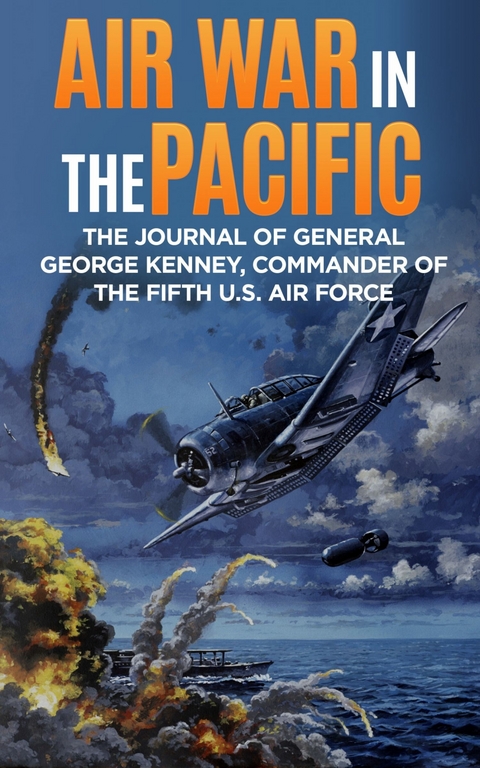
Air War in the Pacific details the development and ultimate supremacy of the US Air Force during World War 2. Written from the perspective of General George C. Kenney, the man in charge, the book is a candid insider's account of how America turned the tables on the Japanese in the Pacific through a combination of strategy, tactics, and superior air technology.
An entertaining read, as well as an important historical document, Air War in the Pacific features a cast of larger-than-life personalities know to WW2 buffs, from brilliant tactician 'Big Chief' General Douglas MacArthur to eccentric hotshot pilot Paul 'Pappy' Gunn.
Air War in the Pacific details the development and ultimate supremacy of the US Air Force during World War 2. Written from the perspective of General George C. Kenney, the man in charge, the book is a candid insider's account of how America turned the tables on the Japanese in the Pacific through a combination of strategy, tactics, and superior air technology.An entertaining read, as well as an important historical document, Air War in the Pacific features a cast of larger-than-life personalities know to WW2 buffs, from brilliant tactician 'Big Chief' General Douglas MacArthur to eccentric hotshot pilot Paul 'Pappy' Gunn.
IT WAS TEN O’CLOCK on the morning of July 7, 1942, at my headquarters in San Francisco where I was commanding the Fourth Air Force. I had just finished reading a long report concerning the exploits of one of my young pilots who had been looping the loop around the center span of the Golden Gate Bridge in a P-38 fighter plane and waving to the stenographic help in the office buildings as he flew along Market Street. The report noted that, while it had been extremely difficult to get information from the somewhat sympathetic and probably conniving witnesses, there was plenty of evidence proving that a large part of the waving had been to people on some of the lower floors of the buildings.
A woman on the outskirts of Oakland was quoted as saying that she didn’t need any help from my fighter pilots in removing her washing from the clotheslines unless they would like to do it on the ground.
Considering the mass of evidence, it was surprising that more complaints had not been registered, but in any event I would have to do something about the matter. Washington was determined to stop low-altitude stunting and had put out some stringent instructions about how to handle the budding young aviators who broke the rules. The investigating officer had recommended a General Court Martial.
I had sent word to the pilot’s commander that I wanted to see the lad in my office, and I was expecting him at any minute. My secretary opened the door and said, “Your bad boy is outside. You remember—the one you wanted to see about flying around bridges and down Market Street.”
I said to send him in. I heard her say, “The General will see you now, Lieutenant,” and in walked one of the nicest looking cherubs you ever saw in your life. I suspected that he was not over eighteen and maybe even younger. I doubted if he was old enough to shave. He was just a little blond-haired Norwegian boy about five feet six, with a round, pink baby face and the bluest, most innocent eyes—now opened wide and a bit scared. Someone must have just told him how serious this court-martial thing might be. He wanted to fly and he wanted to get into the war and do his stuff, but now he was finding out that they really were tough about this low-altitude ‘buzzing’ business and it was dawning on him that the commanders all had orders really to bear down on young aviators who flew down streets and rattled dishes in people’s houses. Why, he might be taken off flying status or even thrown out of the Air Force! He wasn’t going to try to alibi out of it, but he sure hoped this General Kenney wasn’t going to be too rough. You could actually see all this stuff going on in his head just behind those baby blue eyes. He didn’t know it, but he had already won.
I let him stand at attention while I bawled him out for getting himself in trouble, and getting me in trouble, too, besides giving people the impression that the Air Force was just a lot of irresponsible airplane jockeys. He could see that he was in trouble just by looking at the size and thickness of the pile of papers on my desk that referred to his case. But think of all the trouble he had made for me. Now, in order to quiet down the people who didn’t approve of his exuberance, I would have to talk to the Governor, the Mayor, the Chief of Police. Luckily, I knew a lot of people in San Francisco who could be talked into a state of forgiveness, but I had a job of looking after the Fourth Air Force and I should spend my time doing that instead of running around explaining away the indiscretions of my wild-eyed pilots.
“By the way, wasn’t the air pretty rough down in that street around the second story level?” I was really a bit curious. As I remembered, it used to be, when I was first learning to fly.
“Yes, sir, it was kind of rough,” replied the cherub, “but it was easy to control the plane. The aileron control is good in the P-38 and—” He paused. Probably figured he had said enough. For a second, the blue eyes had been interested more than scared. He was talking about his profession and it was more than interest. It was his life, his ambition. I would bet anything that he was an expert in a P-38 and that he wanted to be still better. We needed kids like this lad.
“Lieutenant,” I said, “there is no need for me to tell you again that this is a serious matter. If you didn’t want to fly down Market Street, I wouldn’t have you in my Air Force, but you are not to do it anymore and I mean what I say. From now on, if I hear any more reports of this kind about you, I’ll put you before a General Court and if they should recommend dismissal from the service, which they probably would, I’ll approve it.”
I began slowly to tear up the report and drop the pieces of paper in the wastebasket. The blue eyes watched, a little puzzled at first, and then the scared look began to die out.
“Monday morning you check in at this address out in Oakland and if that woman has any washing to be hung out on the line, you do it for her. Then you hang around being useful—mowing a lawn or something—and when the clothes are dry, take them off the line and bring them into the house. And don’t drop any of them on the ground or you will have to wash them over again. I want that woman to think we are good for something besides annoying people. Now get out of here quick before I get mad and change my mind. That’s all.”
“Yes, sir.” He didn’t dare to change his expression, but the blue eyes had gone all soft and relieved. He saluted and backed out of the office. The next time I saw Lieutenant Richard I. Bong was in Australia.
I was still chuckling to myself over the look on that kid’s face as he watched me tearing up the charges against him and thinking how wonderful it would be to be twenty-two and a lieutenant flying a P-38 instead of fifty-two and a general looking after a whole Air Force, when the light flashed on the direct telephone line from my desk to General ‘Hap’ Arnold,* the head of the Army Air Forces in Washington.
*Air-science buff and US military legend General Henry Harley “Hap” Arnold (1886-1950), a rare double-five-star general, being the only man to have attained the rank in two different forces (Army, Air Force).
Hap believed in working directly with his commanders. He made quick decisions and he demanded immediate action. Once in a while, when his staff had given him insufficient information, his decisions would be wrong. If you had the real facts at your fingertips and could present the case briefly and correctly, you could argue with Hap, but your argument had better be good if you wished to emerge from the ‘brawl’ unscathed. On the other hand, while the interview might be, and generally was, exceedingly stormy, if you put across your point he would reverse his decision immediately and correct the situation.
I remember once hearing Hap say that if he had a hundred problems put up to him in a day he would make one hundred decisions that day. Fifty of them would be good decisions. The other fifty might range from good to fair to poor. Before the day was over he would find out about most of these and correct them, but some days he might make twenty-five that were not so good and he’d just have to take the blame for them later on.
While he and I have had lots of arguments, and the finish on a lot of desktops has suffered in the process, I like to work for a man who will make decisions. If he is right three times out of four, his batting average is far better than most. Hap and I understood each other, we respected each other’s judgment and were strong personal friends of over twenty years’ standing. He called me almost daily about a multitude of matters, some big, some little, and sometimes, I suspected, just to blow off a little excess steam. Hap lived with the throttle well open most of the time. I wondered what was on his mind now.
“George, I’m keeping my promise to you. Pack up and be in my office at eight o’clock Monday morning. That’s the twelfth. I’ll give you all the dope then. I can’t tell you any more on the phone. Tell me, who do you recommend to take over your job?”
I knew this meant that I was leaving the command of the Fourth Air Force for another job. I had three brigadier generals under me, but Barney Giles was my choice if one of them was to succeed me. I told Hap that I wanted to turn the job over to Giles but that he would have to get out some special orders from Washington as Barney was outranked by both the other brigadier generals.
Hap said okay and that he would get the orders out right away. We said goodbye and I told him I would be in his office on Monday morning.
Back in 1940, General Arnold had ordered me to the Air Corps Materiel Division at Wright Field, Dayton, Ohio, to look after the aircraft production program, which was being stepped up to increase our air strength, and to coordinate the stepped-up output with the huge orders then being placed in this country by the British and French. At that time I had remarked to him that, the way things were going, it looked to me as though we would be getting in the war ourselves before very long. If we did get in it, I wanted him to let me take a combat outfit. I promised him that I would get the aircraft production speeded up but asked him not to make me stand around counting airplanes coming out of factories if we started...
| Erscheint lt. Verlag | 18.9.2018 |
|---|---|
| Sprache | englisch |
| Themenwelt | Sachbuch/Ratgeber ► Geschichte / Politik ► Allgemeines / Lexika |
| Geschichte ► Teilgebiete der Geschichte ► Militärgeschichte | |
| Sozialwissenschaften ► Politik / Verwaltung | |
| ISBN-10 | 0-359-09903-3 / 0359099033 |
| ISBN-13 | 978-0-359-09903-0 / 9780359099030 |
| Informationen gemäß Produktsicherheitsverordnung (GPSR) | |
| Haben Sie eine Frage zum Produkt? |
 EPUB (Adobe DRM)
Größe: 989 KB
Kopierschutz: Adobe-DRM
Adobe-DRM ist ein Kopierschutz, der das eBook vor Mißbrauch schützen soll. Dabei wird das eBook bereits beim Download auf Ihre persönliche Adobe-ID autorisiert. Lesen können Sie das eBook dann nur auf den Geräten, welche ebenfalls auf Ihre Adobe-ID registriert sind.
Details zum Adobe-DRM
Dateiformat: EPUB (Electronic Publication)
EPUB ist ein offener Standard für eBooks und eignet sich besonders zur Darstellung von Belletristik und Sachbüchern. Der Fließtext wird dynamisch an die Display- und Schriftgröße angepasst. Auch für mobile Lesegeräte ist EPUB daher gut geeignet.
Systemvoraussetzungen:
PC/Mac: Mit einem PC oder Mac können Sie dieses eBook lesen. Sie benötigen eine
eReader: Dieses eBook kann mit (fast) allen eBook-Readern gelesen werden. Mit dem amazon-Kindle ist es aber nicht kompatibel.
Smartphone/Tablet: Egal ob Apple oder Android, dieses eBook können Sie lesen. Sie benötigen eine
Geräteliste und zusätzliche Hinweise
Buying eBooks from abroad
For tax law reasons we can sell eBooks just within Germany and Switzerland. Regrettably we cannot fulfill eBook-orders from other countries.
EPUB (Wasserzeichen)DRM: Digitales Wasserzeichen
Dieses eBook enthält ein digitales Wasserzeichen und ist damit für Sie personalisiert. Bei einer missbräuchlichen Weitergabe des eBooks an Dritte ist eine Rückverfolgung an die Quelle möglich.
Dateiformat: EPUB (Electronic Publication)
EPUB ist ein offener Standard für eBooks und eignet sich besonders zur Darstellung von Belletristik und Sachbüchern. Der Fließtext wird dynamisch an die Display- und Schriftgröße angepasst. Auch für mobile Lesegeräte ist EPUB daher gut geeignet.
Systemvoraussetzungen:
PC/Mac: Mit einem PC oder Mac können Sie dieses eBook lesen. Sie benötigen dafür die kostenlose Software Adobe Digital Editions.
eReader: Dieses eBook kann mit (fast) allen eBook-Readern gelesen werden. Mit dem amazon-Kindle ist es aber nicht kompatibel.
Smartphone/Tablet: Egal ob Apple oder Android, dieses eBook können Sie lesen. Sie benötigen dafür eine kostenlose App.
Geräteliste und zusätzliche Hinweise
Buying eBooks from abroad
For tax law reasons we can sell eBooks just within Germany and Switzerland. Regrettably we cannot fulfill eBook-orders from other countries.
aus dem Bereich