


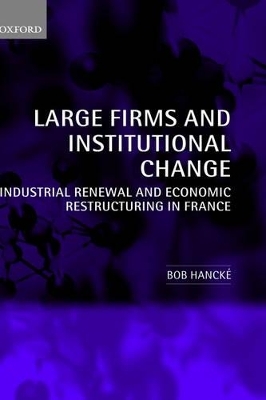
Large Firms and Institutional Change
Industrial Renewal and Economic Restructuring in France
Seiten
2002
Oxford University Press (Verlag)
978-0-19-925205-3 (ISBN)
Oxford University Press (Verlag)
978-0-19-925205-3 (ISBN)
Between 1980 and 1985, the French economy and industry faced a dramatic crisis; in the ten years that followed, it witnessed a remarkable revival. How did the economy make this transition? Building on the "varieties of capitalism" approach in political economy, this text examines what happened.
Between 1980 and 1985, the French economy and industry faced a dramatic crisis; in the ten years that followed, it witnessed a remarkable revival. How did the French economy make this transition? While the state is still an important economic agent in France, and the market certainly has become more central in the organization of the French economy, both state- and market-centered perspectives fail to understand critical elements of this adjustment. Building on the new Varieties of Capitalism approach in political economy which puts firms at the center of the analysis, this book argues that the post-war, state-led system changed into a system organized by and around the large firms.
Large firms have always been central in the French post-war economic development model. In the past, however, they adapted to patterns set by the central state. By exploiting the possibilities in government policies in different areas such as finance, labour relations, and regional policies, the large firms were able to induce their main interlocutors - the state, banks, labour unions, workers, and small firms - to adjust in a way which was congruent with their own interests. From subservient economic agents, they became the drivers of economic adjustment.
Through this case study of readjustment in France, this book offers a subtle critique of neo-institutionalist perspectives on firms. Institutional frameworks do not simply offer scenarios for adjustment, but are themselves constructions of economic and political actors and therefore subject to change and reorganization. By analysing how large firms in France, arguably one of the least likely places to harbour such endogenous capacities, changed their institutional environment to fit their own needs, this book offers an important new perspective on the political economy of industrial and economic change.
Between 1980 and 1985, the French economy and industry faced a dramatic crisis; in the ten years that followed, it witnessed a remarkable revival. How did the French economy make this transition? While the state is still an important economic agent in France, and the market certainly has become more central in the organization of the French economy, both state- and market-centered perspectives fail to understand critical elements of this adjustment. Building on the new Varieties of Capitalism approach in political economy which puts firms at the center of the analysis, this book argues that the post-war, state-led system changed into a system organized by and around the large firms.
Large firms have always been central in the French post-war economic development model. In the past, however, they adapted to patterns set by the central state. By exploiting the possibilities in government policies in different areas such as finance, labour relations, and regional policies, the large firms were able to induce their main interlocutors - the state, banks, labour unions, workers, and small firms - to adjust in a way which was congruent with their own interests. From subservient economic agents, they became the drivers of economic adjustment.
Through this case study of readjustment in France, this book offers a subtle critique of neo-institutionalist perspectives on firms. Institutional frameworks do not simply offer scenarios for adjustment, but are themselves constructions of economic and political actors and therefore subject to change and reorganization. By analysing how large firms in France, arguably one of the least likely places to harbour such endogenous capacities, changed their institutional environment to fit their own needs, this book offers an important new perspective on the political economy of industrial and economic change.
Bob Hancké studied Sociology at the Free University of Brussels and Political Economy at MIT. From 1994 to 2000 he was a research fellow at the Wissenschaftszentrum in Berlin. His research interests are the comparative analysis of economic and industrial restructuring in advanced capitalist countries; the comparative analysis of labour relations systems and trajectories of economic adjustment in advanced capitalist countries; EMU, wage bargaining systems, and macro-economic policy.
PART I: STATE, MARKET, AND FIRMS IN THE FRENCH POLITICAL ECONOMY; PART II: CORPORATE CHANGE IN FRANCE: CASE STUDIES; PART III: CONCLUSION
| Erscheint lt. Verlag | 1.8.2002 |
|---|---|
| Zusatzinfo | numerous tables |
| Verlagsort | Oxford |
| Sprache | englisch |
| Maße | 162 x 242 mm |
| Gewicht | 494 g |
| Themenwelt | Sozialwissenschaften ► Politik / Verwaltung |
| Wirtschaft ► Betriebswirtschaft / Management | |
| Wirtschaft ► Volkswirtschaftslehre ► Mikroökonomie | |
| ISBN-10 | 0-19-925205-X / 019925205X |
| ISBN-13 | 978-0-19-925205-3 / 9780199252053 |
| Zustand | Neuware |
| Informationen gemäß Produktsicherheitsverordnung (GPSR) | |
| Haben Sie eine Frage zum Produkt? |
Mehr entdecken
aus dem Bereich

aus dem Bereich
Wirtschaftszusammenhänge verstehen und mitreden können
Buch | Softcover (2023)
Wiley-VCH (Verlag)
CHF 27,95
die psychologischen Determinanten menschlicher Entscheidungen
Buch | Softcover (2024)
Kohlhammer (Verlag)
CHF 54,60


