


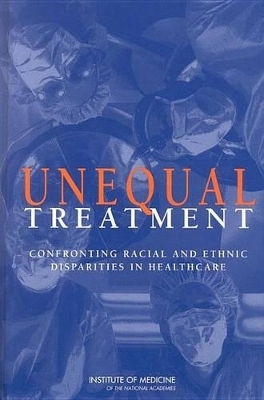
Unequal Treatment
Confronting Racial and Ethnic Disparities in Health Care
Seiten
2009
National Academies Press
978-0-309-08265-5 (ISBN)
National Academies Press
978-0-309-08265-5 (ISBN)
- Titel ist leider vergriffen;
keine Neuauflage - Artikel merken
Zu diesem Artikel existiert eine Nachauflage

Racial and ethnic disparities in health care reflect access to care and other issues. There is evidence that even after such differences are accounted, race and ethnicity remain significant predictors of the quality of health care received. This book documents this evidence and explores how persons of color experience the health care environment.
Racial and ethnic disparities in health care are known to reflect access to care and other issues that arise from differing socioeconomic conditions. There is, however, increasing evidence that even after such differences are accounted for, race and ethnicity remain significant predictors of the quality of health care received. In Unequal Treatment, a panel of experts documents this evidence and explores how persons of color experience the health care environment. The book examines how disparities in treatment may arise in health care systems and looks at aspects of the clinical encounter that may contribute to such disparities. Patients' and providers' attitudes, expectations, and behavior are analyzed. How to intervene? Unequal Treatment offers recommendations for improvements in medical care financing, allocation of care, availability of language translation, community-based care, and other arenas. The committee highlights the potential of cross-cultural education to improve provider-patient communication and offers a detailed look at how to integrate cross-cultural learning within the health professions.
The book concludes with recommendations for data collection and research initiatives. Unequal Treatment will be vitally important to health care policymakers, administrators, providers, educators, and students as well as advocates for people of color.
Racial and ethnic disparities in health care are known to reflect access to care and other issues that arise from differing socioeconomic conditions. There is, however, increasing evidence that even after such differences are accounted for, race and ethnicity remain significant predictors of the quality of health care received. In Unequal Treatment, a panel of experts documents this evidence and explores how persons of color experience the health care environment. The book examines how disparities in treatment may arise in health care systems and looks at aspects of the clinical encounter that may contribute to such disparities. Patients' and providers' attitudes, expectations, and behavior are analyzed. How to intervene? Unequal Treatment offers recommendations for improvements in medical care financing, allocation of care, availability of language translation, community-based care, and other arenas. The committee highlights the potential of cross-cultural education to improve provider-patient communication and offers a detailed look at how to integrate cross-cultural learning within the health professions.
The book concludes with recommendations for data collection and research initiatives. Unequal Treatment will be vitally important to health care policymakers, administrators, providers, educators, and students as well as advocates for people of color.
Brian D. Smedley, Adrienne Y. Stith, and Alan R. Nelson, Editors, Committee on Understanding and Eliminating Racial and Ethnic Disparities in Health Care
| Erscheint lt. Verlag | 6.2.2009 |
|---|---|
| Zusatzinfo | Illustrations |
| Verlagsort | Washington |
| Sprache | englisch |
| Maße | 152 x 229 mm |
| Themenwelt | Medizin / Pharmazie ► Gesundheitswesen |
| Sozialwissenschaften ► Ethnologie | |
| Sozialwissenschaften ► Soziologie | |
| ISBN-10 | 0-309-08265-X / 030908265X |
| ISBN-13 | 978-0-309-08265-5 / 9780309082655 |
| Zustand | Neuware |
| Informationen gemäß Produktsicherheitsverordnung (GPSR) | |
| Haben Sie eine Frage zum Produkt? |


