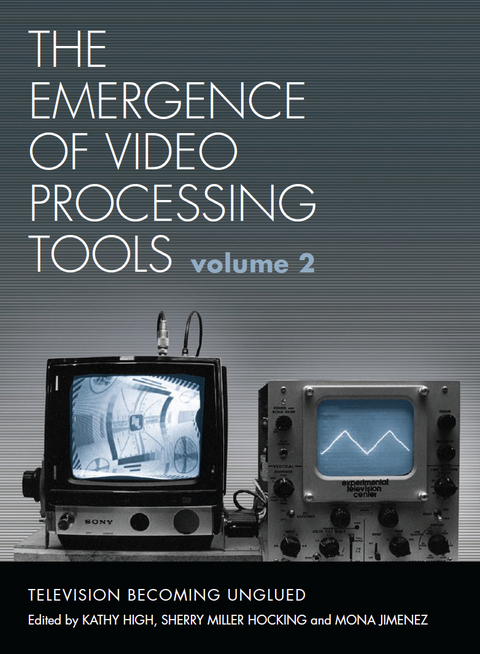
The Emergence of Video Processing Tools Volumes 1 & 2 (eBook)
Intellect Books (Verlag)
978-1-78320-301-7 (ISBN)
This book presents the development of early video tools and systems designed and built by artists and technologists during the late 1960s and 70s. Split over two volumes, the contributors examine the intersection of art and science and look at collaborations among inventors, designers and artists creating images in revolutionary ways.
The Emergence of Video Processing Tools presents stories of the development of early video tools and systems designed and built by artists and technologists during the late 1960s and 70s. Split over two volumes, the contributors examine the intersection of art and science and look at collaborations among inventors, designers and artists trying to create new tools to capture and manipulate images in revolutionary ways. The contributors include 'video pioneers,' who have been active since the emergence of the aesthetic, and technologists, who continue to design, build and hack media tools. The book also looks at contemporary toolmakers and the relationship between these new tools and the past. Video and media production is a growing area of interest in art and this collection will be an indispensable guide to its origins and its future.
lt;p>Kathy High is associate professor in the Department of Arts at Rensselaer Polytechnic Institute and an interdisciplinary artist working with science- and time-based arts.
Sherry Miller Hocking is assistant director at the Experimental Television Center.
Mona Jimenez is an associate professor and associate director in the Moving Image Archiving and Preservation Program at New York University.
VOLUME ONE:
Section 1: Histories
Introduction – Kathy High
Beginnings (With Artist Manifestos) – Kathy High
Mapping Video Art as Category, or an Archaeology of the Conceptualizations of Video – Jeremy Culler
Impulses – Tools – Christiane Paul and Jack Toolin
The Art-Style Computer-Processing System, 1974 – Tom Sherman
Machine Aesthetics Are Always Modern – Tom Sherman
Electronic Video Instruments and Public Sector Funding – Mona Jimenez
TV Lab: Image-making Tools – Howard Weinberg
The New Television Workshop at WGBH, Boston – John Minkowsky
The National Center for Experiments in Television at KQED-TV, San Francisco – John Minkowsky
The Experimental Television Center: Advancing Alternative Production Resources, Artist Collectives and Electronic Video-Imaging Systems – Jeremy Culler
Interstitial Images: Histories
Section 2: People and Networks
Introduction – Sherry Miller Hocking
From Component Level: Interview With LoVid – Michael Connor
Memory Series – Phosphography in CRT 5", Mexico, 2005 – Carolina Esparragoza
The Rhetoric of Soft Tools – Marisa Olson
Jeremy Bailey and His ‘Total Symbiotic Art System’ – Carolyn Tennant
De-commodification of Artworks: Networked Fantasy of the Open – Timothy Murray
Virtuosity as Creative Freedom – Michael Century
Distribution Religion – Dan Sandin and Phil Morton
A Toy for a Toy – Ralph Hocking
Woody Vasulka: Dialogue With the (Demons in the) Tool – Lenka Dolanova with Woody Vasulka
A Demo Tape on How to Play Video on a Violin – Jean Gagnon
Application to the Guggenheim Foundation, 1980 – Ralph Hocking
Thoughts on Collaboration: Art and Technology – Sherry Miller Hocking
Interstitial Images: People and Networks
VOLUME TWO:
Section 3: Tools
Introduction – Mona Jimenez
Mods, Pods and Designs: Designing Tools and Systems – Kathy High
Computer-Based Video Synthesizer System, ETC – Donald McArthur, Walter Wright and Richard Brewster
Design/Electronic Arts: The Buffalo Conference, March 10–13, 1977 – John Minkowsky
Instruments, Apparel, Apparatus: An Essay of Definitions – Jean Gagnon
Expanding ‘Image-processed Video’ as Art: Subverting and Building Control Systems – Jeremy Culler
The Grammar of Electronic Image Processing – Sherry Miller Hocking
ETC’s System – Hank Rudolph
On Voltage Control: An Interview With Hank Rudolph – Kathy High and Mona Jimenez
'Insofar as the rose can remember…' – Carolyn Tennant
Analog to Digital: Artists Using Technology – Yvonne Spielmann
Analog Meets Digital In and Around the Experimental Television Center – Kathy High, Mona Jimenez and Dave Jones
Multi-tracking Control Voltages: HARPO – Carl Geiger and Mona Jimenez
Finding the Tiny Dot: Designing Pantomation – Mona Jimenez
Preserving Machines – Mona Jimenez
A Catalog Record for the Raster Manipulation Unit – Mona Jimenez
Copying-It-Right: Archiving the Media Art of Phil Morton – Jon Cates
Proposal for Low-cost Retrieval of Early Videotapes Produced on Obsolete Equipment and/or Videotape That Will Not Play Back, or Resurrection Bus (1980) – Ralph Hocking
Interstitial Images: Tools
| Erscheint lt. Verlag | 1.1.2014 |
|---|---|
| Verlagsort | Bristol |
| Sprache | englisch |
| Themenwelt | Kunst / Musik / Theater ► Allgemeines / Lexika |
| Kunst / Musik / Theater ► Design / Innenarchitektur / Mode | |
| Kunst / Musik / Theater ► Film / TV | |
| Kunst / Musik / Theater ► Theater / Ballett | |
| Sozialwissenschaften ► Kommunikation / Medien ► Medienwissenschaft | |
| ISBN-10 | 1-78320-301-3 / 1783203013 |
| ISBN-13 | 978-1-78320-301-7 / 9781783203017 |
| Informationen gemäß Produktsicherheitsverordnung (GPSR) | |
| Haben Sie eine Frage zum Produkt? |
 EPUB (Adobe DRM)
Kopierschutz: Adobe-DRM
Adobe-DRM ist ein Kopierschutz, der das eBook vor Mißbrauch schützen soll. Dabei wird das eBook bereits beim Download auf Ihre persönliche Adobe-ID autorisiert. Lesen können Sie das eBook dann nur auf den Geräten, welche ebenfalls auf Ihre Adobe-ID registriert sind.
Details zum Adobe-DRM
Dateiformat: EPUB (Electronic Publication)
EPUB ist ein offener Standard für eBooks und eignet sich besonders zur Darstellung von Belletristik und Sachbüchern. Der Fließtext wird dynamisch an die Display- und Schriftgröße angepasst. Auch für mobile Lesegeräte ist EPUB daher gut geeignet.
Systemvoraussetzungen:
PC/Mac: Mit einem PC oder Mac können Sie dieses eBook lesen. Sie benötigen eine
eReader: Dieses eBook kann mit (fast) allen eBook-Readern gelesen werden. Mit dem amazon-Kindle ist es aber nicht kompatibel.
Smartphone/Tablet: Egal ob Apple oder Android, dieses eBook können Sie lesen. Sie benötigen eine
Geräteliste und zusätzliche Hinweise
Buying eBooks from abroad
For tax law reasons we can sell eBooks just within Germany and Switzerland. Regrettably we cannot fulfill eBook-orders from other countries.
aus dem Bereich